

Hearing the phrase "immigration hold" can send a wave of panic through any family. Many people assume it means immediate removal from the United States, triggering fears of never seeing a loved one again. That assumption, though completely understandable, is not accurate. An immigration hold is a specific legal mechanism with defined rules, timelines, and outcomes that vary depending on where you live. This guide breaks down exactly what an immigration hold means, how the process works from start to finish, and what your family can realistically do when facing one.
Table of Contents
- What is an immigration hold? Definition and legal basics
- How immigration holds work: The process step by step
- State and local differences: Why experiences with immigration holds vary
- What comes next after a hold? Immigration detention, release, and legal options
- Our perspective: What most families miss about immigration holds
- Get support for your immigration journey
- Frequently asked questions
Key Takeaways
| Point | Details |
|---|---|
| ICE hold is not deportation | An 'immigration hold' is a request for temporary custody transfer, not automatic removal from the U.S. |
| Detainers are only requests | Law enforcement does not have to comply with ICE holds, and outcomes vary by state and local policy. |
| Families have action steps | Quick action and legal help can impact what happens during and after an immigration hold. |
| 48-hour window matters | The 48-hour period after release is often the only window ICE has to take custody. |
| Outcomes differ by location | State and local policies can make a major difference for anyone facing an immigration hold. |
What is an immigration hold? Definition and legal basics
The term "immigration hold" sounds vague, and that vagueness causes a lot of unnecessary panic. Let's be direct about what it actually means.
In U.S. immigration practice, an immigration hold most commonly refers to an ICE immigration detainer: a written request by ICE to a local or state law enforcement agency, including jails or other confinement facilities, to notify ICE before release and to hold the person for up to 48 hours beyond their normal release time so the Department of Homeland Security can take custody.
That definition matters enormously. A detainer is a request, not a court order. ICE detainers are requests and ICE states they do not impose legal obligations on law enforcement agencies. This distinction shapes everything about how holds actually play out across the country.
Here is a quick breakdown of the key terms you will encounter:
- Detainer (Form I-247A): The written request ICE sends to a jail or local facility.
- Immigration warrant: A separate document issued when ICE has established probable cause for an arrest. Not the same as a detainer.
- Immigration detention: The physical custody of a person by ICE after transfer from local law enforcement.
- Mandatory detention: A specific category where certain individuals, often those with criminal convictions, must be held without bond.
Understanding these definitions prevents a critical mistake: treating every "hold" as if it automatically leads to removal. It does not. Immigration holds and criminal warrants operate under different legal frameworks, different authorities, and different rights protections.
| Term | Issued by | Legal weight | Purpose |
|---|---|---|---|
| ICE detainer (I-247A) | ICE | Request only | Notify and hold for up to 48 hours |
| Immigration warrant | ICE (administrative) | Administrative only | Authorize ICE arrest |
| Criminal warrant | Federal or state judge | Legally binding | Criminal arrest authority |
| Immigration detention | ICE (ERO) | Federal custody | Long-term holding pending proceedings |
Pro Tip: If you or a family member learns of an immigration hold, ask the facility directly whether a formal detainer has been filed and whether they have a local policy on honoring ICE requests. That single question can clarify your timeline dramatically. You can also find useful background on immigration retainers and how improving immigration outcomes often starts with simply understanding the right terminology.
"An ICE detainer is not a criminal warrant. Local agencies are not required by federal law to honor them, and the legal obligations differ significantly across jurisdictions."
How immigration holds work: The process step by step
Now that you know what an immigration hold is, here's how the process typically unfolds step by step.
Step 1: ICE identifies a person of interest. This can happen through a database check, a tip, or a routine criminal booking process. ICE cross-references immigration records when someone is booked into a local jail.

Step 2: ICE files a detainer. ICE sends Form I-247A to the facility. This form requests that the facility notify ICE at least 48 hours before release and hold the person for up to 48 hours beyond their normal release time to allow ICE to assume custody.
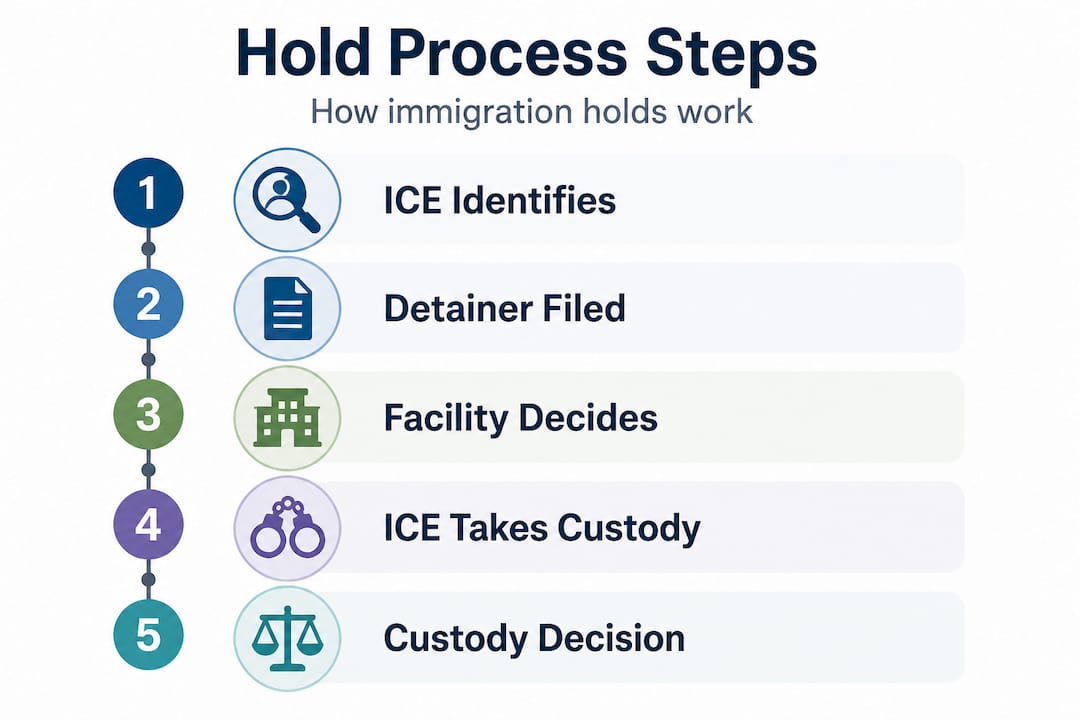
Step 3: The local facility decides whether to comply. Because detainers are requests, facilities can honor or decline them. Most decisions depend on local or state policy, which varies widely (more on this in the next section).
Step 4: If honored, ICE takes custody. ICE Enforcement and Removal Operations (ERO) personnel arrive to transfer the individual to ICE detention management. At this point, the person is in federal immigration custody.
Step 5: ICE makes a custody determination. Not every person transferred to ICE custody is immediately detained long-term. ICE reviews each case individually, considering factors like flight risk, public safety concerns, and whether mandatory detention applies.
Here is a comparison of what happens with and without a detainer:
| Scenario | What happens | Timeline | Outcome |
|---|---|---|---|
| Detainer filed, facility complies | Person held extra 48 hours for ICE pickup | Up to 48 hours post-release | Transfer to ICE custody |
| Detainer filed, facility refuses | Person released at normal time | Normal release date | ICE must find person independently |
| No detainer filed | Normal release process | Standard | No immigration hold |
| Detainer filed, ICE misses window | Person should be released | After 48-hour window expires | Release unless other cause exists |
Families often feel helpless during this window, but those 48 hours matter more than many realize. That window is actually your opportunity to act. Contact an immigration attorney immediately, gather all relevant documents, and start assessing whether your loved one qualifies for bond. Reviewing a solid immigration document checklist ahead of time can save precious hours. Also understanding how navigating immigration delays works in practice helps families avoid reactive decisions.
Pro Tip: The 48-hour window does not include weekends or federal holidays. If the window expires on a Saturday, ICE technically has until Monday. Knowing this detail prevents families from prematurely assuming their loved one will be released.
Once someone is transferred to ICE custody, decisions about continued detention are handled through ICE's Enforcement and Removal Operations framework. The agency describes detention as non-punitive, and custody decisions are case-by-case, including whether someone is subject to mandatory detention or poses a flight or public safety risk.
State and local differences: Why experiences with immigration holds vary
The way an immigration hold is handled doesn't just depend on ICE. Local policies can completely change the experience.
This is one of the most misunderstood realities of immigration law. Federal immigration law sets the framework, but the actual on-the-ground experience depends heavily on whether you are in a sanctuary city, a cooperative state, or somewhere in between.
Real-world state and local hold practices vary significantly. State prison systems generally do not have to honor detainers. Some states explicitly refuse all cooperation, while others actively assist ICE. Even within cooperating states, pickup rates shift over time. California provides a telling example: ICE pickup rates in California prisons dropped to 72% in 2022 and then climbed back to 88% more recently. That variation tells you cooperation is not a constant, even in the same state.
Here is a snapshot of how different states approach ICE detainers:
| State | General stance | Detainer policy |
|---|---|---|
| Illinois | Non-cooperation | Explicitly limits compliance with ICE detainers |
| Oregon | Non-cooperation | State law restricts honoring detainers |
| Vermont | Non-cooperation | Strong local sanctuary policies |
| Texas | Cooperation | Active coordination with ICE |
| Florida | Cooperation | State laws require compliance with detainers |
| California | Mixed | Varies by facility; prison rates fluctuate |
What does this mean practically for your family?
- Your physical location matters as much as your immigration status. Someone held in Cook County, Illinois faces a very different situation than someone held in a county jail in Florida.
- Know your county's policies. Many cities and counties publish their policies on ICE cooperation publicly.
- Sanctuary policies are not absolute. Even "sanctuary" jurisdictions may comply with ICE in cases involving serious criminal charges.
- ICE can still arrest independently. Even when a facility refuses to honor a detainer, ICE can locate and arrest individuals through other means.
This is exactly why working with someone who understands both federal immigration law and local policy is critical. An experienced professional, like the team at using an immigration lawyer can assess your specific situation against both frameworks.
What comes next after a hold? Immigration detention, release, and legal options
Knowing how holds work and why they vary, let's look at what actually happens once ICE takes over and how families can respond.
After ICE assumes custody, the agency determines what happens next. This is where the path can split in very different directions depending on the person's immigration history, criminal record, and the legal arguments available.
What ICE does after taking custody:
- Reviews the immigration file. ICE looks at how the person entered the U.S., their visa or status history, and any prior orders of removal.
- Determines whether mandatory detention applies. Certain individuals, particularly those with specified criminal convictions or prior removal orders, must be held without bond under federal law.
- Issues a custody determination. If mandatory detention does not apply, ICE exercises discretion. They may set a bond, release on supervision, or hold the person pending a hearing.
- Schedules immigration court proceedings. The individual receives notice of a hearing before an immigration judge where they can contest removal or apply for relief.
- Issues a final order if no relief is granted. If the judge issues a removal order and no appeals are filed, removal can proceed.
Many families do not realize there are meaningful legal options even after someone enters ICE detention. Here is what to explore immediately:
- Bond hearing: If mandatory detention does not apply, request a bond hearing before an immigration judge. A judge can set a bond amount the family pays to secure release during proceedings.
- Motions to reopen: If a prior removal order exists, an attorney may be able to file a motion to reopen based on changed circumstances or new evidence.
- Applications for relief: Depending on the case, options like immigration waivers for grounds of inadmissibility, asylum claims, or family-based petitions may apply.
- Supervision and alternatives to detention: ICE also uses ankle monitoring and check-in programs as alternatives to physical detention.
Staying organized during this period is critical. Use a reliable method for tracking your application and all related filings so nothing gets lost in the stress of the moment.
Our perspective: What most families miss about immigration holds
We have worked with families across the country who received a phone call that a loved one was "under an immigration hold." In almost every case, the first assumption was the same: they are going to be deported tomorrow. That assumption is wrong, and acting on it wastes precious time.
Here is what we consistently see missing from families' understanding: the local context is as important as the federal law. ICE operates nationally, but detention and transfer decisions run through local facilities that operate under local policies. Because detainers are requests and outcomes differ by jurisdiction, the "hold" experience can vary widely even for cases that look identical on paper. Knowing whether you are in a sanctuary jurisdiction, understanding whether the local facility has a pattern of honoring ICE requests, and knowing how quickly ICE actually executes pickups in your area can reshape your legal strategy completely.
The second thing families miss is the value of acting immediately. The 48-hour window feels impossibly short, but it is actually enough time to engage an attorney, file for bond, and prepare arguments if you move without delay. Waiting even 24 hours to "see what happens" can close options.
Here is our practical advice: the moment you learn of an immigration hold, make two calls. First, call an immigration attorney or professional consultant who understands both federal detainer law and your state's compliance policies. Second, confirm with the holding facility whether a formal detainer has actually been filed and what their policy is on honoring it. These two steps can completely reframe what you are actually dealing with. Review everything you know about understanding retainers so you walk into those conversations informed.
We believe the families who navigate immigration holds most successfully are the ones who replace panic with process. Every step of this system has rules, timelines, and available responses. You just need to know them.
Get support for your immigration journey
Facing an immigration hold is one of the most stressful moments a family can experience, but you do not have to figure it out alone. At True Ventures, LLC, our team has helped families in Minneapolis and across the country understand their options, organize their documents, and connect with the right legal resources at every stage of the process.

From understanding detainers to preparing for immigration court hearings, our immigration filing assistance services are built to meet you where you are. Whether you need help with filings, case organization, or finding the right professional guidance, our Minneapolis immigration consultants are ready to walk you through what comes next. Reach out today and take the first step toward clarity instead of confusion.
Frequently asked questions
Is an immigration hold the same as being deported?
No. An immigration hold is not deportation; it is a short-term request so ICE can decide whether to assume custody and what legal process follows, which may include hearings, bond, or release.
How long can ICE detain someone under an immigration hold?
ICE can request up to 48 additional hours of detention beyond the person's normal release time, not counting weekends or federal holidays.
Do local law enforcement agencies have to honor ICE detainers?
No. ICE detainers are requests and do not impose legal obligations on state or local law enforcement agencies, which is why compliance varies significantly by location.
What should families do if a loved one is under an immigration hold?
Contact an immigration attorney or professional consultant immediately, confirm whether a formal detainer has been filed, and begin gathering all relevant case documents to prepare for possible bond hearings or court proceedings.
Can a person be released after an immigration hold expires?
Yes. If ICE does not assume custody within the 48-hour hold window, the person should be released by the facility unless there is another independent legal basis for continued detention.