

Most people assume attorneys only matter in a courtroom. In U.S. immigration, that assumption can cost you your case. Whether you're filing an I-485 for Adjustment of Status (AOS), applying for an H-1B visa, or petitioning for a family member, having legal counsel at your side makes a measurable difference. Represented immigrants succeed in avoiding removal 64% of the time, compared to far lower rates for those without counsel. This guide breaks down exactly how attorneys improve your odds, what they actually do, and how to find the right one for your situation.
Table of Contents
- The many roles attorneys play in U.S. immigration
- How legal representation changes the odds: Data and real impacts
- Attorney vs. self-representation: What does USCIS really allow?
- Choosing the right attorney: Red flags, questions, and maximizing value
- Why legal help matters more today than ever: Our take
- Get expert immigration support today
- Frequently asked questions
Key Takeaways
| Point | Details |
|---|---|
| Attorney involvement boosts success | Having a lawyer dramatically improves odds in both filings and immigration court, sometimes as much as 3-10 times. |
| Self-representation carries risks | Filing alone is allowed but increases the chance of costly mistakes and denials, especially for complex cases. |
| Choose your attorney carefully | Check credentials, ask questions, and understand exactly what support you'll get before hiring legal representation. |
| Expert guidance lowers delays | Attorneys help stop Requests for Evidence, reduce denial rates, and ensure your case moves forward smoothly. |
The many roles attorneys play in U.S. immigration
If you've ever looked at a stack of USCIS forms and felt overwhelmed, you're not alone. Immigration applications involve eligibility rules, supporting documents, legal deadlines, and potential pitfalls that aren't obvious to most people. This is where an attorney's value starts, long before anyone steps into a courtroom.
Immigration attorneys assess eligibility for visa applications and AOS, confirming that applicants meet requirements like approved petitions, visa availability, and admissibility under INA Section 245. That word "admissibility" matters. It refers to whether you legally qualify to enter or remain in the U.S., and issues like prior overstays, criminal history, or prior removal orders can block an application entirely if not addressed correctly.
Here's a snapshot of what immigration attorneys actually handle:
- Eligibility screening: Identifying which immigration path fits your situation and confirming you qualify before any forms are filed
- Document preparation: Gathering and organizing evidence like tax records, birth certificates, employment letters, and medical exams
- Risk spotting: Flagging potential inadmissibility issues, prior violations, or gaps in your record before USCIS sees them
- Correct filing: Completing and submitting forms accurately, including filing the G-28 (Notice of Entry of Appearance) to officially represent you before USCIS
- Case monitoring: Tracking your case status, responding to Requests for Evidence (RFEs), and adjusting strategy when needed
- Courtroom representation: Appearing before an immigration judge if your case escalates to removal proceedings
"The difference between a well-prepared application and a rushed one isn't just paperwork. It's the difference between approval and years of delays."
For families navigating complex situations, comprehensive immigration support covers far more than filling out forms. Attorneys build a legal strategy around your specific history, goals, and timeline. That strategy is what separates a smooth approval from a case stuck in limbo.
One often-overlooked role is RFE response. When USCIS sends a Request for Evidence, you have a limited window to respond with the right documentation and legal argument. A missed or weak response can result in denial. Attorneys know exactly what USCIS is looking for and how to frame the response effectively.

How legal representation changes the odds: Data and real impacts
Understanding what attorneys do is useful. Seeing the numbers behind their impact is convincing.
The data on represented versus unrepresented applicants is striking. Represented AOS cases carry denial risks below 10%, compared to roughly 20% for self-filed cases. That's a significant gap, especially when you consider that AOS processing averages 8 to 18 months. A denial doesn't just mean starting over. It can trigger further legal consequences depending on your current immigration status.
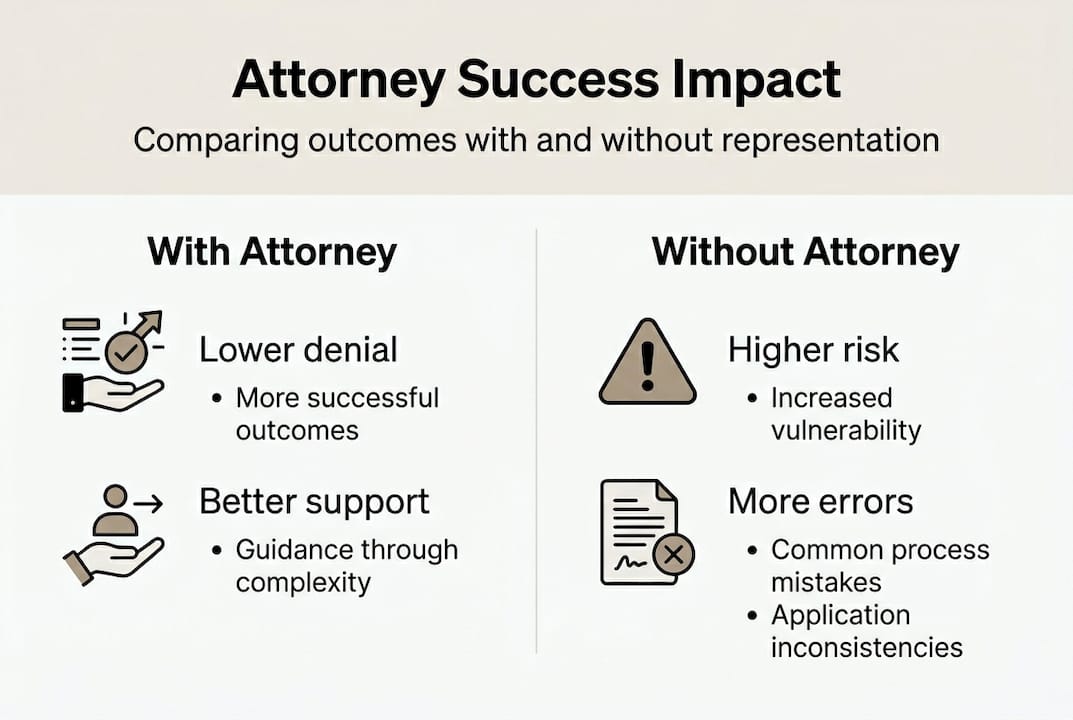
In immigration court, the contrast is even sharper. Non-detained immigrants with representation were ordered removed only 26.9% of the time between FY2019 and FY2024, compared to 61.8% for those without counsel. For detained immigrants representing themselves, success rates drop to near zero.
Here's a side-by-side comparison:
| Scenario | With attorney | Without attorney |
|---|---|---|
| AOS denial risk | Below 10% | Around 20% |
| Non-detained removal rate | 26.9% | 61.8% |
| Overall success improvement | 3 to 10 times higher | Baseline |
| RFE response effectiveness | High | Variable |
These aren't abstract statistics. They represent real families, real delays, and real consequences. A single filing error on an I-485 can trigger an RFE or outright denial. An attorney who has handled hundreds of similar cases knows which boxes trip up USCIS reviewers and how to avoid them.
For petition-based cases, strategic petition support can be the deciding factor in whether a case moves forward or stalls. And for those new to the process, expert immigration guidance helps applicants understand what to expect at every stage, reducing anxiety and preventing costly surprises.
The bottom line: legal representation doesn't just improve your odds. It often determines whether you have a realistic shot at success at all.
Attorney vs. self-representation: What does USCIS really allow?
So if attorneys help this much, are they legally required? The short answer is no.
USCIS allows self-representation for any immigration application. An attorney who officially represents a client must file Form G-28, which grants them online case access and the ability to communicate with USCIS on your behalf. But the G-28 doesn't give attorneys any special influence over decisions. USCIS adjudicators evaluate cases on their merits regardless of who filed them.
That said, "allowed" and "advisable" are very different things. Here's a practical breakdown of when self-filing is reasonable versus when you really should get help:
- Simple, low-stakes renewals: Renewing a green card with no changes to your record is manageable without an attorney for many people.
- Straightforward family petitions: If your situation is clean and well-documented, self-filing an I-130 is possible with careful attention to instructions.
- Complex eligibility questions: If you've had prior removals, overstays, criminal history, or multiple visa types, professional help is strongly advised.
- Appeals and motions: These require legal arguments and knowledge of immigration law. Self-representation here is a serious risk.
- Removal proceedings: If you're in immigration court, the stakes are too high to go without representation.
Pro Tip: Before you decide to self-file, review your full immigration history honestly. Even a minor issue you've forgotten, like a brief overstay years ago, can create complications that an attorney would know how to address.
For those who want to reduce errors from the start, reviewing filing tips to avoid errors is a smart first step. And if cost is a concern, finding immigration help through nonprofit or reduced-fee providers is a real option for eligible applicants.
Choosing the right attorney: Red flags, questions, and maximizing value
Knowing you need an attorney is one thing. Finding the right one is another challenge entirely.
Attorneys who handle the full AOS and visa lifecycle reduce RFEs and denials through experience and process knowledge. But not everyone calling themselves an immigration consultant has the credentials to back it up. Here's what to look for and what to avoid.
Questions to ask before hiring:
- Are you licensed to practice law in this state?
- How many cases like mine have you handled in the last two years?
- Who will actually be working on my case, you or a paralegal?
- How do you communicate updates, and how quickly do you respond?
- What's your fee structure, and what's included?
Red flags to watch for:
- Vague answers about credentials or case outcomes
- Pressure to sign a contract immediately
- Promises of guaranteed approval
- No verifiable bar admission or state license
- Poor reviews or no online presence
Maximizing the value of your attorney relationship also depends on what you bring to the table. Share all relevant documents early, even ones you think might not matter. Stay organized. Respond to requests quickly. The more prepared you are, the more efficiently your attorney can work.
Pro Tip: Before your first consultation, pull together your passport history, any prior immigration filings, and any notices you've received from USCIS. This saves time and helps your attorney spot issues faster.
Understanding compliance review importance is also critical. Attorneys who conduct thorough document reviews before filing catch errors that would otherwise trigger RFEs. If you're exploring employment-based options, EB-3 visa legal help is one area where experienced counsel makes a particularly strong difference.
Why legal help matters more today than ever: Our take
At True Ventures, we've seen firsthand how the immigration landscape has shifted. Denial rates for minor filing errors have climbed. Rule interpretation has become less predictable. What worked two years ago may not work the same way today.
Digital filing didn't simplify things as much as people hoped. It changed the format, not the complexity. Knowing which supporting documents satisfy a particular adjudicator's standard, or how to frame a cover letter that preempts an RFE, still requires deep process knowledge that forms alone can't teach you.
We believe the stakes in 2026 are higher than they've been in years. A delay isn't just an inconvenience. It can mean losing a job offer, missing a family reunion, or facing removal. The margin for error has narrowed, and the cost of mistakes has grown.
Professional support through immigration filing assistance isn't a luxury for complicated cases. It's increasingly the practical choice for anyone who can't afford to start over. We say this not to create fear, but because we've watched too many capable, deserving people lose time and status to preventable mistakes.
Get expert immigration support today
If this guide has clarified anything, it's that the right support at the right time can change everything about your immigration journey. Whether you're starting fresh or dealing with a complicated filing history, you don't have to figure it out alone.

At True Ventures, LLC, we specialize in helping immigrants and their families navigate the U.S. system with accuracy and care. From I-130 and I-485 filings to H-1B petitions and Liberian legal services, our team brings both professional expertise and personal understanding to every case. Explore our True Ventures immigration consulting options, review our immigration filing assistance services, or browse all immigration services to find the right fit for your situation. Reach out today and take the next step with confidence.
Frequently asked questions
Is it mandatory to have an attorney for a U.S. immigration application?
No, USCIS permits self-representation for any application, but legal counsel is strongly recommended for complex, high-stakes, or appeal-related cases.
How does an attorney affect success rates for green card or AOS filings?
Represented AOS applicants face denial risks below 10% versus around 20% for self-filers, and removal rates drop from 61.8% to 26.9% with counsel in non-detained court cases.
What tasks do immigration attorneys handle that make a difference?
Attorneys verify eligibility, prepare filings, respond to RFEs, and build case strategy to prevent delays, denials, and legal complications.
How do I verify an immigration attorney is legitimate?
Confirm state bar admission, check their disciplinary history through your state bar's public records, and review verified client feedback before signing anything.
Does having an attorney guarantee approval?
No attorney can guarantee approval, but representation boosts success 3 to 10 times compared to unrepresented cases in immigration court and USCIS filings.