

Many immigrants assume that signing with an immigration attorney means paying one fixed fee upfront and calling it done. That assumption leads to real confusion, and sometimes real disputes, when invoices keep arriving after the initial payment. An immigration retainer is an upfront payment made to an attorney to secure their services, not a one-time flat charge or a promise that your case will succeed. This guide breaks down exactly what a retainer is, how the billing works, what you should watch out for, and how to choose the right fee arrangement for your specific immigration situation.
Table of Contents
- What is an immigration retainer?
- How immigration retainers work: Mechanics and billing
- Fee structures: Retainers vs. flat fees in immigration cases
- Benefits and potential pitfalls of immigration retainers
- A practical perspective: What most guides miss about immigration retainers
- Get help with your immigration retainer and filing process
- Frequently asked questions
Key Takeaways
| Point | Details |
|---|---|
| Retainer purpose | An immigration retainer secures legal services and is billed as work progresses, not as a flat fee. |
| Refund rights | Clients are entitled to refunds for any unearned retainer funds under legal ethics rules. |
| Fee structure clarity | Clear written agreements help avoid confusion between retainer and flat fee billing for immigration cases. |
| Benefits for clients | Retainers provide attorney commitment and peace of mind for complex immigration matters. |
| Practical guidance | Ask for detailed billing terms and refund policies to protect your interests when hiring an immigration attorney. |
What is an immigration retainer?
At its core, a retainer is a deposit. You pay it before any legal work begins, and the attorney draws from it as they work on your case. Think of it like a prepaid phone plan: you load money in, the attorney uses it up as services are rendered, and you may need to reload when the balance runs low.
A retainer held in trust is deposited into a client trust account and billed against as work is performed, with unearned portions refunded. That trust account is not the attorney's personal bank account. It is a separate, regulated account governed by rules like the IOLTA standard (Interest on Lawyers' Trust Accounts), which ensures client funds are protected and not co-mingled with the firm's operating funds.
Here is what an immigration retainer is, and what it is not:
- It is a secured payment that gives you priority access to your attorney's time
- It is subject to ethical rules about how it is held, billed, and refunded
- It is not a flat fee that covers everything from start to finish
- It is not a guarantee that USCIS will approve your petition
- It is not a payment for a specific outcome
Retainers are most common in complex immigration matters such as deportation defense, removal proceedings, or appeals, where the time required is hard to predict in advance. For more straightforward filings like an I-130 or I-485, attorneys often prefer flat fees instead.
"An immigration retainer secures your attorney's commitment to your case. It does not secure the outcome of your case."
Understanding this distinction is critical before you sign any agreement. Attorneys who are skilled at improving immigration outcomes will always explain this difference upfront, clearly and in writing.
Retainers also protect attorneys. They confirm that a client is financially committed and allow the attorney to allocate staff hours, schedule deadlines, and prepare documents without worrying about non-payment mid-case.
How immigration retainers work: Mechanics and billing
Knowing the definition is a start, but understanding the mechanics is where things get practical. Here is the step-by-step process of how a retainer works from payment to potential refund.
- You sign a retainer agreement. This written contract outlines the scope of work, the retainer amount, billing rates, and refund terms.
- You deposit funds into a trust account. Your payment goes into a separate client trust account, not the attorney's operating funds.
- The attorney bills against the account. As work is performed, hours and expenses are tracked and deducted from your balance.
- You receive billing statements. Ethical attorneys provide regular itemized statements showing how your money was used.
- You replenish when needed. Many agreements include an evergreen clause, which requires you to top up the retainer when it falls below a set threshold.
- Unearned funds are refunded. If the case resolves and funds remain, unearned fees must be returned per ABA (American Bar Association) ethics standards.
Here is a quick comparison to clarify the billing models:
| Feature | Retainer (Hourly) | Flat Fee |
|---|---|---|
| Upfront payment | Yes | Yes |
| Tied to hours worked | Yes | No |
| Refundable balance | Yes (unearned portion) | Rarely |
| Predictable total cost | No | Yes |
| Best for | Complex cases | Routine filings |
One thing immigrants often miss: the retainer amount and the total legal cost are not the same. Your initial retainer may be $3,000, but if your case takes 40 hours at $200 per hour, the total bill is $8,000. You will be asked to replenish the account as it depletes.

Pro Tip: Always ask your attorney for a detailed billing statement at least once a month. If your attorney cannot provide an itemized breakdown of how your retainer was spent, that is a red flag.
If you have questions about refunds specifically, reviewing a firm's refund policy details before signing any agreement can save you significant stress later.
Fee structures: Retainers vs. flat fees in immigration cases
Immigration attorneys use two main billing structures: retainers and flat fees. Knowing which one applies to your situation helps you budget accurately and avoid surprises.
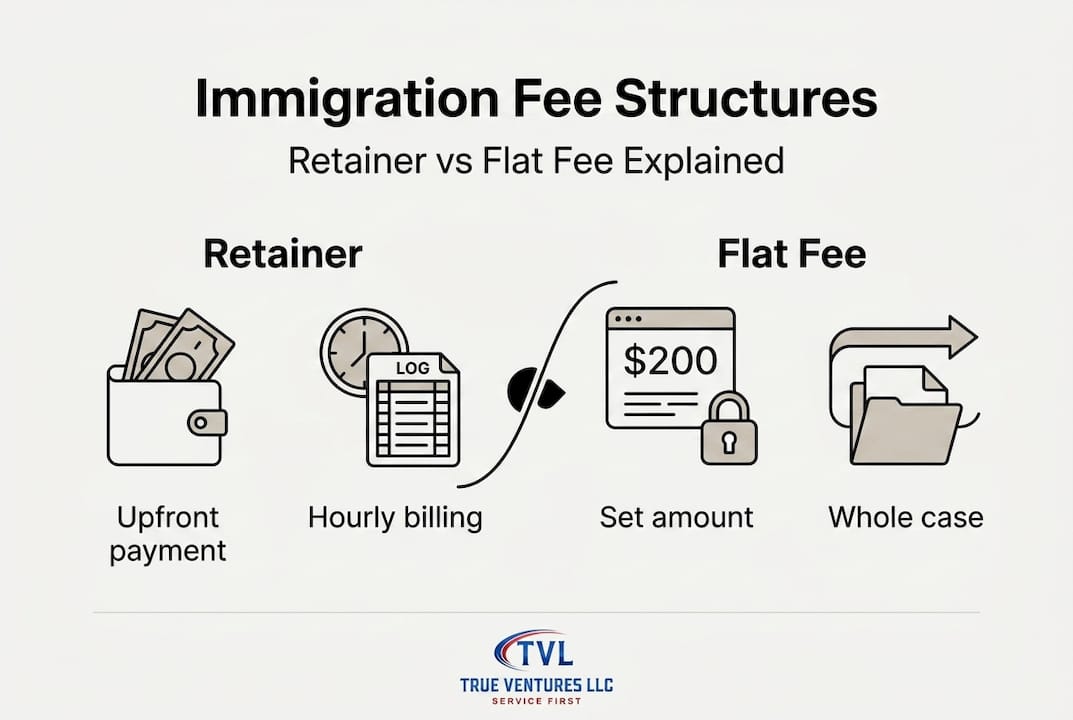
Flat fees are standard for predictable cases, while retainers are used for complex and hourly matters. Here is a breakdown of what that looks like in practice:
When flat fees make sense:
- Routine family petitions like I-130 (spousal or child sponsorship)
- Standard employment-based petitions like H-1B or I-140
- Straightforward adjustment of status (I-485) filings
- Asylum applications with clear facts and documentation
When retainers are more appropriate:
- Deportation or removal defense
- Immigration court hearings and appeals
- Cases with prior denials or complicated immigration histories
- Multi-step cases where the path forward is uncertain
Here are typical attorney fee ranges for common U.S. immigration matters in 2026:
| Case Type | Typical Attorney Fee Range |
|---|---|
| Family green card (I-130/I-485) | $2,000 to $5,000 |
| H-1B petition | $2,000 to $6,000 |
| Asylum application | $3,000 to $8,000 |
| Deportation defense | $5,000 to $15,000+ |
| USCIS appeal | $2,500 to $7,000 |
One common source of confusion: attorneys sometimes use the word "retainer" to describe what is actually a flat fee paid upfront. The label matters less than the terms. Always read the contract carefully. Does the agreement specify an hourly rate and a trust account? Then it is a true retainer. Does it state a fixed total with no hourly tracking? Then it is a flat fee, regardless of what the attorney calls it.
Pro Tip: Government USCIS filing fees are always separate from attorney fees. For example, an I-485 filing fee alone can exceed $1,400 in 2026. Never assume your retainer or flat fee covers these government costs.
Payment plans are also an option with many firms. If a $5,000 retainer feels overwhelming upfront, ask whether the firm allows installment payments. Many do, especially for families navigating green card processes.
Benefits and potential pitfalls of immigration retainers
Retainers work well when everyone understands the rules. When they do not, they can become a source of real financial pain.
Benefits of using a retainer:
- Dedicated representation: Your attorney is committed from day one, knowing payment is secured
- Flexible billing: You pay for the actual work done, not a fixed amount that may overestimate your needs
- Transparency: Monthly billing statements let you track progress and spending in real time
- Ethical protections: Trust account rules mean your money cannot be misused before services are rendered
Common pitfalls to watch for:
- Retainer depletion surprises: If you do not monitor your balance, you may get a replenishment request at the worst possible time
- Vague agreements: An unclear scope of work creates room for disputes about what is or is not included
- Refund complications: Some attorneys make refund claims difficult despite their ethical obligation
- Evergreen clause blind spots: Many clients sign without fully understanding that they will need to keep adding money to the account
Retainers provide security for clients and assurance for attorneys, but clarity in the agreement is the deciding factor in whether the arrangement works for both parties.
"A well-written retainer agreement protects you just as much as it protects your attorney. If the agreement is unclear, the risk lands on you."
For immigrants especially, who may be navigating legal systems in a second language or under significant stress, a vague retainer agreement can turn a difficult process into a devastating financial experience. Firms that follow ethical immigration attorney practices make clear agreements a non-negotiable standard, not an afterthought.
If your case is straightforward, a flat fee structure almost always reduces stress. You know the number upfront, and there are no surprises.
A practical perspective: What most guides miss about immigration retainers
Most articles about immigration retainers stop at the definition. Here is what we have seen actually matter in real cases.
Verbal agreements are a trap. We have worked with families who shook hands on a deal with an attorney and received a bill triple what they expected because nothing was written down. If it is not in writing, it does not exist legally or practically.
Evergreen clauses deserve extra attention. Many clients sign retainer agreements without realizing that a $3,000 deposit is just the starting point and that they are contractually required to keep funding the account. Ask before you sign: what happens if I cannot replenish? What is the threshold that triggers a replenishment request?
Clarity in retainer agreements prevents disputes and disappointment, and we have seen this firsthand. One family we supported avoided nearly $4,000 in unexpected charges simply because their agreement clearly defined the billing scope and excluded certain types of correspondence from billable hours.
Always ask for monthly itemized billing. Always ask about the refund process before you need it. And for simple filings, push for a flat fee. The peace of mind is worth more than the theoretical flexibility of hourly billing.
Working with choosing ethical immigration lawyers who put these details in writing from the start is not just good advice. It is the difference between a smooth process and a stressful one.
Get help with your immigration retainer and filing process
Understanding retainers is only part of the equation. The other part is knowing you have the right team working with you.

At True Ventures, LLC in Minneapolis, we specialize in immigration filing assistance for families and individuals navigating complex U.S. immigration processes, including I-130, I-140, H-1B, and I-485 filings. We know what it feels like to be on your side of the desk, uncertain about costs, timelines, and next steps. Browse our immigration consultant offerings to find support that fits your situation, and reach out to our team when you are ready to move forward with clarity and confidence.
Frequently asked questions
Is a retainer refundable if my immigration case isn't approved?
Yes, unearned fees must be refunded under ABA ethics rules, even if USCIS denies your petition. The attorney keeps only what was earned through actual work performed.
Do retainer payments cover government filing fees?
No, retainer payments cover attorney fees only. USCIS filing fees are separate government costs that typically range from hundreds to thousands of dollars and must be paid directly to USCIS.
How much is a typical immigration retainer?
Retainer amounts vary widely by case type. Typical ranges run from $2,000 for family petitions to over $15,000 for deportation defense, not including government filing fees.
How can I tell if my immigration attorney uses flat fees or retainers?
Request a written fee agreement before signing anything. If it references hourly billing and a trust account, it is a retainer arrangement. If it states a fixed total with no hourly tracking, it is a flat fee.