

Sixty-four percent of immigrants with legal representation avoid deportation, while those who go it alone face removal orders at more than double the rate. That single fact should stop anyone in their tracks who assumes a DIY immigration application is good enough. U.S. immigration law is one of the most complex and frequently changing areas of federal law, and the consequences of getting it wrong can mean years of separation from your family or permanent bars from the country you call home. This guide walks you through exactly why professional legal help is not optional, it is essential, and what you gain when you have the right person in your corner.
Table of Contents
- The complexity of U.S. immigration law
- How immigration lawyers improve your success rate
- Avoiding costly mistakes and delays
- Beyond paperwork: The value of tailored legal strategy
- The hidden truth: Why every case deserves professional review
- Get expert immigration support for your journey
- Frequently asked questions
Key Takeaways
| Point | Details |
|---|---|
| Legal expertise matters | Immigration lawyers expertly handle changing laws and paperwork to avoid costly errors. |
| Increase success rate | Having a lawyer massively improves your chances compared to going it alone. |
| Avoid delays and denials | Lawyers proactively prevent mistakes that cause unnecessary delays or rejections. |
| Tailored strategies | A lawyer customizes your case approach, unlocking the best path for your unique situation. |
| Early help is best | Consulting a lawyer early means fewer problems later—and more peace of mind throughout. |
The complexity of U.S. immigration law
Now that we've set the stage, it's important to understand why navigating the U.S. immigration system is especially challenging.
U.S. immigration law is not a single rulebook. It is a layered system of federal statutes, agency regulations, court rulings, and policy memoranda that can shift with every new administration, court decision, or USCIS (U.S. Citizenship and Immigration Services) guidance update. A form that was acceptable last year may require new supporting documents today. A visa category that was current in January may retrogress by March. For someone without legal training, keeping up with these changes while simultaneously managing work, family, and daily life is genuinely overwhelming.
Immigration lawyers are trained to navigate these complex laws, forms, and shifting policies to prevent errors that lead to delays, Requests for Evidence (RFEs), or outright denials. The difference between a correctly filed petition and one with a small but critical error can be a denial letter that sets your case back by months or even years. And that's if you're lucky. In the worst cases, filing mistakes can trigger grounds of inadmissibility, meaning you may be barred from applying again.
Common pitfalls for DIY applicants include:
- Using outdated forms: USCIS updates forms regularly. Using an old version, even one downloaded from a third-party site, almost guarantees rejection.
- Missing deadlines: Many immigration processes have strict timelines, and missing them can close your window permanently.
- Incorrect fee payments: Filing the wrong amount, even by a few dollars, leads to rejection.
- Incomplete supporting documents: Applications must include specific evidence tied to legal eligibility criteria. Guessing what to include is not a strategy.
- Misunderstanding eligibility: Applicants often don't realize they're ineligible for a benefit, or that a past entry or status gap could disqualify them.
"A single paperwork error can cost an applicant months of lost time and thousands of dollars in reapplication fees. What feels like a simple form is actually a legal declaration with lasting consequences."
Pro Tip: Always confirm the current version of any USCIS form directly on the official USCIS.gov website before submitting. Third-party sites and older bookmarks are often outdated and can lead to automatic rejection.
Good legal counsel is about improving immigration outcomes before problems arise, not just reacting after the fact. Lawyers track regulatory changes as part of their daily work and translate them into concrete action steps for your specific case. That ongoing vigilance is something no amount of internet research can fully replicate. The benefits of professional immigration services extend well beyond form completion. They include strategy, timing, and risk management at every stage of your case.
How immigration lawyers improve your success rate
Understanding the complexity is only half the story. Measuring the impact of legal expertise brings real clarity.
The data on legal representation in immigration cases is striking. When you look at removal proceedings specifically, the outcomes for represented versus unrepresented immigrants are not just different, they are dramatically different. Here is what recent data shows:
| Outcome | With legal counsel | Without legal counsel |
|---|---|---|
| Ordered removed (FY2019-2024) | 26.9% | 61.8% |
| Successfully avoid deportation | ~64% | ~38% |
| Representation rate in completed cases (2013-2024) | 52% | N/A |
| Representation in pending cases (2024) | 31% | N/A |
According to immigration court data, represented immigrants were ordered removed at a rate of just 26.9% compared to 61.8% for those without counsel between FY2019 and 2024. That is not a small margin. It is the difference between staying in the country and being forced to leave. Separately, representation rates in completed removal cases rose from 37% to 52% between 2013 and 2024, signaling that more immigrants are recognizing the value of legal help. But 31% representation in pending cases in 2024 shows that too many people are still going through the process alone.
What does this mean for you personally? If you are trying to stay in the U.S., keep your family together, and build a stable future, the numbers are telling you something important. Having a lawyer by your side while navigating your immigration journey is one of the most decisive factors in your outcome.
Pro Tip: Retain an immigration attorney as early as possible, ideally before you file anything. Early involvement means your lawyer can spot eligibility issues, flag potential bars, and structure your case for the best possible outcome. Waiting until you receive a denial or a Notice of Intent to Deny (NOID) puts you in a reactive position that is far harder to recover from.
The impact of representation is not limited to removal hearings. Attorneys who help win cases through family-based petitions, employment-based green cards, and adjustment of status applications also see measurably better results because they understand the exact standards USCIS applies and how to meet them with precision.
Avoiding costly mistakes and delays
Given the stakes, let's break down exactly what goes wrong for unrepresented immigrants and how a lawyer changes the equation.
When immigrants file on their own, the most common errors fall into predictable categories. Understanding these categories helps you see why legal guidance is not just helpful but often decisive.
The top mistakes DIY filers make include:
- Missing priority dates or Visa Bulletin windows: Attorneys track the Visa Bulletin, premium processing, and concurrent filing opportunities so you do not miss your window.
- Failing to respond correctly to RFEs: A Request for Evidence demands a precise legal response with proper documentation. Many self-filers do not know what evidence is actually required or how to present it.
- Ignoring prior immigration violations: A short overstay years ago, a status gap, or an old unlawful presence issue can trigger the 3-year or 10-year bar. Many applicants do not know these triggers exist until it's too late.
- Filing the wrong form or in the wrong category: Some applicants file for adjustment of status when they are not eligible, or pursue the wrong visa category for their situation.
- Missing the 245(k) eligibility window: Section 245(k) of the Immigration and Nationality Act allows certain employment-based applicants to adjust status despite past status violations, but only within a specific timeframe. Most applicants have never heard of it.
Here is how lawyer-led and self-filed applications typically compare in practice:
| Application factor | With attorney | Self-filed |
|---|---|---|
| RFE rate | Significantly lower | Significantly higher |
| Approval on first submission | Higher probability | Lower probability |
| Inadmissibility issues caught early | Yes | Rarely |
| Proper documentation compiled | Yes | Often incomplete |
| Timeline management | Proactive | Reactive |
| Response to NOIDs | Legally sound | Often inadequate |
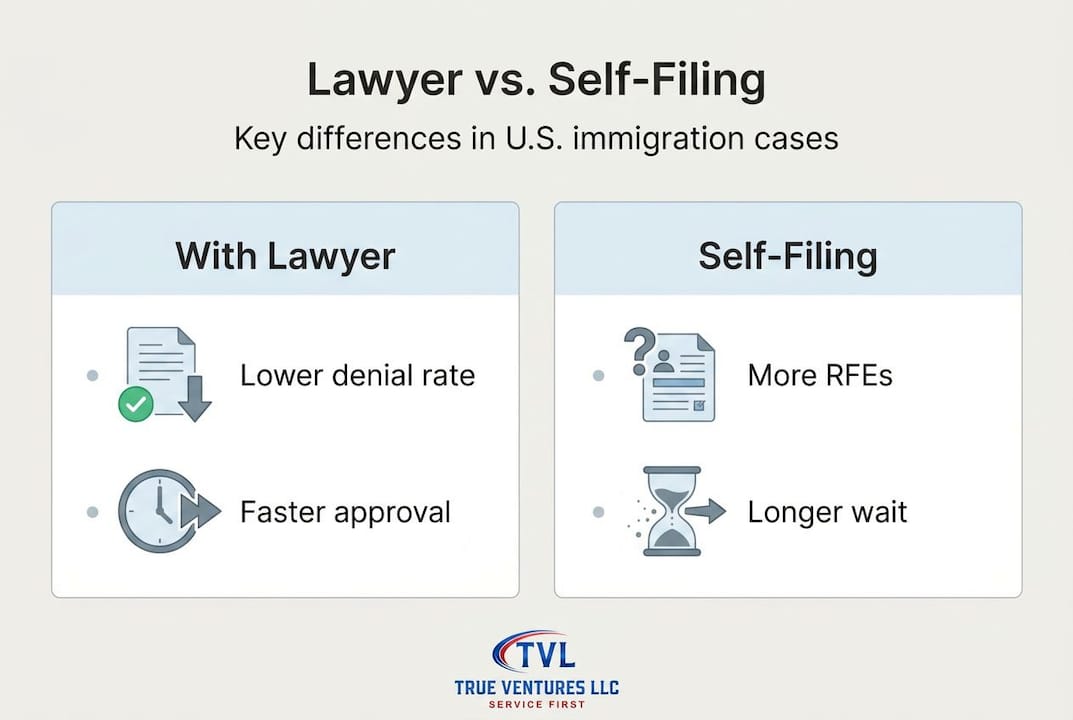
Immigration lawyers also prevent errors by reviewing your full immigration history before filing a single document. They look for hidden problems that you may not even know are problems. A prior visa denial. A short period of unauthorized work. An old entry that was marked incorrectly. These details matter enormously and can surface at any point in the process.

Pro Tip: Ask your attorney to review your complete immigration history before submitting any application. Even details that seem minor, like a single trip overstay or an employer who failed to file an extension on time, can affect your current eligibility. Learn more about common causes of immigration delays and how to stay ahead of them.
Smart filing practices to avoid errors are not just about filling out paperwork correctly. They are about understanding what the system is looking for and presenting your case in the strongest possible light from day one.
Beyond paperwork: The value of tailored legal strategy
After discussing how lawyers avert errors, let's look at their role in crafting strategies that go beyond handling forms.
Most people think of an immigration lawyer as someone who fills out forms. That is a serious underestimation of what quality legal representation actually does. A skilled attorney does not just complete applications. They build a strategy tailored to your unique situation, your goals, your history, and your timeline.
Here are the strategic services a qualified immigration attorney provides:
- Selecting the right immigration path: Employment-based, family-based, or humanitarian? The right category determines your timeline and chances of success.
- Responding to RFEs and NOIDs: These legal notices require precise, documented responses. A weak response can turn an approvable case into a denial.
- Defending in immigration court: If you face removal proceedings, having counsel is the single biggest factor in your outcome.
- Adjusting to enforcement shifts: When enforcement priorities change, strategies must change with them. An attorney tracks these shifts in real time.
- Family reunification planning: Lawyers coordinate across multiple petitions to keep families together and minimize processing time.
"True legal strategy in immigration is not about avoiding paperwork, it is about preventing family separation. Every filing decision carries the weight of someone's future."
Immigration legal strategies also address issues like 245(k) ineligibility, the 3-year and 10-year bars, and triggers for inadmissibility that most applicants have never heard of. A lawyer tailors their approach to whether you are on an employment-based, family-based, or humanitarian path, and that personalization makes a real difference. For families especially, legal services ensure compliance with current law, help avoid separation, and protect against the unexpected consequences of shifting enforcement priorities.
Finding comprehensive immigration support means working with professionals who understand not just the law but the human stakes involved in every case. It means having someone prepare evidence, anticipate roadblocks, and advocate for the most favorable options available to you.
The hidden truth: Why every case deserves professional review
To cap off this exploration, let's shift from statistics to the lessons only experience provides.
Here is the uncomfortable reality that most people discover too late: there is no such thing as a truly simple immigration case. Every application carries risk because every applicant has a unique history, and that history interacts with immigration law in ways that are not always predictable or obvious. A client who presents what looks like a routine I-485 adjustment may have a short period of unauthorized employment from years ago that triggers inadmissibility. A spouse applying for a green card may have an old visa overstay from a trip that slipped their memory. These are not exotic edge cases. They happen all the time.
We've seen families discover mid-process that a parent's past entry on a tourist visa with the intent to immigrate creates a misrepresentation issue. We've seen employment-based cases stall because the applicant unknowingly worked for a different employer during a brief gap, violating their status. The real outcomes for people who got early legal review versus those who discovered problems at the denial stage are starkly different, in cost, in time, and in emotional impact.
The other truth worth saying plainly is this: waiting until you have a problem almost always costs more than getting reviewed upfront. An RFE response, an appeal, or a motion to reopen a denial takes far more time, money, and legal effort than a properly filed original application. Think of legal review before filing as preventive care. You would not wait until a tooth is abscessed to see a dentist. The same logic applies here.
An immigration lawyer is not just for emergencies or complex corporate cases. They are the most reliable safeguard against the unknown, and in immigration, the unknown can have life-changing consequences. Full-service immigration support ensures that nothing about your case is left to chance, no matter how routine it appears on the surface.
Get expert immigration support for your journey
If you're ready to move forward with peace of mind, reputable support is available.
At True Ventures, LLC, we understand what is at stake because many of us have lived the immigrant experience firsthand. We know that behind every form is a family, a future, and years of hard work. Our team stays current on policy changes, court decisions, and USCIS updates so that your case reflects the most current legal landscape at every step.

Whether you need immigration filing assistance for I-130, I-485, H-1B, or I-140 petitions, or you're looking for guidance on a more complex situation involving Liberian legal services, we are here to help you build the strongest case possible. Our immigration consultant services are designed to protect your family's future through accuracy, trust, and genuine care. Explore our full service immigration support to see how we can walk this journey with you.
Frequently asked questions
What does an immigration lawyer do that I can't do myself?
Lawyers handle complex law, prevent filing errors, respond to RFEs and legal notices, and track policy changes to give you the best possible chance of approval. They also catch hidden eligibility issues that most applicants never see coming.
How much more likely am I to succeed with an immigration lawyer?
The data is clear: represented immigrants are ordered removed at a 26.9% rate compared to 61.8% for those without counsel, meaning having a lawyer dramatically improves your odds of staying in the U.S.
Can an immigration lawyer help with family reunification?
Yes. Attorneys improve family-based petition approvals, coordinate multiple filings to avoid family separation, and advise on the fastest and safest reunification path given current law and enforcement priorities.
When should I hire an immigration lawyer?
Hire as early as possible, before you file anything. Early involvement lets your attorney identify eligibility pitfalls like 245(k) issues, the 3/10-year bars, and inadmissibility triggers before they become costly problems.