
Many families assume that a single past mistake—an overstayed visa, a prior removal, or a health issue—permanently closes the door to U.S. immigration benefits. That assumption causes real harm. An immigration waiver is a form of relief that allows certain inadmissible individuals to overcome specific grounds of inadmissibility under INA section 212(a) when seeking immigrant visas, adjustment of status, or other benefits. Waivers exist precisely because rigid rules sometimes produce unjust outcomes for families. This guide breaks down what immigration waivers are, the main types, who qualifies, and how the process works so you can make informed decisions about your family's future.
Table of Contents
- What is an immigration waiver?
- Types of immigration waivers and what they cover
- Who qualifies for an immigration waiver?
- How the waiver process works: Steps, evidence, and key considerations
- A deeper look: What most guides miss about immigration waivers
- Get expert help with your immigration waiver
- Frequently asked questions
Key Takeaways
| Point | Details |
|---|---|
| Waivers overcome barriers | Immigration waivers let applicants ask to forgive certain legal grounds that would otherwise block U.S. entry or status. |
| Key forms and criteria | I-601, I-212, and I-601A are the main types, each with unique uses and requirements. |
| Extreme hardship is critical | Applicants must often prove hardships to family beyond normal separation for waivers to be considered. |
| Process requires evidence | Strong evidence and careful preparation are essential for a successful immigration waiver. |
| Expert advice helps | Navigating waiver rules is challenging—professional support can improve your chances of approval. |
What is an immigration waiver?
Think of an immigration waiver as a formal request asking the government to overlook a specific legal barrier in your immigration history. It does not erase what happened. Instead, it asks USCIS or a consular officer to weigh the reasons you should be allowed to proceed despite that barrier. Understanding this distinction matters because many applicants mistakenly believe approval is automatic once they file.
Waivers are discretionary relief, meaning an officer evaluates your case on its individual facts. Approval is never guaranteed. The officer considers positive factors, like family ties and community contributions, against negative ones, like the nature of the inadmissibility ground. That balancing act is why preparation and evidence quality matter so much.
The legal foundation sits in INA section 212(a), which lists grounds of inadmissibility. Congress built waiver pathways into the law because it recognized that strict enforcement without flexibility could devastate families. USCIS policy promotes family unity while remaining strict on security threats and certain serious crimes. In 2016, provisional waivers were expanded specifically to reduce the family separation that occurred when immigrants had to leave the U.S. to attend consular interviews.
Common grounds that waivers can address include:
- Unlawful presence triggering the three or ten year bar
- Certain health-related grounds
- Fraud or misrepresentation on prior applications
- Prior removal orders
- Certain criminal grounds (with limitations)
Important: No waiver exists for a false claim to U.S. citizenship made after September 30, 1996, except in very narrow categories. If this applies to your situation, get professional advice immediately before filing anything.
Before gathering your required documents for waivers, it helps to understand the full scope of U.S. immigration law so you know exactly which ground you are trying to overcome. Knowing how to start collecting evidence for immigration cases early can also significantly strengthen your application.
Types of immigration waivers and what they cover
Not all waivers are the same. The form you file, the evidence you submit, and the process you follow depend entirely on which inadmissibility ground applies to you. Here are the three primary waivers most families encounter.
The three main waiver forms:
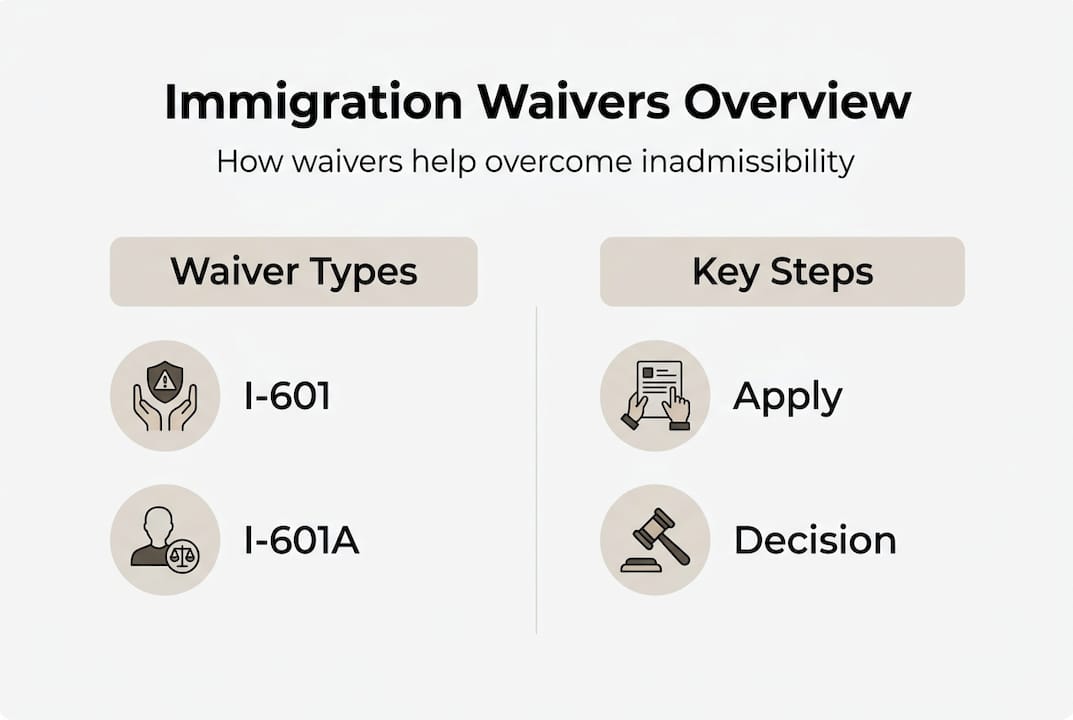
- Form I-601 (Application for Waiver of Grounds of Inadmissibility): This is the broadest waiver. It covers health issues, certain crimes, fraud and misrepresentation, unlawful presence bars, and prior removals. Primary waivers under I-601 address grounds like health issues, crimes, fraud, unlawful presence (3/10-year bars), and prior removal.
- Form I-212 (Permission to Reapply After Deportation): If you were previously removed or deported, you generally cannot return without permission. I-212 is the form that grants that permission under INA 212(a)(9)(A) or (C). It is separate from I-601 and often filed together with it.
- Form I-601A (Provisional Unlawful Presence Waiver): This is specifically for unlawful presence only. The I-601A provisional waiver is filed inside the U.S. before you leave for a consular interview. It requires an approved I-130 or I-360, no other triggering inadmissibility bar, and proof of extreme hardship to a qualifying relative. It only becomes effective after the consulate finds you otherwise admissible.
| Waiver Form | Ground Covered | Where Filed | Key Requirement |
|---|---|---|---|
| I-601 | Multiple grounds (health, crime, fraud, unlawful presence) | USCIS or abroad | Extreme hardship or specific eligibility |
| I-212 | Prior removal/deportation | USCIS or abroad | Discretionary factors |
| I-601A | Unlawful presence only | Inside the U.S. | Extreme hardship to qualifying relative |
Special categories also exist. Applicants for T visas (trafficking victims), U visas (crime victims), and VAWA (Violence Against Women Act) self-petitioners face different standards and may qualify for waivers that are not available to general applicants. These are worth exploring if you fall into those groups.
If you are unsure which form applies to your situation, reviewing help with immigration waivers from a qualified consultant can prevent costly filing errors. An experienced immigration attorney can also help you map your history to the correct form.
Who qualifies for an immigration waiver?
Eligibility depends on two things: the specific inadmissibility ground and whether you can demonstrate the required level of hardship to the right person. Let's break both down.

Qualifying relatives are the people whose hardship USCIS considers. For most I-601 waivers involving unlawful presence or fraud, extreme hardship must be shown to a U.S. citizen or lawful permanent resident (LPR) spouse or parent. Children are not qualifying relatives for this purpose, though a child's situation can factor into the overall hardship calculation for the qualifying relative.
What counts as extreme hardship? This is where many applications fall short. Hardship must go well beyond the normal difficulty of family separation. USCIS looks at a combination of factors:
- Medical needs of the qualifying relative that cannot be met abroad
- Financial consequences of the applicant's absence
- Emotional and psychological impact, including documented mental health effects
- Conditions in the applicant's home country (safety, healthcare access, economic stability)
- Length of the relationship and degree of dependence
Pro Tip: Do not just list hardships. Show how they combine. A qualifying relative dealing with a chronic illness and financial dependence and living in a country with poor medical infrastructure presents a much stronger cumulative case than any single factor alone.
| Hardship Type | Examples | Documentation Needed |
|---|---|---|
| Medical | Chronic illness, disability, mental health | Medical records, doctor letters |
| Financial | Loss of primary income, debt | Tax returns, bank statements |
| Psychological | Anxiety, depression from separation | Psychological evaluations |
| Country conditions | Danger, lack of services | State Dept. reports, news articles |
Not every inadmissibility ground is waivable. Security-related bars, international child abduction grounds, and false citizenship claims (with narrow exceptions) generally cannot be overcome through a waiver. Understanding this early saves time and protects you from filing fees you cannot recover.
Reviewing the immigration consultation process before you start can help you organize your situation clearly. Strong immigration document compliance also prevents avoidable rejections. For families already in the green card process, understanding the green card process alongside waiver requirements gives you the full picture.
How the waiver process works: Steps, evidence, and key considerations
Knowing you may qualify is only the starting point. The process itself requires careful sequencing, strong documentation, and an honest assessment of your case.
Step-by-step waiver application process:
- Identify the correct form. Match your inadmissibility ground to the right waiver. Filing the wrong form wastes time and money.
- Gather supporting evidence. This includes affidavits from the qualifying relative, medical records, financial documents, psychological evaluations, and country condition reports.
- Prepare a personal statement. A well-written, detailed statement from the qualifying relative explaining the hardship carries significant weight.
- Submit the application with fees. Incomplete packages or missing fees are among the most common reasons for rejection without review.
- Respond to any Requests for Evidence (RFEs). USCIS may ask for more information. A timely, thorough response is critical.
- Attend interviews if required. Some waivers, particularly those processed abroad, involve a consular interview.
The USCIS FY2024 data shows that USCIS received 34,449 I-601A applications in FY2024, while processing 75,555 non-I-601A waivers, with backlogs still growing for the latter category. That means patience is essential, but so is filing a complete, well-documented application the first time.
Pro Tip: The I-601A is faster and avoids physical separation for unlawful presence cases. However, if denied or revoked, it can trigger additional bars. The three and ten year bars are serious consequences, so weigh the I-601A option carefully with professional input.
Common mistakes include submitting generic hardship letters, skipping psychological evaluations, misidentifying the qualifying relative, and underestimating how long the process takes. Working with a consultant who understands immigration filing tips can help you avoid these pitfalls. For complex cases, immigration consultant advice tailored to your specific history is worth considering early.
A deeper look: What most guides miss about immigration waivers
Most articles explain what waivers are. Fewer explain why so many families who seem to qualify still get denied. After working with immigrant families navigating these processes, we have seen a consistent pattern: the difference between approval and denial is rarely about the facts of the case. It is almost always about how those facts are presented.
Cumulative hardship is one of the most powerful and underused arguments in waiver applications. A qualifying relative facing one serious hardship may meet the threshold. But a qualifying relative facing medical issues, financial strain, and dangerous country conditions simultaneously presents a case that is genuinely hard to deny. Proving extreme hardship requires layering medical, economic, and emotional evidence together, not listing them separately.
Psychological evaluations are another tool families often skip because they feel uncomfortable or unnecessary. They are not. A licensed psychologist's report documenting the emotional impact of potential separation carries real weight with officers. It transforms an abstract claim into clinical evidence.
Finally, many denials trace back to a misreading of policy nuances that a second set of eyes would catch. Reviewing immigration document compliance before submission is not optional for high-stakes applications. It is the step that protects everything else you have built.
Get expert help with your immigration waiver
Immigration waivers are among the most evidence-intensive applications in the U.S. immigration system. A missing document, a weak hardship argument, or the wrong form can set your family back by months or years.

At True Ventures, LLC, we work with families across the country to build strong, well-documented waiver applications. Our team understands both the legal requirements and the human story behind every case. Whether you are preparing an I-601, I-601A, or I-212, our immigration filing assistance services are designed to give you the best possible foundation. Explore our full range of consultant support to see how we can help you move forward with confidence.
Frequently asked questions
What is the difference between an I-601 and I-601A waiver?
The I-601 covers multiple inadmissibility grounds, while the I-601A is a provisional waiver for unlawful presence only, letting applicants apply before leaving the U.S. for their consular interview.
Who counts as a qualifying relative for extreme hardship waivers?
For most I-601 waivers, extreme hardship must be shown to a U.S. citizen or LPR spouse or parent. Children's hardships are considered indirectly but do not qualify them as primary qualifying relatives.
Can an immigration waiver overcome a false claim to U.S. citizenship?
No general waiver exists for false citizenship claims made after September 30, 1996, per USCIS policy, except for very narrow exceptions such as refugees or asylees.
How long does the immigration waiver process take?
Processing times vary widely. USCIS FY2024 data shows growing backlogs for non-I-601A waivers, meaning decisions can take several months or longer depending on case complexity and evidence submitted.