

Most people assume that if their immigration case is stuck, they must have done something wrong. That assumption is costing families months, sometimes years, of unnecessary anxiety. The reality in 2026 is that the majority of delays have nothing to do with applicant error. Policy changes like PM-602-0194 pause reviews for nationals of 39 countries, and sweeping security mandates have reshaped processing timelines across the board. Understanding where delays actually come from is the first step toward making better decisions and protecting your immigration goals.
Table of Contents
- Common government policies causing immigration delays
- Visa bulletin limits and numerical caps: A data-driven slowdown
- Security reviews and enhanced background checks
- Applicant mistakes and missing information: What you can actually control
- Most advice on immigration delays misses the real story
- Expert help when delays threaten your immigration goals
- Frequently asked questions
Key Takeaways
| Point | Details |
|---|---|
| Policy shifts drive delays | Most current immigration delays result from government changes, not applicant errors. |
| Visa bulletins set wait times | Backlogs form mainly due to annual and per-country visa limits in the bulletin. |
| Security reviews slow cases | Enhanced checks especially impact applicants from certain countries. |
| Some delays are preventable | Avoiding mistakes on your application can prevent avoidable setbacks. |
| Expert help saves time | Professional guidance can boost your odds by keeping you compliant and up-to-date. |
Common government policies causing immigration delays
Now that you know delays are often driven by policy, let's break down the most significant rules affecting cases in 2026.
The U.S. government has always had the authority to pause, review, or restructure how immigration cases are processed. In 2026, that authority has been used more broadly than at any point in recent memory. Policy memorandum PM-602-0194 introduced mandatory enhanced vetting for nationals of dozens of countries, effectively putting thousands of pending cases on hold without any fault on the applicant's side. This is not a bureaucratic inconvenience. It is a structural shift.
Several policy actions are driving the slowdowns most families are experiencing right now:
- PM-602-0194 vetting requirements pause case reviews for nationals of 39 countries pending additional screening
- Presidential Proclamation 10998 authorizes the State Department to suspend immigrant visa issuance for nationals of high-risk countries
- DOS suspension measures have affected visa issuance across 39 to 75 countries, depending on the category
- Both family-based and employment-based cases are affected, with no category fully insulated
- Applicants with otherwise complete files are waiting simply because their nationality triggers a review flag
"The legal rationale behind these policies centers on national security, but the ripple effects reach far beyond high-risk profiles. Ordinary families with clean records face the same processing pauses as anyone else flagged by the system." — Immigration law perspective
Understanding these policies matters because it changes what you should do next. A delay caused by a government pause requires a completely different response than one caused by a missing document. A strong compliance review for immigration documents can at least ensure your file is airtight when processing resumes.
Visa bulletin limits and numerical caps: A data-driven slowdown
With government policies in mind, let's examine how quota systems and the Visa Bulletin force waiting lines, even for thoroughly prepared cases.

The Visa Bulletin is a monthly publication from the State Department that controls when applicants in certain categories can move forward. The U.S. limits the total number of family-sponsored green cards to 226,000 per year, and no single country can receive more than 7% of the annual total. For high-demand countries like India, China, Mexico, and the Philippines, that cap creates waiting lines measured in decades, not months.
Recent category and country backlog snapshot (January 2026)
| Category | Country | Estimated wait |
|---|---|---|
| F-2A (Spouse of LPR) | Mexico | 2 to 3 years |
| F-4 (Siblings of U.S. citizens) | Philippines | 20+ years |
| EB-3 (Skilled workers) | India | 10+ years |
| EB-2 (Advanced degree) | China | 5 to 8 years |
These visa bulletin numerical limits and per-country caps are a structural feature of U.S. immigration law, not a glitch. They reflect political decisions made decades ago that have not kept pace with global demand.
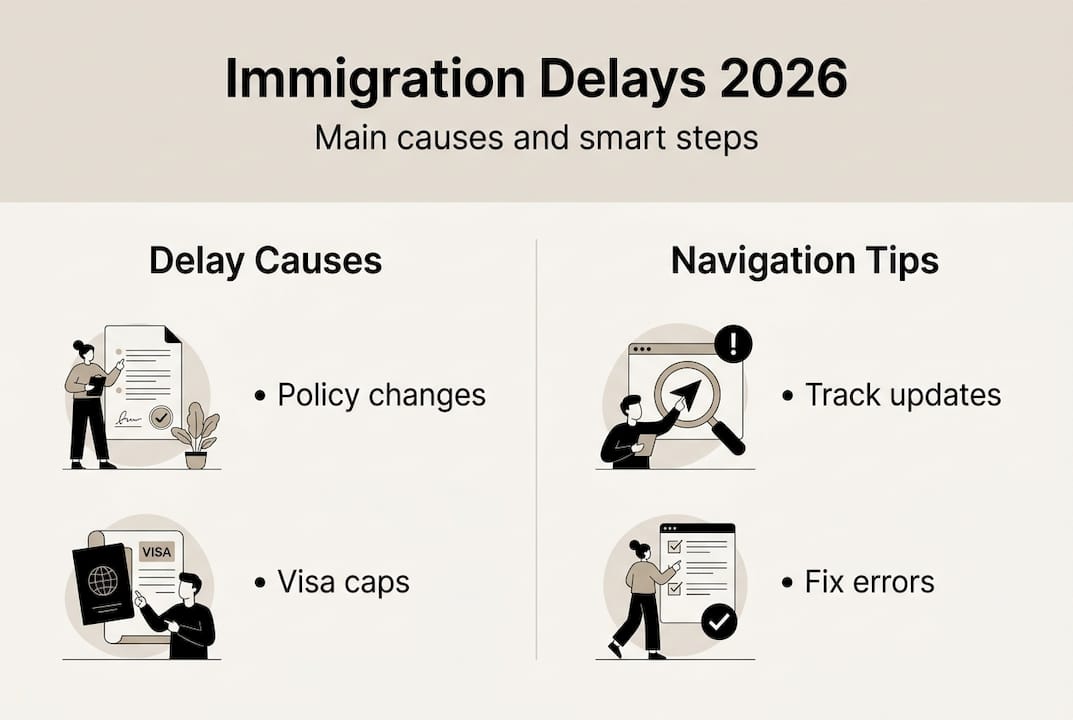
Retrogression makes this even more complicated. A priority date that was current in one month can move backward the next, forcing applicants who thought they were close to wait even longer. This uncertainty is genuinely difficult to plan around.
Important stat: As of early 2026, over 1.8 million applicants are waiting in the employment-based backlog alone, with some priority dates stuck for generations.
Pro Tip: Read the visa bulletin retrogression section carefully each month. Pay attention to both the "Final Action Dates" chart and the "Dates for Filing" chart, since only one applies to your specific case depending on USCIS guidance that month.
Security reviews and enhanced background checks
Delays aren't just about limited numbers. Security enhancements introduce another unpredictable layer.
In 2026, enhanced vetting policies have paused cases from high-risk countries and terminated several prior humanitarian programs. This marks a sharp contrast from the more lenient screening frameworks of earlier years. Even applicants with no criminal history and fully complete applications are experiencing holds that stretch months beyond standard timelines.
Here is what a typical security review process looks like for a flagged case:
- Initial application receipt — case enters the USCIS system and is assigned a priority date
- Name check and database screening — automated systems flag certain nationalities or name patterns for additional review
- Interagency referral — flagged cases may be forwarded to the FBI, DHS, or other agencies
- Interview scheduling — some applicants receive an interview notice as part of the enhanced process
- Administrative processing — cases can sit in this status for weeks or months pending clearance
- Final adjudication — once all checks clear, a decision is issued
"Even thoroughly eligible applicants can find themselves in administrative processing with no clear timeline for resolution. The system is functioning as designed, but that design creates genuine hardship for real families."
Pro Tip: If your case has been in administrative processing for more than 180 days past your interview, document everything and consult a professional about whether an inquiry or legal action is appropriate. Our immigration consultation workflow can walk you through that process.
For applicants from impacted regions, connecting early with expert immigration guidance helps you build a realistic timeline and prepare documentation that holds up under scrutiny. You can also review a broad overview of what immigration law covers to better understand the legal framework shaping your case.
Applicant mistakes and missing information: What you can actually control
With the external causes covered, let's zero in on mistakes you can actually address.
Not every delay comes from Washington. A significant share of cases slow down because of issues applicants can prevent. Knowing the difference matters because it tells you where to focus your energy.
Common mistakes that trigger unnecessary delays include:
- Incomplete forms — leaving required fields blank or using outdated versions of USCIS forms
- Missing supporting documents — failing to include birth certificates, marriage records, or financial evidence
- Translation errors — submitting documents in a foreign language without a certified English translation
- Inconsistent information — discrepancies between your application and supporting records raise red flags
- Missed deadlines — not responding to a Request for Evidence (RFE) within the required timeframe
- Wrong filing address — USCIS regularly updates where forms must be sent, and sending to the wrong location causes rejection
An RFE is a written request from USCIS asking for more information or clarification. It is not a denial, but it does add 60 to 90 days to your timeline and sometimes more if the response is incomplete. Understanding how to collect immigration evidence correctly before you file is one of the highest-leverage things you can do.
Here is the critical distinction: a document problem creates a correctable delay. A policy pause does not. Knowing which type of delay you are facing shapes your entire response strategy. If PM-602-0194 pauses reviews for your nationality, no amount of additional documentation will speed up that hold.
Pro Tip: Before submitting any immigration application, have a professional review your complete package. Research on how attorneys improve outcomes consistently shows that professionally reviewed files face fewer RFEs and faster resolution.
Most advice on immigration delays misses the real story
Here is something that gets under our skin as practitioners: most of the guidance available to immigrant families still frames delays as a personal failing. "Did you submit the right form? Did you include every document?" Those are valid questions, but in 2026, they miss the bigger picture by a wide margin.
Policy is now the primary driver of delays, not applicant error. Governments issue security updates, proclamations, and processing holds faster than advocacy groups or family advisors can track. The families we work with often spend months blaming themselves for a delay that was caused by a policy shift announced quietly on the USCIS website.
The fix is not more paperwork. It is better information. Monitoring official USCIS and State Department channels, understanding which policies affect your nationality and category, and working with someone who tracks these changes in real time is what actually moves cases forward. Our consultation workflow tips are built around exactly this kind of proactive monitoring. Preparation informed by current policy is the sharpest tool you have.
Expert help when delays threaten your immigration goals
If delays or confusion threaten your immigration journey, expert guidance can make all the difference.
At True Ventures, LLC, we work directly with immigrant families navigating exactly these challenges, from policy-driven pauses to visa quota backlogs and evidence preparation. We know what it feels like to wait, and we know what it takes to move a case forward under pressure.

Our team provides hands-on immigration filing assistance that covers document review, compliance checks, and submission guidance tailored to your specific situation. Whether you are facing a security hold, an RFE, or a visa bulletin backlog, we are here to help you understand what is happening and what to do next. Explore all our offerings through our Minneapolis immigration consultants page and take the first step toward clarity.
Frequently asked questions
What are the main reasons for immigration application delays in 2026?
The main reasons are government policy changes, visa quota backlogs, stricter security checks, and applicant mistakes. Policy changes like PM-602-0194 and visa bulletin numerical limits together account for the majority of delays affecting families today.
How can I check if a policy is delaying my immigration case?
Check official USCIS or State Department updates regularly for policy announcements that may pause or slow processing for your nationality or visa category. USCIS policy updates are published online and often explain which groups are affected.
How does the visa bulletin affect my wait time?
The visa bulletin enforces annual and per-country quotas, which often lead to multi-year backlogs for high-demand categories. Per-country caps mean that nationals of countries with high demand can wait far longer than those from less-demanded countries, even in the same visa category.
Can anything speed up my immigration case in 2026?
Careful document preparation and staying updated on policy shifts can help reduce applicant-side delays, but many holds are entirely outside your control. DOS visa suspensions for high-risk countries, for example, cannot be resolved by submitting better paperwork.