

Waiting on an immigration application can feel like shouting into a void. Weeks pass, sometimes months, and the silence from USCIS or the Department of State (DOS) can make even the most patient person anxious. The good news is that clear, official tools exist to track your case, understand what status updates actually mean, and take smart action when things stall. This guide walks you through exactly what you need, how to use the right portals, how to read your status, and what to do if your case feels stuck. Whether you filed an I-130, I-485, or a nonimmigrant visa petition, this is your practical roadmap.
Table of Contents
- What you need to track your immigration application
- Step-by-step: How to check your USCIS or visa case status
- Understanding your USCIS status updates and processing times
- Troubleshooting delays and next steps if your case stalls
- Expert insights: What most applicants overlook when tracking cases
- Reliable support for your immigration application journey
- Frequently asked questions
Key Takeaways
| Point | Details |
|---|---|
| Receipt and case numbers are essential | Always start tracking with the official ID numbers provided in your USCIS or DOS notices. |
| Use trusted portals | Stick to official government tracking tools to avoid delays or scams. |
| Status terms have clear meanings | Learn what each USCIS status update means so you can respond appropriately and avoid unnecessary worry. |
| Processing times vary by application | Consult the latest USCIS benchmarks to understand expected timelines for your specific case type. |
| Know your options for delays | If stalled, you can submit e-Request inquiries, consider expediting, or seek legal help for stubborn cases. |
What you need to track your immigration application
Before you open any tracking portal, you need the right information in front of you. Starting with incomplete or incorrect details is the fastest way to get confused or, worse, fall for a scam.
Know who holds your case: USCIS vs. DOS
This is where many applicants trip up. USCIS handles petitions and applications filed inside the U.S., such as I-130 family petitions, I-485 adjustment of status, and H-1B work visas. Once USCIS approves a petition and your case moves abroad for a visa stamp, it transfers to the Department of State, which operates its own separate tracking system. Knowing which agency holds your case determines which portal you use.
What you need before you start
Here is what to gather before logging into any system:
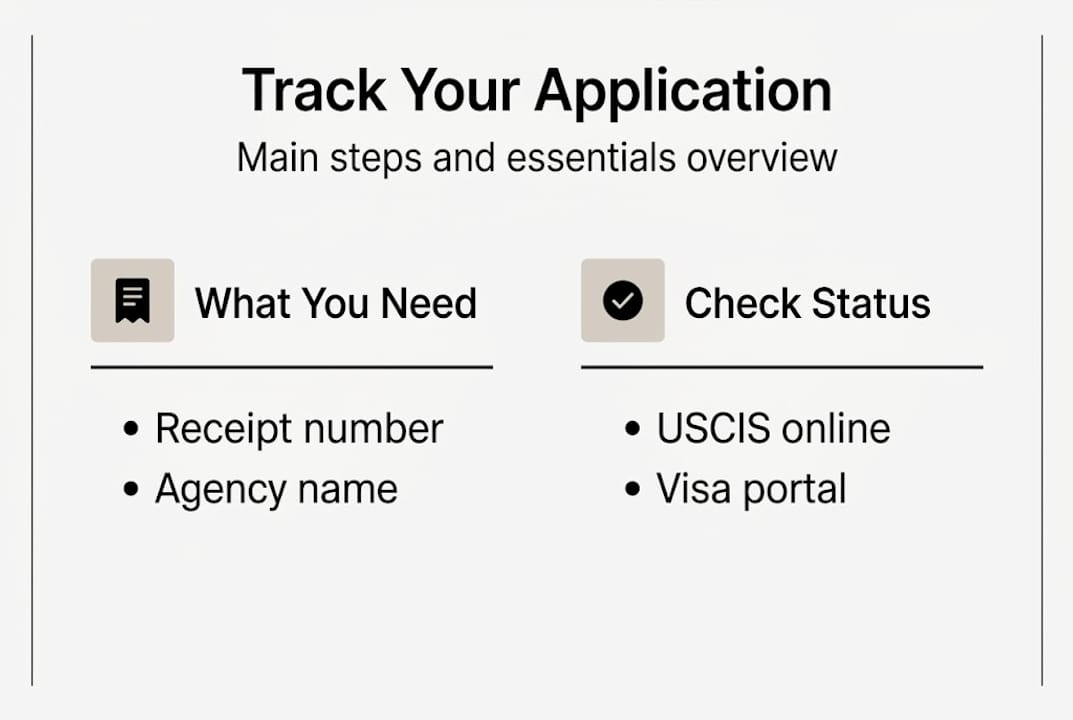
- Receipt number: A 13-character code printed on Form I-797C, the Notice of Action USCIS mails after receiving your filing. This is your primary key for USCIS tracking.
- Case number: Used for DOS visa tracking, found in correspondence from the National Visa Center (NVC).
- Applicant name and date of birth: Required for some portals and phone inquiries.
- Form type: Knowing whether you filed an I-130, I-140, or N-400 helps you select the right category when checking processing times.
Make sure your immigration document checklist is complete before filing, because errors at submission can delay the receipt notice itself.
Comparison of main tracking methods
| Method | Agency | Best for | What you need |
|---|---|---|---|
| USCIS Case Status Online | USCIS | All USCIS filings | 13-character receipt number |
| USCIS Contact Center (phone) | USCIS | Escalations, no internet | Receipt number, personal info |
| Visa Status Check portal | DOS | Immigrant and nonimmigrant visas | NVC case number |
| SAVE CaseCheck | DHS | Benefit verification only | Not for main application tracking |
Always use official government websites ending in .gov. Third-party sites that charge fees for case checks are not legitimate. If you are unsure whether a site is official, check how other countries handle similar processes, like the EU visa status check, to understand how transparent government portals should look.
The primary method for tracking USCIS cases is the online Case Status tool using your 13-character receipt number from Form I-797C. For DOS cases, a completely separate portal applies. Always confirm which agency holds your file before searching.

Pro Tip: SAVE CaseCheck is designed only for agencies verifying immigration status for benefits. Do not use it to track your application progress. It will not show your petition or visa status.
Also make sure your mailing address and contact information are current with USCIS. Missed notices are one of the most common and avoidable problems. You can review keeping contact info updated as part of your overall filing strategy.
Step-by-step: How to check your USCIS or visa case status
Once you have your receipt number and know which agency holds your case, the actual tracking process is straightforward.
Checking USCIS case status online
- Go to uscis.gov/casestatus.
- Enter your 13-character receipt number exactly as it appears on Form I-797C. No spaces, no dashes.
- Click "Check Status."
- Read the status message carefully. Write it down with the date you checked.
- Scroll down to see if any action is required from you.
Checking by phone
If you do not have internet access or need to speak with someone, the USCIS Contact Center is available at 1-800-375-5283 for U.S. callers and 212-620-3418 for international callers. Phone lines are open Monday through Friday, 8 a.m. to 8 p.m. Eastern Time. Have your receipt number and personal information ready before calling.
Checking DOS visa status
For U.S. visas processed through the Department of State, use the Visa Status Check portal at ceac.state.gov. You will need your NVC case number. The portal distinguishes between immigrant visas (like IR-1 or F2A) and nonimmigrant visas (like B-1/B-2 or F-1). Select the correct visa type to get accurate results.
Pro Tip: Each family member has a separate case file. If you filed for a spouse and two children, you have three receipt numbers. Track each one individually. Missing a notice on a dependent's file can delay the entire family's case.
2026 processing benchmarks
| Form | Category | Estimated time (80th percentile) |
|---|---|---|
| I-130 | U.S. citizen spouse | ~14.5 months |
| I-485 | Family-based adjustment | 6 to 18 months |
| N-400 | Naturalization | 5.5 to 9.5 months |
| I-140 | Employment-based | Varies by preference |
For more on checking visa status and understanding what each stage requires, reviewing your full filing checklist is a smart first step. If you are on an employment path, the EB-3 visa process has specific timelines worth understanding separately.
Understanding your USCIS status updates and processing times
Seeing a status update is one thing. Understanding what it actually means for your timeline is another.
Common USCIS status terms decoded
These are the most frequent statuses you will encounter:
- Case Was Received: USCIS has your application and issued a receipt. No action needed yet.
- Case Is Being Actively Reviewed: An officer is reviewing your file. This can last weeks or months.
- Request for Evidence (RFE): USCIS needs more documents. You must respond by the deadline stated in the notice.
- Interview Scheduled: You have been assigned an interview date. Prepare your documents immediately.
- Case Approved: Your application was granted. Watch for the approval notice or document in the mail.
- Case Denied: Your application was not approved. The notice will explain why and whether you can appeal.
What to do if you receive an RFE
An RFE is not a denial. It is a request for clarification or additional evidence. Here is how to handle it:
- Read the entire RFE notice before doing anything else.
- Note the response deadline. Missing it can result in denial.
- Gather every document requested, even if you think it is unnecessary.
- Organize your response clearly and include a cover letter.
- Send your response via a trackable mail method.
- Review the USCIS evidence guide to make sure your submission is complete.
Status updates are not real-time. A status of "Actively Reviewed" can sit unchanged for months during high-volume periods. This does not mean your case is lost or ignored. It reflects the volume of cases in the system.
For processing times, the USCIS tool lets you select your specific form, category, and field office to see how long 80% of similar cases take. The 2026 benchmarks show I-130 for a citizen spouse averaging about 14.5 months, N-400 naturalization running 5.5 to 9.5 months, and I-485 family adjustment ranging from 6 to 18 months at the 80th percentile. These numbers shift regularly, so check the tool directly for your specific situation.
Troubleshooting delays and next steps if your case stalls
Sometimes tracking is not enough. If your case has exceeded posted processing times, it is time to take action.
How to submit an e-Request inquiry
- Go to egov.uscis.gov/e-request.
- Select the type of inquiry: outside normal processing time or non-delivery of a document.
- Enter your receipt number and confirm your case exceeds the posted processing time.
- Submit the inquiry. USCIS will respond within 30 to 60 days in most cases.
If you submit an e-Request and receive no useful response, the next step is contacting your congressional representative's office. Congressional offices have liaisons who can make formal inquiries to USCIS on your behalf. This often produces faster responses than standard channels.
Requesting an expedite
An expedite request asks USCIS to move your case faster than normal. Expedite requests are reviewed case-by-case and may be granted for severe financial loss, humanitarian emergencies, nonprofit work in the national interest, or a USCIS error. Submit your request through the USCIS Contact Center and include supporting evidence. Be specific and factual.
Pro Tip: Expedite requests are discretionary. USCIS is not required to grant them. Do not assume approval. If your form is eligible, premium processing is a more reliable way to get faster action, though it does carry a separate fee.
Handling edge cases
If you moved, update your address online immediately to avoid missed notices. If you need original documents returned before your case closes, you can make a request, but USCIS recommends waiting until the end of the process when possible. If your case involves immigration court, contact the EOIR hotline at 1-800-898-7180 for status updates separate from USCIS.
For cases with complex delays, legal help for delays can make a real difference. Understanding premium processing advice and strategic petition support are also worth exploring if your situation is time-sensitive.
Expert insights: What most applicants overlook when tracking cases
Here is something we see constantly: applicants checking their case status multiple times a day, convinced that more checking will somehow speed things up. It does not. Status updates are not real-time. A status like "Actively Reviewed" can sit unchanged for months due to backlogs. Checking it 20 times a week produces the same result as checking it once.
What actually matters is staying organized, keeping records of every notice and correspondence, and knowing exactly when your case crosses into delayed territory based on official benchmarks. That is when action is warranted.
The other thing applicants overlook is scam exposure. Unofficial sites that mimic government portals are common. If a site asks for payment to check your status or promises faster processing for a fee, it is not legitimate.
For those who genuinely need speed, expedite requests are an option, but they are discretionary and rarely granted without strong documented evidence. Premium processing, where eligible, is a more predictable route. And if your filing has errors or gaps, no amount of tracking fixes that. Review filing tips to avoid errors before you submit, not after.
Reliable support for your immigration application journey
Tracking your case is one piece of the puzzle. Filing accurately, responding to requests on time, and knowing when to escalate are what truly protect your application.

At True Ventures, LLC in Minneapolis, we work with immigrants and families at every stage of the process. From initial filing to complex delays, our team brings firsthand experience and professional precision to every case. Whether you need immigration filing assistance, want to explore our full range of immigration legal consultants, or are looking for additional immigration services tailored to your situation, we are here to help. Reach out today and take the next step with a team that understands what is at stake.
Frequently asked questions
Where can I find my USCIS receipt number?
Your USCIS receipt number is printed on Form I-797C, the Notice of Action mailed to you after USCIS receives your application. It is a 13-character code starting with three letters.
How often should I check my case status?
Check once a week or after you expect a major action. Status updates do not change in real time, so daily checks rarely show anything new and add unnecessary stress.
How do I know if my case is delayed?
Use the official USCIS processing times tool to compare your wait against posted benchmarks for your specific form and office. If your case exceeds those times, it qualifies as delayed.
What is an expedite request and when can I use it?
An expedite request asks USCIS to prioritize your case. It is considered only for documented urgent situations like financial hardship, humanitarian emergencies, or USCIS error. Approval is not guaranteed.
Can I update my address while my case is pending?
Yes. Update your address online through the USCIS website as soon as you move to make sure all notices reach you without delay.
Recommended
- Understanding the U.S. Green Card Process: A Step-by-Step Guide for Immigrant Families
- U.S. Immigration Document Checklist: What Every Applicant Needs
- Comprehensive Immigration Support: Navigating the U.S. System with Precision
- Navigating Immigration Filing: Tips to Avoid Errors
- Moldova Digital Nomad Visa: 2025 Guide | Incorpore