

If you've ever searched for help with a U.S. immigration form, you've likely seen dozens of services calling themselves "immigration consultants," "notarios," or "visa specialists." The confusion is real, and unfortunately, so are the consequences of choosing the wrong help. USCIS warns that immigration consultants generally cannot provide immigration legal advice or legal strategy unless they are an attorney or a DOJ-accredited representative. Understanding that single distinction could protect your case, your money, and your future in this country.
Table of Contents
- Defining immigration consulting: Roles, boundaries, and myths
- What immigration consultants do: Practical workflow for key forms
- Legal boundaries and risk management: Why verification matters
- Regulation and consumer protection for immigration consulting
- Our perspective: What most people miss about immigration consulting
- Get compliant filing help: Immigration consulting with True Ventures
- Frequently asked questions
Key Takeaways
| Point | Details |
|---|---|
| Consultants assist with paperwork | Immigration consultants help assemble and organize forms but cannot give legal advice. |
| Legal advice is tightly regulated | Only attorneys or DOJ-accredited representatives may provide immigration legal advice or strategies. |
| Verification is crucial | Clients should always verify consultant credentials and registration to avoid scams. |
| Regulation varies by state | State laws can require consultants to register or provide disclosures before assisting clients. |
| Compliance protects outcomes | Following legal boundaries and compliance checks ensures safer immigration filing for families and individuals. |
Defining immigration consulting: Roles, boundaries, and myths
Many people assume that anyone advertising immigration services can guide them through every step, including giving advice on strategy, eligibility, or what to do if USCIS denies a petition. That assumption is wrong, and it's one of the most common reasons cases fall apart.
Immigration consulting refers to non-lawyer assistance for immigration paperwork and procedures. Consultants help you fill out forms, gather supporting documents, and organize your package. What they cannot do is provide immigration legal advice unless they are attorneys or DOJ-accredited representatives. This is not a gray area. It is a federal and state-level legal boundary.
The USCIS guide overview breaks down exactly how USCIS classifies who can help with filings. The difference between administrative support and legal advice is enormous in practice. Unauthorized practice of immigration law (often abbreviated as UPIL) happens when someone without credentials gives legal guidance, and it is illegal.
Here are some myths that put applicants at serious risk:
- Myth: Any immigration consultant can tell you which visa to apply for. Reality: Visa eligibility analysis is legal advice and must come from an attorney or accredited representative.
- Myth: Consultants can represent you if USCIS sends a Request for Evidence (RFE). Reality: Only attorneys and accredited reps can represent clients before USCIS.
- Myth: Paying more means better legal protection. Reality: A non-attorney charging high fees is still not qualified to give legal advice.
- Myth: Notarios have special legal authority in the U.S. Reality: In Latin American countries, notarios often hold legal credentials. In the U.S., that title carries no legal authority whatsoever.
"Not everyone who offers immigration assistance is authorized to do so. Using the wrong person could result in your case being denied, your money being lost, and even deportation." — USCIS
The volume of immigration scam cases is staggering. People lose thousands of dollars and sometimes their immigration status because they trusted someone who claimed to be more than they were. Knowing the real scope of what consultants can and cannot do is not just helpful. It is protective.
Gathering the right evidence for your petition is one area where consultants genuinely add value. The USCIS evidence gathering process can feel overwhelming, and having someone organized and knowledgeable about document requirements makes a real difference. That is where legitimate consulting shines.

What immigration consultants do: Practical workflow for key forms
Now that you understand the legal boundaries, it helps to see exactly what a legitimate immigration consultant does in the day-to-day filing process. The answer is quite a lot, as long as it stays on the administrative side.
Consulting commonly involves assisting with major USCIS filings including I-130, I-485, I-140, and H-1B, but it strictly avoids legal advice or representation. Within those limits, there is meaningful, practical support that helps families and individuals avoid costly errors.
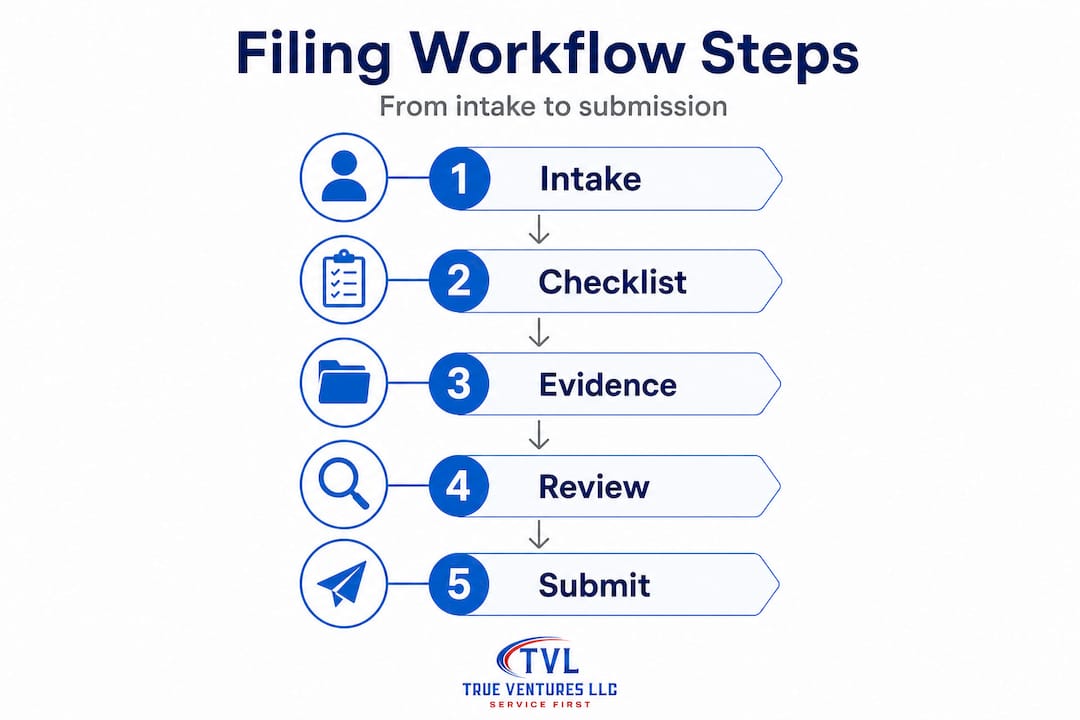
Here is a typical step-by-step flow for a family-based immigration case involving both the I-130 and I-485:
- Initial document review: The consultant reviews your identification, relationship documents, and any prior immigration history to understand what evidence you will need.
- Form completion assistance: The consultant walks you through each question on the I-130 petition, flagging areas that commonly cause confusion (such as address history and prior marriages).
- Evidence checklist preparation: You receive a tailored checklist of supporting documents based on your specific family relationship (spouse, parent, sibling, etc.).
- Document organization: Once you gather your documents, the consultant organizes them in the exact order USCIS expects, reducing the risk of a rejection notice.
- I-485 package assembly: When the priority date becomes current, the consultant helps compile the adjustment of status package, which often includes dozens of supporting documents.
- Filing check before submission: A final review of completeness, signatures, fees, and photo requirements before the package goes to USCIS.
The family immigration workflow guide offers deeper guidance on how these steps connect across multiple forms and timelines.
Here is a quick comparison of the major forms consultants typically assist with:
| Form | Purpose | Consultant role |
|---|---|---|
| I-130 | Petition for alien relative | Document assembly, form completion |
| I-485 | Adjustment of status | Evidence checklist, package organization |
| I-140 | Immigrant petition for alien workers | Supporting document preparation |
| H-1B | Specialty occupation work visa | Paperwork coordination, document gathering |
One thing worth noting: the immigration petition steps for sponsoring a family member involve a specific sequence. Missing a step or filing forms out of order can add months or even years to the process. A well-organized consultant helps you avoid that.
Pro Tip: Always ask your consultant for a written checklist before you start gathering documents. A good consultant provides one upfront. If they cannot tell you exactly what documents you need, that is a warning sign.
Understanding the consultation workflow from intake to filing submission is also useful for setting your own expectations. When you know the process, you are less likely to be misled about timelines or requirements.
Legal boundaries and risk management: Why verification matters
Immigration consultants operate in a space where the risks to clients are unusually high. One wrong move, one misleading piece of advice, and you could face a denied petition, lost fees, or even removal proceedings. Understanding how to protect yourself is not optional. It is essential.
Immigration services scams are a known enforcement target, and ICE has actively pursued cases of unauthorized practice and fraud. The problem is widespread enough that federal and state agencies run dedicated enforcement programs to stop it.
Here is a side-by-side comparison of authorized versus unauthorized helpers to clarify who you should and should not rely on for legal matters:
| Type of helper | Can complete forms | Can give legal advice | Can represent before USCIS |
|---|---|---|---|
| Immigration attorney | Yes | Yes | Yes |
| DOJ-accredited representative | Yes | Yes | Yes |
| Registered immigration consultant | Yes | No | No |
| Notario (U.S.) | No | No | No |
| Unlicensed "visa specialist" | No | No | No |
Some states have moved to regulate immigration consultants more formally. Utah, for example, requires consultants to register with the state and provide written contracts and disclosures to clients. These state-level protections exist because too many people were harmed by unqualified operators.
Here is how to protect yourself when evaluating any immigration consulting service:
- Ask whether the consultant is registered with your state agency.
- Request a written service agreement before paying any fees.
- Confirm the consultant does not claim to be an attorney unless they are licensed.
- Check that they do not promise specific outcomes. Legitimate consultants can help with paperwork. They cannot guarantee approvals.
- Look for transparency. Good consultants are clear about what they can and cannot do.
The consultant compliance standards at True Ventures are built around exactly these principles. Transparency about scope is not just good ethics. It is the foundation of trustworthy service.
The compliance review importance is often underestimated by clients who just want their forms done quickly. But a missing signature or an incorrect date in the wrong field can trigger a Request for Evidence that delays your case by six months or more. Verification at every stage matters.
Pro Tip: Before signing any agreement with an immigration consultant, search their name or business name with your state attorney general's office. If there are complaints or disciplinary records, they will usually be accessible online.
If you ever feel uncertain about whether you need an attorney instead of a consultant, the attorney vs consultant roles breakdown explains clearly when legal counsel becomes necessary.
Regulation and consumer protection for immigration consulting
The regulatory environment for immigration consulting varies significantly across the United States. Some states have robust frameworks that protect consumers. Others have minimal oversight, leaving more room for bad actors.
State-level regulation can require immigration consultants to register, provide written contracts, and issue specific disclosures. In Utah, for example, consultants must register with the Division of Commerce unless they qualify for an exemption. Failure to register or misrepresenting credentials can result in criminal charges.
"A person may not engage in activity as an immigration consultant for compensation unless registered or exempt." — Utah Code, as enforced by the Utah Division of Commerce
This kind of language is powerful because it makes the standard clear. Being paid for immigration consulting without proper registration is not a technicality. It is a violation. Several states have enacted similar protections, and more are moving in that direction as the demand for immigration services grows.
Here is what consumers have the right to expect from any registered immigration consultant:
- A written contract stating the services to be provided and the total cost.
- A clear statement that the consultant is not an attorney and cannot give legal advice.
- A refund policy that complies with state law.
- A bond or other financial protection in some states.
- The consultant's registration number, available for verification.
Even in states without formal registration requirements, you still have protections through consumer fraud laws. If a consultant claims to be an attorney without a license or promises guaranteed results, those claims can be actionable.
The compliance review insights at True Ventures reflect our commitment to meeting and exceeding what these regulations require. Compliance is not a checkbox for us. It is the standard we hold ourselves to in every client interaction.
Understanding state regulations also helps you ask smarter questions. Instead of simply hoping a consultant is legitimate, you now know what to check, what to ask for in writing, and what red flags should make you walk away.
Our perspective: What most people miss about immigration consulting
Here is something most articles about immigration consulting will not tell you directly: the biggest risk is not using an unqualified consultant. The biggest risk is not knowing what questions to ask in the first place.
Clients come to us after working with someone who promised the world and delivered nothing. Sometimes the harm is financial. Sometimes it is much worse: a missed deadline, a misfiled form, or a case thrown into a legal problem that now requires an attorney to fix. The sad reality is that these situations were often preventable.
People treat immigration consulting like a shortcut to a complicated system. But the value of good consulting is not speed. It is accuracy, organization, and honest communication about what falls outside the consultant's scope. The consultants who do this work well are the ones who say "you need an attorney for that" without hesitation, because they understand that protecting you sometimes means redirecting you.
We have firsthand experience navigating immigration systems as immigrants ourselves. That perspective changes how we approach every client file. We know what it feels like to wonder whether a form was filled out correctly, to wait on a response from USCIS, to worry that one small error could mean starting over. That lived understanding is why we are deeply committed to streamlining immigration workflow in a way that does not cut corners on compliance.
Our strongest advice: choose a consultant who is upfront about what they cannot do. That honesty is a feature, not a limitation.
Get compliant filing help: Immigration consulting with True Ventures
Navigating USCIS paperwork without the right support can feel like reading a legal document in a foreign language while the clock is ticking. The good news is that you do not have to figure it out alone.

At True Ventures, LLC in Minneapolis, Minnesota, we provide compliant, transparent legal filing assistance for families and individuals working through I-130, I-485, I-140, and H-1B filings. Our team operates with full clarity about the scope of consulting services, and we always refer clients to qualified attorneys when legal advice is needed. Explore our True Ventures offerings to see how we can support your immigration journey with accuracy, empathy, and integrity. Your case deserves more than guesswork.
Frequently asked questions
Can an immigration consultant provide legal advice for U.S. immigration?
No. Only attorneys or accredited reps can provide legal advice. Consultants are limited to administrative tasks like form completion and document organization.
What immigration forms can consultants help with?
Consultants commonly assist with forms like I-130, I-485, I-140, and H-1B by helping gather, organize, and prepare supporting documentation for submission.
How can I verify that an immigration consultant is legitimate?
Check consultant registration with your state agency and confirm they do not claim attorney status or offer legal advice without proper credentials.
What are the risks of using a non-accredited immigration consultant?
The risks include scams, unauthorized practice, and damaged cases. ICE actively targets immigration fraud, so always verify credentials and demand written service agreements before paying.