
Family immigration is one of the most emotionally charged processes anyone can go through, and it is also one of the most paperwork-heavy. Many families start the journey without a clear picture of what lies ahead, only to face unexpected delays, confusing requirements, or costly errors that push their timeline back by months or even years. Understanding the full family immigration process before you file your first form is not just helpful, it is essential. This guide walks you through every major stage so you can move forward with confidence and avoid the most common pitfalls that derail even well-intentioned families.
Table of Contents
- What is the family immigration workflow?
- Essential documents and requirements for a smooth start
- Step-by-step family immigration workflow (I-130, I-485, and more)
- Common roadblocks and how to avoid them
- The real secret: Proactive organization and understanding your timeline
- Get help with your family immigration journey
- Frequently asked questions
Key Takeaways
| Point | Details |
|---|---|
| Start with I-130 | All family immigration cases begin with a properly filed Form I-130, establishing the family relationship. |
| Strong evidence prevents delays | Submitting complete, consistent documents and affidavits reduces the risk of requests for evidence and denials. |
| Process timing matters | Immediate relatives move faster, while preference categories face annual caps and significant wait times. |
| Know troubleshooting steps | If you receive an RFE or denial, you can respond, appeal, or refile to keep your case moving. |
| Organization is key | Tracking your requirements and watching procedural updates helps your family immigration workflow succeed. |
What is the family immigration workflow?
The family immigration workflow is the sequence of steps a U.S. citizen or lawful permanent resident (LPR) must complete to help a qualifying relative gain lawful permanent residence, also known as a green card. Think of it as a relay race: every leg of the race depends on the previous one being completed correctly. Miss a handoff, and the whole team loses time.
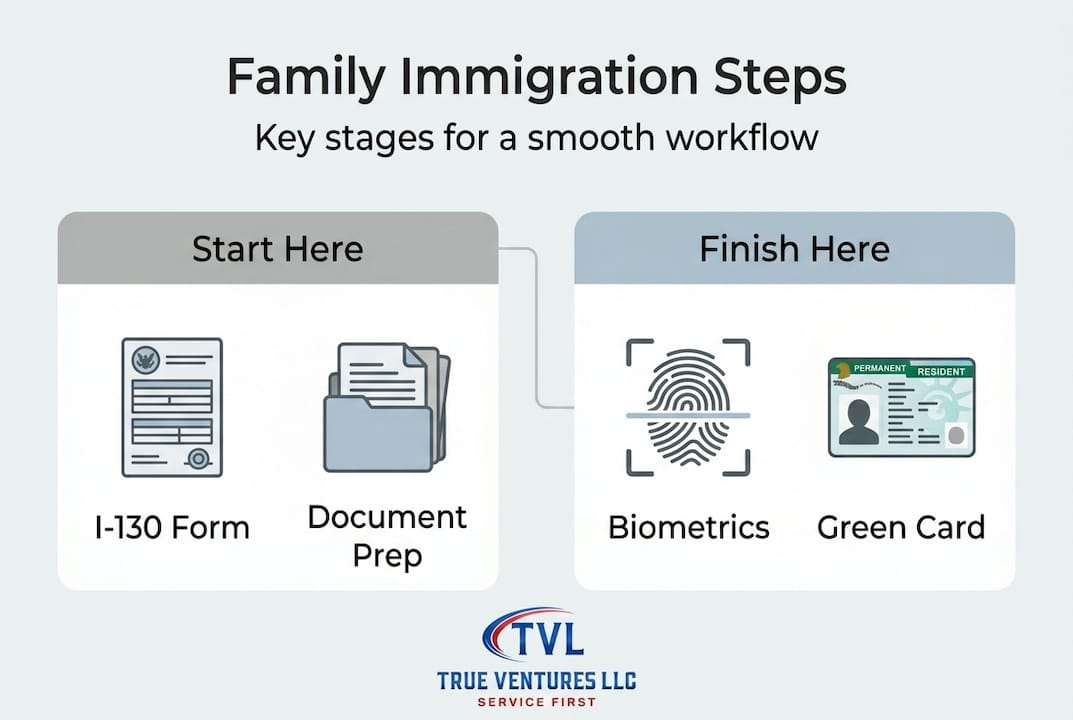
The core stages of the workflow look like this:
- Filing a petition (Form I-130) to establish a qualifying family relationship
- USCIS approval of the petition
- Waiting for a visa number to become available (for preference categories)
- Either adjusting status in the U.S. using Form I-485, or completing consular processing abroad through the National Visa Center (NVC) and Form DS-260
- Submitting a financial sponsor affidavit (Form I-864)
- Attending a biometrics appointment and interview
- Receiving the green card
The full green card workflow may look linear on paper, but in practice it has branches and decision points. The biggest one is whether your relative is already inside the U.S. or living abroad, which determines whether you pursue adjustment of status or consular processing.
Where does Form I-140 fit? In a purely family-based case, it does not. Form I-140 is for employment-based petitions, where an employer sponsors a foreign worker for permanent residence. Some families confuse the two forms because both are "immigrant petitions," but for family cases, Form I-130 is the starting and central document. Understanding the many immigration visa types helps you recognize immediately which pathway applies to your family situation.
Processing times in 2026: what you should expect
Timing is one of the most misunderstood parts of this process. Many families assume approval takes a few weeks. The reality is much longer. I-130 processing times in 2026 average 17 months for immediate relatives at service centers, and can exceed 60 months at field offices. Preference categories face even steeper waits: the F4 sibling category, for example, sits at 95 to 173 months due to annual visa caps.
| Relationship category | Average I-130 wait (2026) | Visa cap? |
|---|---|---|
| Immediate relatives (spouse, child, parent of U.S. citizen) | 17 months (service center) | No |
| F1: Unmarried adult children of U.S. citizens | 7 to 10 years | Yes |
| F2A: Spouses/children of LPRs | 2 to 3 years | Yes |
| F4: Siblings of U.S. citizens | 8 to 14+ years | Yes |
These timelines reinforce why starting early and filing correctly the first time matters so much. Even one Request for Evidence (RFE) can add 3 to 5 months to your timeline.
Essential documents and requirements for a smooth start
With the broader workflow in mind, preparation comes down to organizing your documents and understanding requirements. Think of your initial filing package as a legal argument: you are proving to USCIS that your relationship is real, your petition is eligible, and your sponsor can financially support the immigrant. Weak arguments get questioned. Strong arguments move faster.
Sponsor responsibilities vs. beneficiary responsibilities
| Responsibility area | Petitioner/Sponsor (U.S. citizen or LPR) | Beneficiary (the relative abroad or in U.S.) |
|---|---|---|
| Filing Form I-130 | Yes | No |
| Submitting Form I-864 (Affidavit of Support) | Yes | No (but must submit I-864A if a household member) |
| Providing relationship evidence | Shared | Shared |
| Submitting civil documents (birth, marriage) | Varies | Primary responsibility |
| Attending interview | Sometimes | Yes |
Documents you will typically need:
- For the petitioner: Proof of U.S. citizenship or LPR status (passport, naturalization certificate, or green card), government-issued ID, and tax returns for the past 3 years to support the I-864
- For the relationship: Marriage certificate (for spouses), birth certificates (for parent-child relationships), adoption decrees, or other legal documents proving the qualifying tie
- For the beneficiary: Valid passport, civil documents such as birth certificate and any prior marriage termination records, police clearance, and medical examination results (Form I-693, completed by a USCIS-designated civil surgeon)
- For bona fide marriage claims: Joint bank account statements, shared lease agreements, utility bills in both names, photos together across different time periods, and affidavits from people who know the couple
Collecting strong USCIS evidence from the very beginning saves enormous time later. Weak or inconsistent documentation is the number one trigger for RFEs.
Pro Tip: Use a consistent set of names across all documents. If your spouse uses a middle name on their passport but not on the marriage certificate, USCIS may flag the discrepancy. Include a brief explanation letter (cover letter) with your filing package to address any name differences or missing documents proactively.
Strong initial evidence is especially important because all cases, even those for immediate relatives who process faster, still require an I-864 affidavit ensuring the sponsor earns at or above 125% of the federal poverty level. If you fall short of that threshold, you may need a joint sponsor. Knowing this before you file prevents a scramble later.
Use an immigration document checklist as your organizing backbone. A physical or digital checklist that tracks what you have, what needs to be translated, and what still needs to be obtained will keep the process from feeling overwhelming.
Step-by-step family immigration workflow (I-130, I-485, and more)
Once requirements are in hand, you are ready to move to filing and step-by-step execution. Here is how the process flows from petition to green card.

1. File Form I-130
The petitioner files Form I-130 either online through the USCIS website or by mail to the appropriate USCIS service center or lockbox. This form establishes the qualifying family relationship. Include all supporting evidence at this stage to minimize the chance of an RFE. Pay the required filing fee (currently $675 online or $820 by mail as of 2026).
2. Wait for USCIS to adjudicate the petition
After filing, USCIS will issue a receipt notice (Form I-797). Keep this. It contains your case number and allows you to track progress online. This stage can take anywhere from several months to over a year depending on your relationship category and the processing center.
3. Determine your next step based on where the beneficiary lives
This is the most important decision point in the workflow. The full green card process splits here into two branches.
- Adjustment of status (if the beneficiary is already in the U.S.): File Form I-485 concurrently with I-130 if your relative is an immediate relative and a visa is immediately available. Concurrent filing of I-130 and I-485 is allowed for immediate relatives, allowing parallel processing and saving months of waiting.
- Consular processing (if the beneficiary is abroad): After I-130 approval, USCIS transfers the case to the National Visa Center (NVC). The NVC collects civil documents, fees, and Form DS-260 (the immigrant visa application), and then schedules a visa interview at the U.S. consulate or embassy in the beneficiary's country.
4. Attend biometrics and interview
Whether adjusting status or going through consular processing, your relative will have biometrics taken (fingerprints and photo) and attend an in-person interview. Prepare thoroughly by reviewing all submitted documents together before this appointment.
5. Complete the medical examination
Form I-693 is required for all adjustment of status applicants. The exam must be completed by a USCIS-designated civil surgeon. For consular processing, the medical exam is done at a panel physician authorized by the consulate.
6. Submit Form I-864 (Affidavit of Support)
This form legally obligates the sponsor to financially support the immigrant until they become a U.S. citizen or earn 40 work quarters (about 10 years of work history). This is not optional, and an incomplete I-864 is one of the top reasons for delays.
Pro Tip: Review detailed petition guidance to make sure you are filing each form correctly for your exact situation. Small errors like missing signatures or wrong dates cause avoidable rejections.
7. Receive the green card
After the interview is approved and all checks clear, USCIS or the consulate issues the green card. For adjustment of status applicants, the card is mailed to the U.S. address on file. For consular processing, the visa is placed in the beneficiary's passport for entry, and the green card arrives by mail after they enter the U.S.
Need personalized support at each of these stages? Explore immigration consultation steps to understand how professional guidance fits into your workflow.
Common roadblocks and how to avoid them
Even the best-prepared families can encounter issues. Here is how to spot and fix the most common challenges before they derail your timeline.
The top pitfalls families face:
- Incomplete relationship evidence: USCIS requires proof that is current and thorough. A few old photos or one bank statement rarely suffice for proving a bona fide marriage.
- Name discrepancies across documents: A middle name used on one document but not another can trigger a lengthy RFE.
- Missing prior marriage termination records: If either party was previously married, you must submit divorce decrees or death certificates. Forgetting this is surprisingly common.
- Insufficient financial documentation: Many sponsors underestimate how thoroughly USCIS reviews income. Missing a tax year or submitting an unsigned return can stall the I-864 review.
- Incorrect or outdated forms: USCIS updates form editions regularly. Submitting an older version of any form results in automatic rejection.
Edge cases that require extra attention:
Common RFE triggers include proving bona fide marriages through joint finances, photos, and affidavits; prior marriage terminations; step and adopted relationships; name discrepancies; and foreign document translations. An RFE adds 3 to 5 months to your timeline, sometimes more.
For stepchildren, you must show that the marriage creating the stepparent relationship occurred before the child turned 18. For adopted children, you typically need to prove a 2-year legal custody and joint residence requirement under U.S. immigration law.
"An overlooked discrepancy in a name or a missing foreign language translation can turn a 6-month process into a 12-month ordeal. Treat every document as evidence in a legal case, because it is."
What to do when things go wrong:
If you receive an RFE, respond fully and on time. USCIS gives you 87 days in most cases. Send every piece of evidence you can find that directly addresses what the officer asked for, along with a clear cover letter explaining how the evidence answers the request.
If your I-130 is denied, I-130 denial options include filing an appeal using Form EOIR-29 with the Board of Immigration Appeals, filing a motion to reopen or reconsider using Form I-290B, or refiling a new petition with stronger evidence. Each path has different timelines and costs, so evaluate carefully.
Handling immigration delays requires patience and strategy. Do not assume silence means progress. Monitor your case status online, keep copies of everything, and know when to escalate by contacting USCIS or the NVC directly.
The real secret: Proactive organization and understanding your timeline
After working alongside families through the immigration process, one truth stands out above all else: most delays are not caused by the system. They are caused by underpreparation.
Families spend enormous energy worrying about the outcome of their petition, but very little time tracking the Visa Bulletin or understanding how their specific preference category affects their timeline. The State Department publishes the Visa Bulletin monthly and knowing your priority date versus the current cut-off date tells you exactly where you stand in line. Families who monitor this avoid the shock of unexpected waits.
Checklists are not bureaucratic busywork. They are the single most powerful tool in this process. A well-maintained checklist that tracks every document's translation status, expiration date, and submission history gives you a live picture of where delays might emerge before they happen.
Planning for edge cases is an investment, not a setback. Yes, translating 10 foreign documents by a certified translator costs time and money. But it costs far less than the 4 to 5 months an RFE adds to your timeline. The families who move quickly are the ones who treated preparation as their first filing.
Get help with your family immigration journey
Navigating forms, evidence requirements, and strategic decisions in family immigration is a lot to handle on your own. Whether you are just starting with Form I-130 or dealing with an RFE mid-process, professional guidance makes a measurable difference.
At True Ventures, LLC, we specialize in walking families through every step of the immigration process with accuracy, empathy, and real experience. Our team has firsthand knowledge of what it takes to reunite families across borders, and we bring that understanding to every case we support. Explore our immigration consulting services for a full picture of how we can help you. When you are ready for hands-on support with filing, our immigration filing assistance service is built to make the process smoother, faster, and far less stressful. Contact us today for a tailored plan designed around your family's specific situation.
Frequently asked questions
How long does the family immigration workflow take in 2026?
Processing times vary based on relationship category. Immediate relatives of U.S. citizens average 17 months at USCIS service centers, while sibling petitions (F4 category) can take 8 to 14 or more years due to visa backlogs.
Who can a U.S. citizen or permanent resident sponsor through family immigration?
U.S. citizens can petition for spouses, unmarried children of any age, parents (if the petitioner is 21 or older), and siblings. Lawful permanent residents can only sponsor spouses and unmarried children.
What happens if my I-130 petition is denied?
You have three options after a denial: file an appeal using Form EOIR-29, submit a motion to reopen or reconsider using Form I-290B, or refile a new petition with stronger supporting evidence.
Is Form I-140 required for family-based immigration?
No. Form I-140 is specifically for employment-based immigration where an employer petitions for a foreign worker. Family-based cases use Form I-130 as the foundational petition and I-140 plays no role in a purely family-based workflow.