

Your immigration case could be rock-solid on paper, yet still get delayed or denied because of missing documents or a disorganized submission. In fact, incomplete or insufficient evidence is one of the most common reasons USCIS issues Requests for Evidence (RFEs) or outright denials. The good news? This is entirely preventable. This guide walks you through exactly how to identify, collect, and present your immigration evidence in a way that gives reviewers everything they need to say yes. Whether you are filing an I-130, I-485, or another petition, these practical steps will help you move forward with confidence.
Table of Contents
- Understanding immigration evidence requirements
- Preparing your evidence: What to collect and how
- Organizing and presenting your evidence for success
- Handling special cases: RFEs, gaps, and challenging proof
- What most applicants overlook: Lessons from immigration professionals
- Ready to strengthen your case? Get expert support
- Frequently asked questions
Key Takeaways
| Point | Details |
|---|---|
| Prioritize primary evidence | Always collect official documents first, and only use secondary evidence when a valid explanation is provided. |
| Organization improves outcomes | Label, sort, and present your evidence clearly to reduce review time and avoid unnecessary delays or RFEs. |
| Respond quickly to RFEs | Meet all deadlines with organized, point-by-point evidence sets to protect your case from denial. |
| Consistency builds credibility | Ensure that all documents tell the same story to prove eligibility and earn trust from reviewers. |
Understanding immigration evidence requirements
Before you start gathering documents, you need to understand what USCIS actually expects. Not all evidence carries the same weight, and knowing the difference between primary and secondary evidence can save you from costly mistakes.
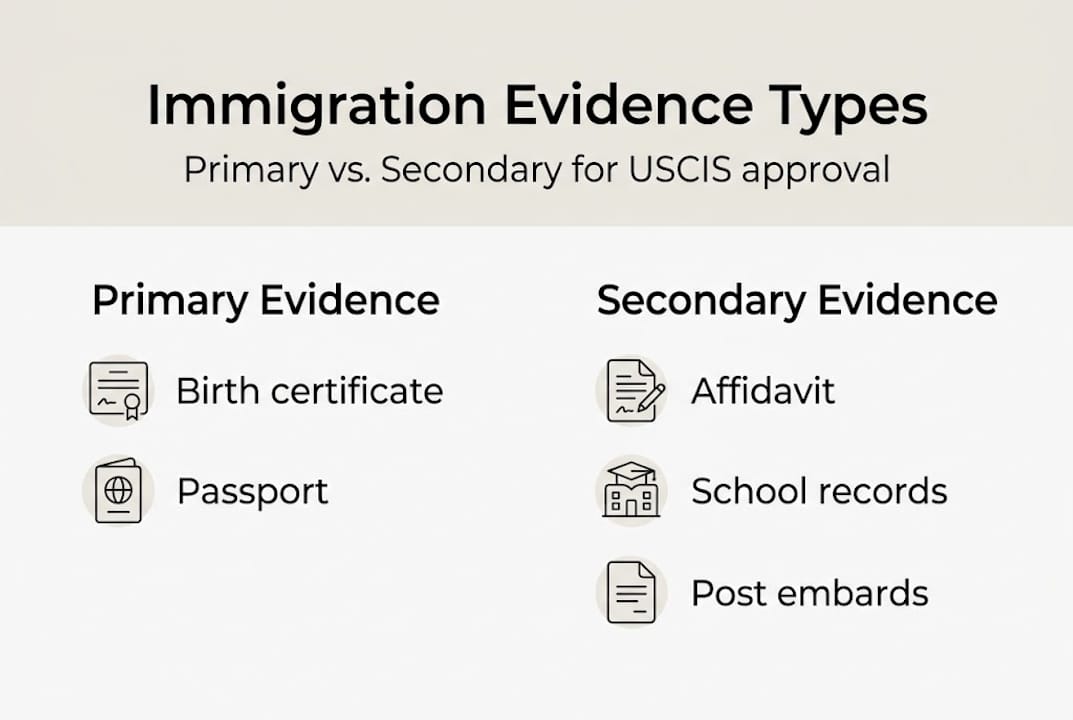
Primary evidence refers to official government-issued documents that directly prove a fact. Think birth certificates, marriage certificates, divorce decrees, and passports. USCIS requires primary evidence where available, such as official birth, marriage, or divorce certificates. These are your strongest documents, and you should always lead with them when they exist.
Secondary evidence steps in when primary documents are unavailable, lost, or never existed. Examples include:
- Affidavits from people with personal knowledge of the facts
- School records, church records, or baptismal certificates
- Medical records or hospital records
- Letters from government officials confirming a document cannot be obtained
If primary evidence is unavailable, applicants must explain its absence and then submit secondary evidence like affidavits or school records. You cannot simply skip a required document without explanation. USCIS needs to understand why the primary record does not exist before they will accept alternatives.
The legal standard USCIS uses is called preponderance of the evidence. This means your evidence must show it is more likely than not that your claim is true. You do not need to prove your case beyond a reasonable doubt like in a criminal trial. But you do need enough credible, consistent, and well-organized documentation to tip the scales in your favor.
Credibility matters enormously here. A single inconsistency between your application and your supporting documents can raise red flags. Dates, names, and addresses should match across every document you submit.
For non-English documents, certified translation is not optional. Every foreign-language document must be accompanied by a full English translation and a certification statement from a qualified translator. Skipping this step is a surprisingly common mistake that leads to unnecessary delays.
Before you begin collecting anything, review a thorough immigration document checklist to make sure you understand exactly what your specific form requires. A compliance review guide can also help you spot gaps before they become problems.
| Evidence type | Examples | When to use |
|---|---|---|
| Primary | Birth certificate, marriage certificate, passport | Always, when available |
| Secondary | Affidavits, school records, medical records | When primary is unavailable |
| Supporting | Photos, letters, financial records | To strengthen your overall claim |
Pro Tip: Always provide a certified English translation for every non-English document, including the translator's full name, signature, and a statement confirming their competence.
Preparing your evidence: What to collect and how
Once you understand which types of evidence matter, the next step is to gather all required documents and address any missing pieces before they become a problem.
Different USCIS forms have different evidence requirements. Here is a comparison of what three common forms typically require:
| Form | Key evidence required |
|---|---|
| I-485 (Adjustment of Status) | Passport photos, birth certificate, valid ID, entry evidence, I-693 medical exam, affidavit of support, criminal records |
| I-130 (Petition for Alien Relative) | Petitioner's proof of citizenship or residency, marriage certificate (if applicable), birth certificates, photos |
| I-140 (Immigrant Petition for Alien Workers) | Labor certification or job offer, educational credentials, employment records, expert letters |
For the I-485 specifically, USCIS requires passport photos, birth certificate, ID, entry evidence, I-693 medical exam, affidavit of support if needed, and criminal records. Missing even one of these items can trigger an RFE or rejection.
Here is a numbered process for collecting your documents efficiently:
- Start with what you have. Pull together every document you already own and check it against the official USCIS checklist for your specific form.
- Identify what is missing. Make a list of every required item you do not currently have in hand.
- Contact issuing authorities. For birth or marriage certificates, reach out to the vital records office in the country or state where the event occurred. Many countries allow requests by mail or through their embassy.
- Request certified copies. Always request certified copies, not photocopies. USCIS wants documents that can be verified.
- Handle overseas documents early. International documents take the longest. Start those requests first, sometimes weeks or months in advance.
- Draft affidavits where needed. If a document truly cannot be obtained, prepare a detailed affidavit from someone with firsthand knowledge of the facts.
Pro Tip: If a document is unavailable because the issuing country has no records system or the records were destroyed, get a letter from the relevant government authority confirming this. It strengthens your secondary evidence significantly.
For personalized help figuring out exactly what your case needs, immigration consultant support can walk you through the specific requirements for your form and situation.
Organizing and presenting your evidence for success
With your documents in hand, the way you present your evidence can make the difference between approval and delay. A disorganized submission tells the reviewer that you are not prepared, and that impression can color how they evaluate everything else.

Evidence must be organized, relevant, probative, and credible; evaluated under the preponderance standard. Submit all available evidence with your initial filing to avoid RFEs. Waiting to submit something until you are asked for it is a strategy that almost always backfires.
Here is how to structure your submission:
- Create a cover letter. Briefly explain what you are filing, why you are eligible, and what documents are included. Keep it factual and direct.
- Include a table of contents. List every document in the order it appears, with page numbers or tab references.
- Use labeled tabs or dividers. Each major document or category gets its own tab. Label them clearly so a reviewer can flip directly to what they need.
- Use consistent naming. If your name appears differently on different documents (a maiden name, a nickname, or a spelling variation), address it in your cover letter and provide an explanation.
- Include only what is relevant. More is not always better. Submitting unrelated documents adds confusion and bulk without adding value.
"Organization is key: use tabs, indexes, and cover letters matching RFE points to facilitate USCIS review." How to Respond to a USCIS RFE
One of the most overlooked risks is inconsistency. If your I-485 lists one address and your tax returns show another, USCIS will notice. Review every document side by side and reconcile any discrepancies before you submit. For a deeper look at avoiding these kinds of errors, the tips to avoid errors resource covers the most common pitfalls in detail. If you want a broader picture of how the process fits together, step-by-step immigration support offers a fuller framework.
Pro Tip: Make two complete copies of your entire submission before mailing. Keep one for your records and use the other as your reference if USCIS contacts you later.
Handling special cases: RFEs, gaps, and challenging proof
Even with good preparation, challenges can arise. Let's look at what to do if you hit a snag or receive an RFE.
An RFE is not a denial. It is USCIS asking for more information. How you respond determines what happens next. If USCIS issues an RFE, respond by the deadline (typically 30 to 90 days) with a cover letter, table of contents, and tabbed evidence. Missing the deadline almost always results in denial, so treat it as urgent from day one.
Here is a step-by-step approach to RFE responses:
- Read the RFE carefully. Identify every specific item USCIS is asking for. Do not guess or assume.
- Draft a point-by-point cover letter. Address each RFE item directly, referencing the tab or page where your evidence appears.
- Gather new or stronger evidence. If USCIS doubted a document's credibility, provide additional corroborating evidence alongside it.
- Use expert opinions when needed. For complex eligibility questions, a letter from a qualified expert (a doctor, a professor, or an industry specialist) can carry significant weight.
- Send via trackable mail. Use USPS certified mail or a courier service with tracking so you have proof of delivery.
Some cases involve particularly difficult proof requirements. Continuous presence is one example. For a T-visa, USCIS accepts pay stubs, tax returns, school records, and utility bills to document continuous presence, but you must also explain any gaps in the record.
When documents are missing or gaps exist, a consistent narrative supported by multiple smaller pieces of evidence is far more persuasive than one weak document.
Affidavits work best when they are specific, detailed, and signed under penalty of perjury. A vague affidavit that simply says "I know this person" adds little. One that describes specific events, dates, and personal observations is genuinely useful. For cases involving unusual complexity, understanding the role of attorneys in complex cases can help you decide when professional legal help is worth it.
What most applicants overlook: Lessons from immigration professionals
Here is something we see constantly at True Ventures: applicants spend enormous energy collecting documents but almost no time thinking about how those documents tell a story. USCIS reviewers process hundreds of files. A submission that is easy to read, clearly labeled, and internally consistent moves faster and creates less doubt.
The biggest myth we encounter is that more documents automatically mean a stronger case. That is not true. A focused, well-labeled submission with 15 relevant documents beats a chaotic stack of 50 every time. Over-documenting without organization actually signals that you are not sure what matters.
Consistency is the real currency of a strong application. Every name, date, and address across every document should tell the same story. When they do, reviewers gain confidence. When they do not, doubt creeps in and RFEs follow.
Our honest advice? Treat your submission like a presentation to someone who has never met you and has 20 minutes to evaluate your entire life. Make it impossible to misunderstand. That mindset, more than any single document, is what separates approvals from delays. For families working through the green card process, the green card process guide offers a clear picture of what to expect at each stage.
Ready to strengthen your case? Get expert support
Putting together a complete, well-organized immigration submission takes time, attention to detail, and a clear understanding of what USCIS expects. If you want to make sure nothing is missed, working with experienced professionals can give you real peace of mind.

At True Ventures, LLC, we have helped immigrants across the country prepare strong, accurate submissions for I-130, I-485, I-140, and H-1B filings. Our team reviews your documents, identifies gaps, and helps you present your case clearly. Explore our immigration filing assistance to see how we can support your specific situation, or browse our full range of immigration consultant services to find the right fit for your case.
Frequently asked questions
What is considered primary immigration evidence?
Primary evidence includes official documents like birth, marriage, or divorce certificates that directly prove your eligibility. USCIS requires these whenever they are available before accepting any alternatives.
What should I do if I cannot obtain a primary document?
Submit a statement explaining why the document is unavailable, then provide secondary evidence such as affidavits, school records, or medical records. USCIS requires applicants to prove the document does not exist or cannot be obtained before accepting substitutes.
How should I organize my immigration evidence submission?
Use a table of contents, labeled tabs, and clearly divided sections so reviewers can locate each required item quickly. Tabs, indexes, and cover letters matched to specific requirements are the most effective organizational tools.
What happens if I receive a Request for Evidence (RFE)?
Respond before the deadline, typically 30 to 90 days, with a point-by-point cover letter and organized, tabbed evidence sent via trackable mail. A late or incomplete reply to an RFE almost always results in denial of your petition.
Recommended
- U.S. Immigration Document Checklist: What Every Applicant Needs
- Navigating Immigration Filing: Tips to Avoid Errors
- How Attorneys Improve Immigration Outcomes: A Guide
- Understanding the U.S. Green Card Process: A Step-by-Step Guide for Immigrant Families
- How to Swear an Affidavit: A Step-by-Step Guide - The Online Notary