

Starting a U.S. immigration petition for a family member can feel like standing at the base of a mountain with no trail map. The forms are dense, the timelines are long, and a single mistake can set your case back by months or even years. Many families give up before they begin, not because they lack the will, but because they lack a clear starting point. This guide breaks down the entire process into manageable stages, from confirming who you can sponsor to handling tricky edge cases, so you can move forward with confidence instead of guessing.
Table of Contents
- Who can you sponsor? Understanding eligibility and petition types
- Gathering documentation: What you'll need before you file
- Step-by-step: Filing your immigration petition
- Common pitfalls and how to avoid delays or denials
- Edge cases: Adoptions, VAWA, and life changes during your case
- What we've learned: Hard-won lessons from filing family immigration petitions
- Get professional help for your family's immigration petition
- Frequently asked questions
Key Takeaways
| Point | Details |
|---|---|
| Know eligibility | Understand who you can sponsor and which petition applies before starting the process. |
| Prepare documents early | Gather all necessary paperwork and evidence to support your family relationship and status. |
| Follow proven steps | Use a checklist and file online when possible to reduce mistakes and speed up processing. |
| Avoid common errors | Missing documents and incomplete forms are top reasons for delays and denials; double-check before filing. |
| Seek expert help when needed | For special situations like VAWA or adoption, professional guidance is valuable and can protect your petition. |
Who can you sponsor? Understanding eligibility and petition types
Not everyone living in the U.S. can sponsor a family member, and not every family relationship qualifies. Your ability to petition depends on your immigration status and who you want to bring over.
U.S. citizens have the widest sponsorship options. They can petition for spouses, unmarried children under 21, unmarried sons and daughters 21 and older, married sons and daughters, siblings 21 and older, and parents 21 and older. Lawful Permanent Residents (LPRs) have a narrower list: they can sponsor spouses and unmarried sons and daughters of any age.
The difference matters because it determines whether your relative is an immediate relative or falls under a preference category. Immediate relatives of U.S. citizens face no annual visa cap, meaning they move through the system faster. Preference categories, however, are subject to annual numerical limits, which can mean waits of several years.
Form I-130 is the primary petition for U.S. citizens or LPRs to sponsor eligible alien relatives for immigration. As clarified in the I-130 Instructions, eligible relatives for U.S. citizens include spouses, unmarried children under 21, unmarried sons and daughters 21+, married sons and daughters, siblings 21+, and parents 21+. LPRs may sponsor spouses and unmarried sons and daughters of any age.
Here is a quick comparison to make it easier:
| Petitioner status | Eligible relatives | Category | Visa cap? |
|---|---|---|---|
| U.S. Citizen | Spouse, children under 21, parents | Immediate Relative | No |
| U.S. Citizen | Adult unmarried/married children, siblings | Preference (F1, F3, F4) | Yes |
| LPR | Spouse, unmarried children (any age) | Preference (F2A, F2B) | Yes |
There are also special cases worth noting. VAWA petitions allow abused family members to petition independently. Adoptions follow their own eligibility rules. Life changes like marriage, divorce, or naturalization can shift your relative's category entirely. For a deeper look at what qualifies, our green card eligibility guide covers those nuances. Understanding the basics of immigration law also helps you frame these decisions properly before you file.
Gathering documentation: What you'll need before you file
After confirming eligibility, the next step is gathering the right paperwork for a petition that stands up to review. Missing even one document can trigger a Request for Evidence (RFE) and stall your case for months.
Every petition requires proof of your status as the petitioner, which means a U.S. birth certificate, valid passport, or green card. You also need relationship documents, such as birth certificates for children or marriage certificates for spouses. USCIS requires proof of petitioner status, relationship documents like birth and marriage certificates, and for spouses, evidence of a bona fide marriage.
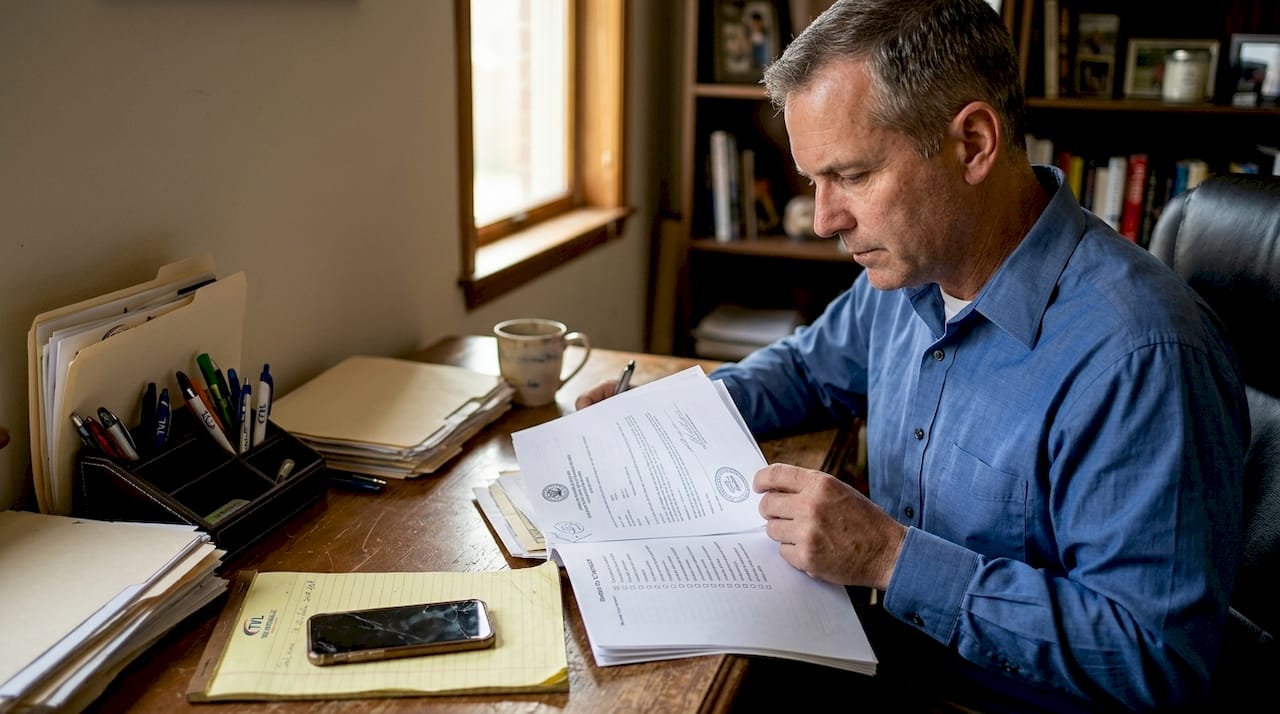
Spouse petitions deserve special attention. USCIS actively screens for marriage fraud, and vetting for fraud means you need robust evidence that your marriage is genuine. That includes joint bank statements, shared lease agreements, photos together over time, and correspondence.
Here is a quick checklist by relationship type:
| Relationship | Key documents needed |
|---|---|
| Spouse | Marriage cert, joint financials, photos, correspondence |
| Child under 21 | Child's birth cert, petitioner's proof of citizenship |
| Parent | Your birth cert (proving relationship), parent's ID |
| Sibling | Both birth certs showing shared parent |
A few best practices to streamline your filing:
- Organize by category: separate petitioner docs, relationship docs, and supporting evidence into labeled folders
- Use certified translations: all foreign documents must be translated into English by a qualified translator
- Match formats: online filing requires scanned copies; mail filing requires physical originals or certified copies
- Date everything: USCIS wants current, relevant evidence
Pro Tip: Download the official USCIS checklist specific to your petition type and use it as a cross-reference before you submit. Our immigration evidence requirements guide and document checklist resource can also help you stay organized.
Step-by-step: Filing your immigration petition
With your documents prepared, it's time to tackle the actual filing process. Getting it right the first time saves months of waiting and avoids unnecessary scrutiny.
Step 1: Choose online or mail filing. USCIS now allows online filing for many petitions. Online filing is faster, reduces errors, and lets you track your case in real time. Mail filing is still valid but adds processing time and room for postal issues.
Step 2: Complete Form I-130 carefully. Every field matters. Leave nothing blank. If a section does not apply, write "N/A." Sign the form in ink if mailing.
Step 3: Include the filing fee. As of 2026, fees for I-130 vary. Check USCIS for the current amount before submitting. A payment error will get your petition rejected without review.
Step 4: Assemble your evidence packet. Use your checklist. Organize documents in the same order the form requests them. Include a cover letter that lists every item enclosed.
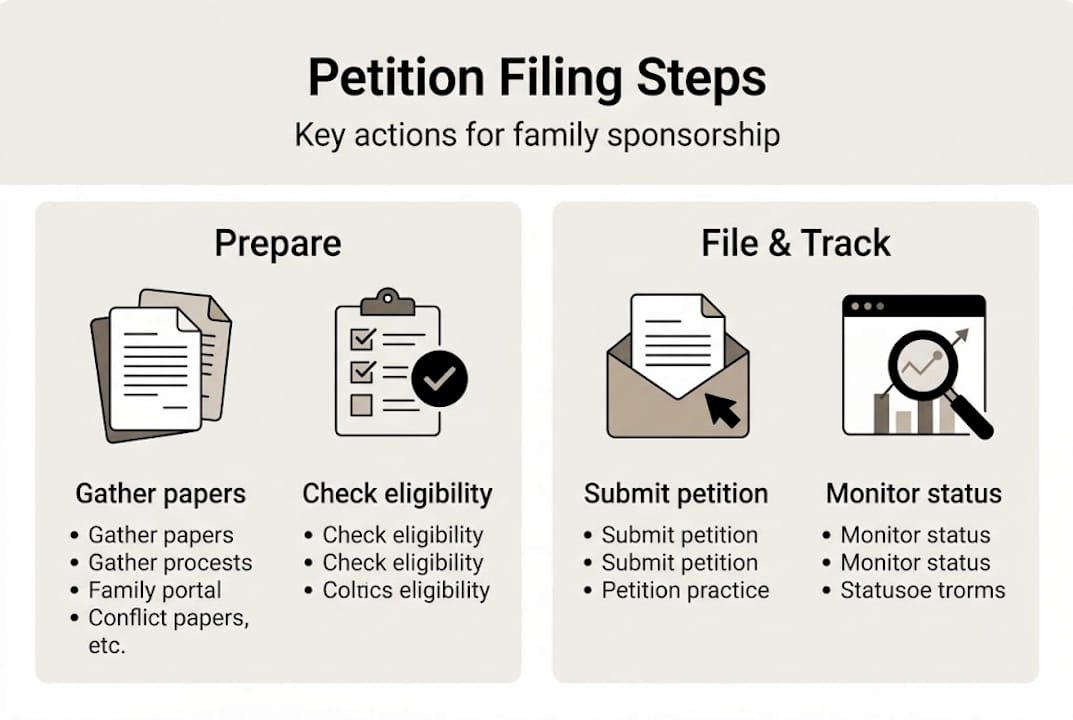
Step 5: Submit and save your receipt. USCIS will send a receipt notice (Form I-797). This is your proof of filing and includes your case number for tracking.
Step 6: Monitor your case. Use the USCIS online case tracker. Respond to any RFE immediately and completely. Delays in responding can lead to denial.
After I-130 approval, the next step depends on your relative's category. Immediate relatives proceed to I-485 adjustment of status or consular processing, while preference categories must wait for visa availability per the monthly Visa Bulletin.
Our consultation workflow resource walks through what to expect at each stage. For complex legal questions, a licensed immigration attorney through a resource like legal help for immigration can be a valuable safety net.
Pro Tip: Set a monthly calendar reminder to check the Visa Bulletin if your relative falls into a preference category. Visa priority dates move, and missing a window can mean losing months of progress.
Common pitfalls and how to avoid delays or denials
Even a well-prepared petition can be derailed by common mistakes. Knowing where families go wrong puts you in a much stronger position.
"An ounce of prevention is worth a pound of cure." Nowhere is this truer than in immigration filings, where a single missing signature can add six months to your case.
Denial rates in FY2025 show I-130 immediate relatives denied at roughly 7%, while other relatives face denial rates around 21.8%. Common causes include incomplete documents, failure to prove eligibility or a genuine relationship, and inadmissibility grounds.
Processing times for I-130 in 2026 show immediate relatives waiting about 14.5 to 17 months at the 80th percentile, while family preference categories can wait 60 or more months depending on the service center and country of origin.
Here is a comparison of common outcomes by relative type:
| Relative type | Approx. denial rate | Primary cause of denial |
|---|---|---|
| Immediate relative | ~7% | Incomplete documents |
| Preference category | ~21.8% | Eligibility proof or relationship evidence |
| Spouse petitions | Higher scrutiny | Insufficient bona fide marriage proof |
The most common avoidable mistakes include:
- Missing or unsigned forms: Review every page before submission
- Wrong filing fee: Always verify the current fee on USCIS.gov
- Weak relationship evidence: The more documentation, the better
- Ignoring RFEs: You typically have 87 days to respond. Missing this window is treated as abandonment
- Outdated documents: Some USCIS offices reject documents older than a certain date range
For families navigating complicated filings, our strategic petition support resource offers practical guidance specific to your situation.
Edge cases: Adoptions, VAWA, and life changes during your case
Aside from the standard process, special situations can bring unique challenges. If your case falls into one of these categories, acting early and getting informed guidance is essential.
VAWA self-petitions allow abused spouses, children, or parents of U.S. citizens or LPRs to petition on their own using Form I-360, without relying on the abuser. This protection is confidential, and USCIS is required to keep the filing private from the alleged abuser. Evidence requirements are different and often more sensitive than standard petitions.
Adoptions for immigration purposes follow strict rules. Adoption eligibility requires the child to be under 16 at the time of adoption, with at least two years of legal custody and joint residence. International adoptions involve additional steps through the Hague Convention process or the orphan process, depending on the country.
Life changes mid-petition are surprisingly common and can have major consequences:
- If your U.S. citizen petitioner naturalizes while a preference petition is pending, the relative may convert to an immediate relative category
- If a child turns 21 while waiting, the Child Status Protection Act (CSPA) may help preserve their priority date
- Divorce before approval generally terminates a spouse petition
- Remarriage by either party during the process can affect eligibility
Pro Tip: If any major life event happens while your petition is pending, notify USCIS promptly and consult a qualified representative. Waiting to report a change can create much larger problems later.
Notaries can play a role in authenticating foreign documents during this process. Understanding the role of notaries in immigration matters helps you avoid using the wrong type of authentication. For families navigating VAWA or adoption cases, expert petition help can make a significant difference.
What we've learned: Hard-won lessons from filing family immigration petitions
After guiding many families through these steps at True Ventures, one pattern is clear: the clients who struggle most are not the ones with the most complicated cases. They are the ones who start disorganized and try to solve problems under pressure.
Here is the uncomfortable truth about immigration petitions. Most delays are preventable. Not by being perfect, but by being methodical. Clients who use official USCIS checklists from day one and gather everything before they file almost always have smoother experiences. Those who rush to submit an incomplete packet to "get the process started" end up waiting longer, not shorter.
Over-preparing on documentation is rarely a mistake. If you have extra evidence of a genuine relationship, include it. USCIS officers reviewing your file have seconds per page. Make it easy for them to say yes.
Seek guidance early for edge cases. If your case involves VAWA, adoption, or a mid-petition life change, waiting until a problem surfaces is the wrong approach. Resolving issues early is dramatically easier than correcting them after a denial or RFE. You can find real-world petition guidance through reputable sources that understand what families go through.
You do not have to navigate this alone. The resources exist. Use them.
Get professional help for your family's immigration petition
Immigration paperwork does not have to feel like a maze you are solving by yourself. At True Ventures, LLC, we work with families at every stage of the petition process, from confirming eligibility and reviewing evidence to responding to USCIS requests and managing complex situations like VAWA cases or adoptions.
Our team brings firsthand immigrant experience to every case, which means we understand both the legal requirements and the personal weight these petitions carry. Whether you are just starting out or need help recovering from a setback, our immigration filing assistance is designed to give you clarity and confidence. Connect with our Minneapolis immigration consultants today and take the next step with a team that truly has your back.
Frequently asked questions
How long does it take to process a family immigration petition in 2026?
Processing times for I-130 range from about 14.5 to 17 months for immediate relatives, and up to 60+ months for preference categories depending on the service center and your relative's country of birth.
What documents must I include with my immigration petition?
You need proof of your status as petitioner, evidence of your family relationship, and for spouse petitions, documentation of a bona fide marriage such as joint financials and shared residence records.
What can cause a family petition to be denied?
Common denial reasons include incomplete documents, failure to establish eligibility or a genuine relationship, and inadmissibility based on prior violations or other statutory grounds.
How do special situations like abuse or adoption affect the immigration process?
VAWA allows abused spouses, children, or parents to self-petition via Form I-360 independently, while adoption cases require the child to be under 16 with at least two years of legal custody and shared residence with the adoptive parent.
Is it faster to file an immigration petition online?
Online filing is faster and less prone to processing errors, but you will need all supporting documents scanned, organized, and ready to upload before you begin.
Recommended
- Understanding the U.S. Green Card Process: A Step-by-Step Guide for Immigrant Families
- Streamline your immigration consultation: step-by-step guide
- Navigating Your Immigration Journey with Expert Guidance
- Understanding What is Immigration Law: A Clear Guide | Serendib Law Firm
- Step-by-Step Guide to Preparing Travel Documents Easily