
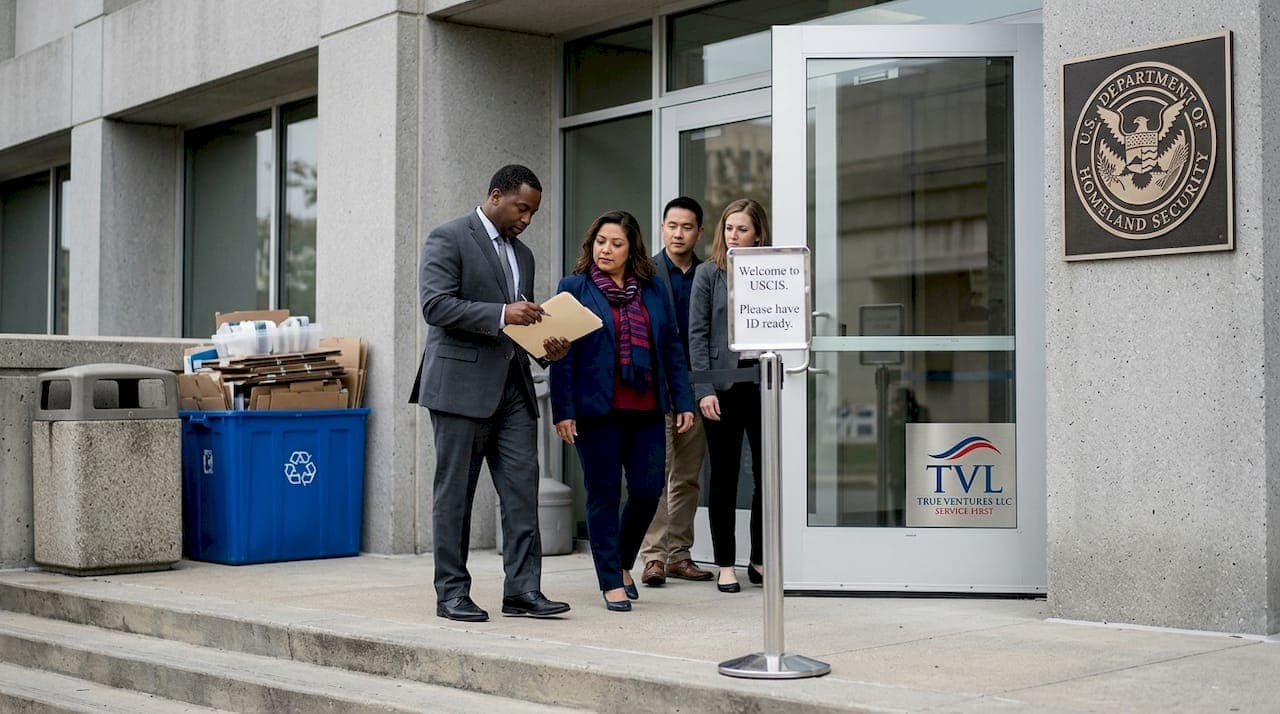
Every year, thousands of families submit immigration applications to the wrong agency, use outdated forms downloaded from unofficial websites, or miss critical deadlines because they relied on advice that was no longer accurate. The confusion is understandable. The U.S. immigration system involves multiple federal agencies, layers of policy, and forms that change without much public notice. As part of DHS, USCIS is the agency that processes most immigration benefit applications, and understanding exactly what it does, and what it doesn't do, can be the difference between a successful case and a costly delay.
Table of Contents
- What is USCIS? Purpose and background
- Key responsibilities and services offered by USCIS
- How USCIS policies work: The Policy Manual and your case
- Eligibility and filing guidance: Using USCIS correctly
- Where to find trustworthy immigration information and help
- Our take: The single biggest mistake families make with USCIS
- Need help with USCIS forms or the process?
- Frequently asked questions
Key Takeaways
| Point | Details |
|---|---|
| USCIS is the benefits agency | USCIS handles all major immigration applications like citizenship and green cards. |
| Official guidance matters | Rely on USCIS.gov for up-to-date forms, steps, and eligibility rules. |
| Application accuracy is critical | Missing fees or using incorrect forms can cause major delays or denials. |
| Policy Manual shapes outcomes | USCIS's online Policy Manual guides officers and explains why some applications succeed. |
| Help is available | Legal experts and immigration services can guide you if the process seems overwhelming. |
What is USCIS? Purpose and background
USCIS stands for U.S. Citizenship and Immigration Services. It is the federal agency responsible for processing applications for immigration benefits inside the United States. If you are applying for a green card, naturalization, a work permit, or family reunification, USCIS is almost certainly involved.
USCIS was established on March 1, 2003, when the former Immigration and Naturalization Service (INS) was dissolved and its functions were divided between three new agencies inside the Department of Homeland Security (DHS). The decision to split INS was largely a response to the September 11 attacks, which revealed critical gaps in how immigration was managed nationally.
Understanding how those three agencies divide their work matters a lot for applicants:
- USCIS: Handles immigration benefits, including green cards, work permits, citizenship, and asylum applications filed within the U.S.
- CBP (Customs and Border Protection): Manages ports of entry, border crossings, and admission to the United States.
- ICE (Immigration and Customs Enforcement): Focuses on immigration enforcement, removal, and investigations.
The State Department, meanwhile, handles immigrant visas issued abroad through U.S. consulates.
USCIS's core purpose is service, not enforcement. Its job is to adjudicate applications fairly and consistently, following federal law and official policy. This distinction matters: if you are filing for a benefit, USCIS is your primary point of contact inside the U.S., not ICE or CBP.
That difference is important because many families mistakenly fear that interacting with USCIS puts them at enforcement risk. Filing a benefit application with USCIS is a legal process with defined rules. It is separate from enforcement functions handled by other agencies.
Key responsibilities and services offered by USCIS
USCIS processes a wide range of immigration applications. Knowing which forms and benefit types fall under USCIS's authority helps you prepare correctly from the very beginning. Here is a breakdown of the most common services:

| Benefit type | Primary USCIS form | Who typically applies |
|---|---|---|
| Family-based green card | I-130, I-485 | Immediate relatives of U.S. citizens or LPRs |
| Employment-based green card | I-140, I-485 | Workers sponsored by a U.S. employer |
| Naturalization (citizenship) | N-400 | Lawful permanent residents |
| Work permit (EAD) | I-765 | Adjustment applicants, asylees, TPS holders |
| H-1B specialty occupation | I-129 | Skilled workers sponsored by employers |
| Travel document | I-131 | Green card holders, adjustment applicants |
| Asylum | I-589 | Individuals seeking protection in the U.S. |
The filing guidance from USCIS covers all of these processes in detail, including where to file, how to pay fees, and what supporting documents to include. Following official guidance is not optional. It is the only way to make sure your application reaches the right office and contains everything a USCIS officer needs to adjudicate your case.
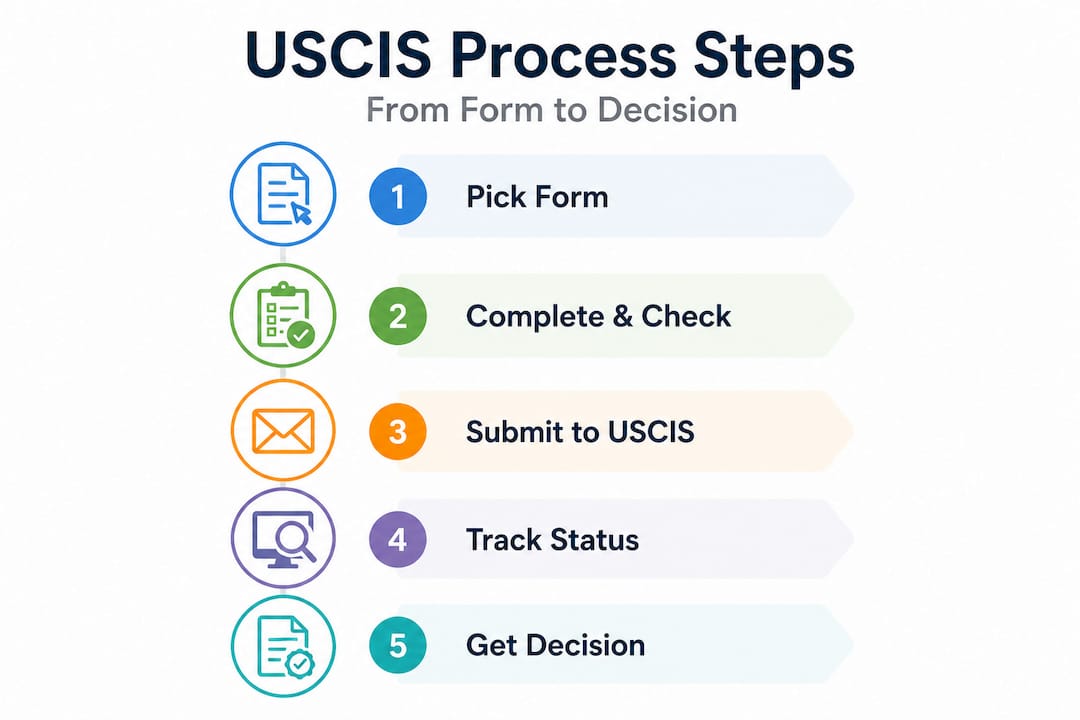
How the process typically works follows a general pattern: you identify the correct form, complete it using the most current edition, gather supporting documents, pay the filing fee, and submit everything to the correct USCIS facility. After submission, USCIS issues a receipt notice, schedules any required biometrics appointments, and eventually sends a decision. Understanding each of these steps is important. You can find a detailed breakdown in this step-by-step immigration process guide, which walks you through the stages that most families encounter.
Common mistakes at this stage are avoidable but surprisingly frequent. Applicants regularly send forms to the wrong USCIS lockbox or service center, submit forms with incorrect edition dates (meaning they used an outdated version), or fail to include required initial evidence. Each of these errors can result in a rejection or a Request for Evidence (RFE), both of which delay your case by weeks or months. For guidance on the types of documents you'll need, reviewing information about collecting USCIS evidence before you file is time well spent.
Pro Tip: Never print USCIS forms from a third-party website. Always download directly from USCIS.gov. Forms are updated regularly, and USCIS will reject an outdated edition.
How USCIS policies work: The Policy Manual and your case
One thing many applicants never think about is what actually guides the officer reviewing their file. USCIS does not make decisions casually or subjectively. Every adjudication is governed by federal law, regulations, and, most importantly for day-to-day decisions, the USCIS Policy Manual.
The USCIS Policy Manual is the centralized, publicly available repository for all official immigration policies. It covers everything from how officers evaluate evidence to what standard of proof applies to specific benefit types. It is organized by volume and updated when policies change. That means any family or individual navigating the system has direct access to the exact standards an officer will apply to their case.
Here is how the Policy Manual differs from the law itself and what it means for you:
| Source | What it is | Who writes it | Your role as an applicant |
|---|---|---|---|
| Federal law (INA) | Statutory authority for immigration | Congress | Must qualify under its terms |
| Federal regulations (CFR) | Binding rules implementing the law | DHS/DOJ rulemaking | Must comply with requirements |
| USCIS Policy Manual | Officer guidance for applying law | USCIS | Useful for understanding how your case will be evaluated |
| Private websites | Unofficial interpretation | Third parties | No official weight; may be outdated |
The Policy Manual is not a guarantee of outcome, but it is a transparency tool. When you understand the standards an officer will apply, you can build a stronger application.
Why does this matter for your case? Because policies change. USCIS regularly updates its guidance in response to court decisions, new regulations, and changes in administration priorities. A policy that applied to a case filed two years ago may not apply the same way today. Staying current with official USCIS sources is not just good practice. It is essential for accuracy. Outdated advice from well-meaning friends or informal online forums can lead families to file under standards that no longer apply, which is a major reason cases get delayed or denied. Staying informed about avoiding case delays starts with reading policy from the source.
Pro Tip: Bookmark the USCIS Policy Manual at uscis.gov/policy-manual and check it when you have a specific question about how a benefit is evaluated. It is publicly available and written to be usable by the general public.
Eligibility and filing guidance: Using USCIS correctly
Before you file anything, you need to confirm you actually qualify for the benefit you are seeking. This sounds obvious, but many families skip this step and file applications they do not yet qualify for, which wastes time and money.
Eligibility for family-based green cards, for example, depends on the specific family relationship involved, whether the petitioner is a U.S. citizen or lawful permanent resident, and whether the applicant is adjusting status inside the U.S. or applying through a consulate abroad. Immediate relatives of U.S. citizens (spouses, unmarried children under 21, and parents) generally have more direct paths with no wait for a visa number to become available. Other family categories face annual numerical limits, which can mean waiting years.
Here is a straightforward process for filing correctly with USCIS:
- Identify the correct benefit type based on your current immigration status and goal (citizenship, green card, work permit, etc.).
- Find the official form on USCIS.gov and verify the edition date in the lower left corner of the form matches the current version listed on the site.
- Read the form instructions completely before filling anything out. USCIS form instructions are detailed and list every document you need to include.
- Gather supporting documents according to the instructions. This includes identity documents, financial records, relationship evidence, and any prior immigration records.
- Determine the correct filing location, since many USCIS forms have specific lockbox addresses that change based on your state or the type of application.
- Pay the correct fee, using the payment method accepted for that specific form. Fees change, and the current fee schedule is always posted on USCIS.gov.
- Make copies of everything before you mail or submit your package.
- Track your case after you receive a receipt notice. Tracking your USCIS application using the online case status tool keeps you informed and helps you respond quickly to any notices USCIS sends.
Pro Tip: If USCIS sends you a Request for Evidence (RFE) or a Notice of Intent to Deny (NOID), respond within the stated deadline. Missing these deadlines almost always results in a denial, and extensions are rare.
Where to find trustworthy immigration information and help
The internet is full of immigration information, and a significant portion of it is wrong, outdated, or produced by websites trying to sell you services you may not need. This creates real risk. Families have filed incorrect forms, paid fees to unofficial sites, and missed deadlines because they relied on unreliable sources.
USCIS.gov is the official source for all current forms, instructions, fees, and policy information. Third-party sites, even those that look professional, cannot guarantee their content matches the current USCIS requirements.
Here is how to protect yourself:
- Always start at USCIS.gov. This applies to forms, instructions, fee schedules, and processing time estimates.
- Be skeptical of notarios and unauthorized practitioners. In many communities, individuals offer immigration help without legal authority to do so. Using unauthorized practitioners can result in fraud, missed deadlines, and serious immigration consequences.
- Check that forms are undated correctly. Every USCIS form shows an edition date in the bottom left corner. Compare this to the current edition shown on the official USCIS website.
- Look for the .gov domain. Any site ending in .gov is an official government resource. Sites ending in .com, .org, or .net are not official government sources, even if they use official-sounding names.
- Use USCIS's contact center for direct questions. You can call USCIS at 1-800-375-5283 to speak with a representative about your case.
Pro Tip: If a website charges you to download a USCIS form, close the browser. All USCIS forms are available for free on USCIS.gov. You should never pay just to download a form.
When should you consider expert immigration guidance? If your case involves any complexity, such as prior immigration violations, criminal history, prior denials, or complicated family situations, working with a qualified professional is strongly advisable. Even straightforward cases benefit from a second set of experienced eyes.
Our take: The single biggest mistake families make with USCIS
After working with dozens of families through the immigration process, one pattern stands out more than any other. Families spend enormous energy filling out the forms, and almost no time understanding whether they are filling out the right forms for their specific situation.
There is a widespread belief that immigration success comes down to paperwork. Get the papers right, and you're done. But that thinking misses something critical. USCIS policies change. Fee schedules update. Filing addresses shift. A process that worked for your neighbor two years ago may be different today. We have seen families confidently file complete applications that were rejected not because they made errors on the forms, but because they used procedures that had quietly changed months before.
The uncomfortable truth is that form-filling is the easy part. The hard part is staying current with policy updates, understanding which benefit category actually fits your situation, and building a case file that speaks directly to the standards an officer will apply. That requires intentional, detail-oriented preparation, not a shortcut. Comprehensive immigration support means being guided by someone who is paying attention to what USCIS requires right now, not just what worked in the past.
The families who navigate this process most successfully are not necessarily the ones with the simplest cases. They are the ones who treat every submission as a deliberate, researched act rather than a checkbox exercise.
Need help with USCIS forms or the process?
Navigating USCIS requirements on your own is possible for simple situations, but the stakes are too high to leave anything to chance when your family's future in the United States is involved.
At True Ventures, LLC, we provide personalized, knowledgeable support for individuals and families at every stage of the USCIS process. Our team has firsthand experience with the immigration journey, which means we understand what is actually on the line for you. Whether you need help with an I-130, I-485, H-1B, or any other major filing, our USCIS consulting and support services are designed to help you file accurately and confidently. You can also explore our dedicated immigration filing assistance page for a detailed look at how we can support your specific case.
Frequently asked questions
What is the main function of USCIS?
USCIS administers all major U.S. immigration benefit applications, including citizenship, green cards, work permits, and family reunification petitions. It is a service agency, not an enforcement agency.
How can I know if a USCIS form is current and official?
Always download forms directly from USCIS.gov to confirm you have the latest version. Check the edition date in the bottom left corner of the form and match it to what is currently listed on the official site.
Does USCIS decide who is eligible for all types of green cards?
USCIS decides most green card applications filed inside the United States, but the rules governing each category are set through the USCIS Policy Manual and federal law. Your eligibility depends on which category you qualify under and how those standards are currently applied.
What should I do if I made a mistake on my USCIS application?
Visit USCIS.gov for official filing guidance on corrections, or contact an accredited immigration professional promptly. Acting quickly after discovering an error reduces the risk of serious consequences.
Should I rely on private websites for USCIS forms and advice?
No. Use only the official USCIS site for all forms and filing instructions. Private websites may be outdated, inaccurate, or attempting to charge fees for free government materials.