
Most people spend months gathering documents, translating certificates, and filling out government forms with surgical precision — then walk into a consular interview completely unprepared for the conversation that actually decides their case. The paperwork gets you into the room. What you say, how you say it, and whether your story holds together is what gets you the visa. This article breaks down exactly why consular interviews are required, what officers are evaluating, and what recent policy changes mean for your preparation strategy in 2026.
Table of Contents
- The real purpose: How consular interviews shape visa eligibility
- National security and eligibility checks: More than paperwork
- Credibility and consistency: Why your answers matter
- Recent policy changes: Who must attend and why waivers are limited
- A fresh perspective: What most applicants underestimate about consular interviews
- How we can support your successful consular interview
- Frequently asked questions
Key Takeaways
| Point | Details |
|---|---|
| Interviews are critical | Consular interviews serve as the main decision point for visa eligibility and security screening. |
| Waivers are limited | Interview waivers apply only to certain categories and can be overridden by consular discretion. |
| Credibility matters | Consistent, credible answers during your interview have major influence on the final outcome. |
| Policy changes require attendance | Recent updates mean more applicants must attend interviews, making preparation vital. |
The real purpose: How consular interviews shape visa eligibility
The consular interview is not a checkpoint you pass on the way to approval. It is the approval process itself, compressed into a single face-to-face meeting. Understanding this distinction changes how you prepare.
The Department of State requires interviews because they serve two simultaneous functions: determining whether an applicant qualifies under the relevant visa category, and identifying any grounds that would make the person ineligible. As stated in official State Department guidance, the interview is required to determine visa eligibility and screen for ineligibility, with waivers being discretionary and tightly limited by category and criteria. That word "discretionary" is doing a lot of heavy lifting. Even when a waiver theoretically exists, the officer can still pull you in.
For immigrant visas — including family reunification cases built on I-130 approvals — the interview carries even more weight. Per the Foreign Affairs Manual (FAM) guidance, consular interviews function as a decisive decision point where officers must verify applicant qualifications and determine whether any inadmissibility grounds apply. That's two separate legal questions answered in one sitting.
Here's what officers are actually deciding during those minutes:
- Eligibility: Does the applicant meet the legal requirements for the visa category?
- Admissibility: Is there any legal bar — criminal history, prior visa violations, health-related grounds — that prevents entry?
- Intent: Is the stated purpose of travel genuine?
- Fraud indicators: Do the documents, story, and supporting evidence all align?
- Security flags: Does anything in the record or the conversation trigger further screening?
For a deeper overview of consular interview requirements and how preparation fits into the broader immigration process, it's worth reviewing how supporting documentation is handled before you even reach the consulate.
"The consular interview is required — or may be waived for certain nonimmigrant categories — because the Department of State and consular officers use it to determine visa eligibility and screen for ineligibility."
National security and eligibility checks: More than paperwork
Here is something most applicants don't realize: every visa decision is also a national security decision. That framing isn't dramatic. It comes directly from State Department policy.
The Department of State treats visa adjudication as a national security function, using screening and vetting tools — including interviews — to flag applicants who may be inadmissible due to security risks or public safety concerns. Expanded vetting protocols introduced in recent years mean consular officers now have more data cross-referencing tools available to them before you even sit down. By the time you reach the window, the officer may already have flagged discrepancies in your travel history, prior applications, or biometric data.
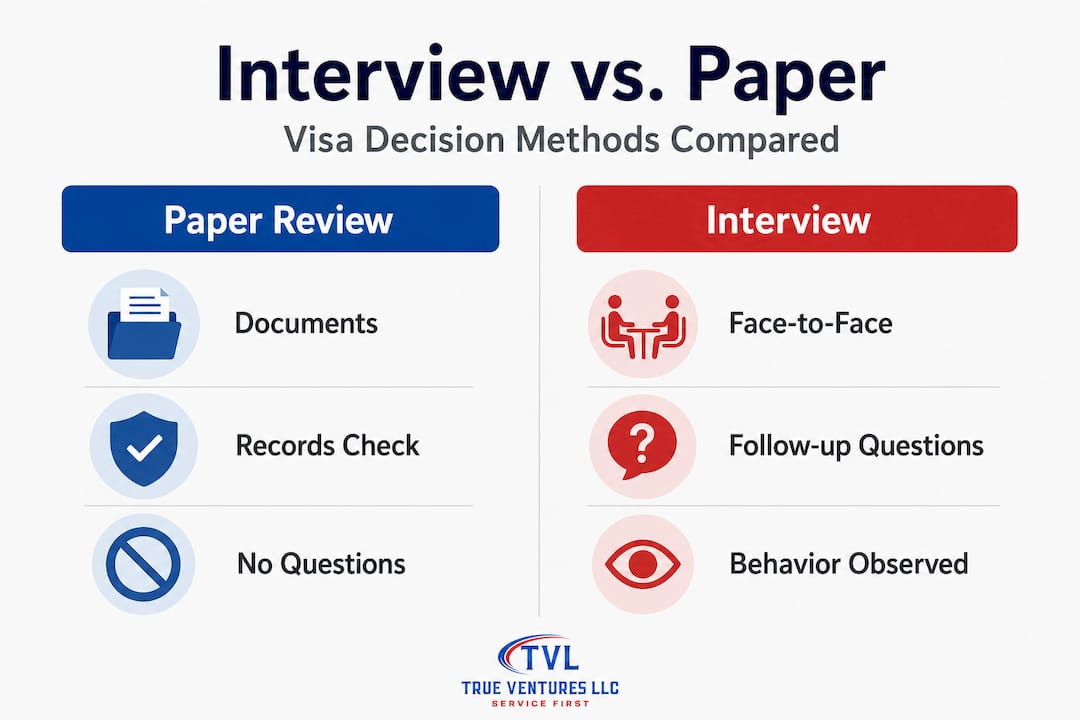
This is why the interview is not redundant with the paper review. They serve different functions:
| Check type | Paper review only | In-person interview |
|---|---|---|
| Identity verification | Documents checked | Face, voice, biometrics |
| Travel history | Passport stamps | Verbal explanation required |
| Intent | Form answers | Spontaneous responses assessed |
| Fraud detection | Document cross-check | Behavioral and consistency signals |
| Security screening | Database queries | Real-time officer judgment |
| Inadmissibility grounds | Listed in application | Probed through follow-up questions |
The table above shows why data-only checks and face-to-face interviews are complementary, not interchangeable. Officers can spot inconsistencies in your explanation of a two-year gap in travel that no database would catch.
For applicants dealing with prior visa denials or potential inadmissibility issues, understanding interview waivers and ineligibility is a critical step before you schedule your appointment.
Pro Tip: Answer consistently regardless of whether a question seems trivial. Officers are trained to probe for inconsistencies in casual conversation. A relaxed exchange about your job can quickly become a credibility test if your answer doesn't match your DS-160.
Credibility and consistency: Why your answers matter
Documents are static. You are not. That's both your advantage and your vulnerability in the interview room.
A consular officer reads your application before you arrive. They know what you wrote. What they don't know yet is whether you actually know what you wrote — and whether your oral answers match. FAM guidance on credibility assessment makes clear that adjudication requires officers to assess credibility, and that the burden of proving eligibility rests on the applicant under INA Section 291. You are not presumed eligible. You must demonstrate it, in real time, under questioning.
"Adjudication requires you to assess the credibility of the applicant — oral answers to interview questions are part of the evidence record."
This places enormous pressure on consistency. The following are the most common traps applicants fall into during interviews:
- Document-answer contradictions: Your sponsor letter says one address; you give a different one verbally.
- Date inconsistencies: Your travel history as described doesn't match passport stamps.
- Vague purpose statements: "I'm visiting family" with no specific detail raises flags for officers screening for intent.
- Over-rehearsed responses: Scripted answers that don't adapt to follow-up questions signal coaching, not genuine knowledge.
- Nervous over-explanation: Volunteering information that contradicts earlier answers when trying to clarify.
For credibility in immigration interviews, affidavits and supporting declarations play a big role — but only when they align with what you actually say in the room. And collecting the right evidence for interviews is the foundation that makes credibility possible in the first place.
Pro Tip: Before your interview, read your entire application out loud to a trusted person and have them ask you questions about it. If you stumble on dates, relationships, or timelines, those are the exact areas the officer will probe.
Recent policy changes: Who must attend and why waivers are limited
Interview waiver rules changed significantly in recent years, and many applicants are still operating under outdated assumptions. If you think your category automatically qualifies for a waiver, you may be wrong — and arriving unprepared for a mandatory interview is a fast path to refusal.
Recent policy changes at U.S. embassies worldwide have substantially narrowed interview-waiver eligibility for nonimmigrant visa applicants. Many categories that previously qualified under administrative exception now require in-person attendance. The rationale is straightforward: expanded vetting requirements and security protocols have made face-to-face screening a default, not an option.
More importantly, even if your category technically qualifies for a waiver, consular officers retain full discretion to require an interview whenever eligibility or inadmissibility concerns arise. That means a waiver-eligible applicant with an unusual travel history or a prior denial could still be called in.
| Scenario | Interview required? |
|---|---|
| First-time B-1/B-2 applicant, age 14 to 79 | Yes, in most cases |
| Renewal applicant, same visa category, within 48 months | May qualify for waiver |
| Any applicant with prior refusal or overstay | Yes, mandatory |
| H-1B, F-1, or J-1 applicants | Yes |
| Diplomatic or official visa holders | Case-by-case |
| IV (immigrant visa) applicants | Always required |
Here are the practical steps to avoid being turned away before the interview even begins:
- Confirm your DS-160 barcode matches your appointment confirmation. Mismatches in application identifiers are grounds for denial of entry to the consular section before you even speak to an officer.
- Verify the exact document checklist for your specific post, since requirements vary by country and embassy.
- Arrive with printed copies of all forms, confirmations, and supporting evidence organized by category.
- Check for any post-specific protocols such as appointment reschedule windows or photo specification changes, which differ between embassies.
- Confirm whether your category requires a medical exam completed before the interview date, particularly for immigrant visa applicants.
For help with document compliance for consular appointments, a compliance review of your full package before your appointment date can prevent avoidable delays and denials.
A fresh perspective: What most applicants underestimate about consular interviews
After working through hundreds of immigration cases, we've noticed a consistent pattern: applicants who are denied are rarely denied because their documents were incomplete. They're denied because their story didn't hold together in the room.
The immigration system rewards people who can articulate their situation clearly, specifically, and consistently. Official guides focus on forms. Checklists focus on evidence. Neither one prepares you for the moment an officer looks up from your passport and asks a question you didn't anticipate. That gap between document readiness and conversational readiness is where most cases are lost.
There's another underestimated risk that almost no one talks about: process controls. Before you even reach the officer, your interview can be terminated. As we covered above, appointment identifiers, barcodes, and application matching requirements are enforced at the door. An error in your DS-160 confirmation number, a name spelling mismatch, or a missing document code can prevent you from entering the consular section at all. The interview is required — and so is the process of getting into the room correctly.
"Preparing your documents perfectly while leaving your interview narrative to chance is like building a strong foundation on the wrong lot."
The deeper lesson is this: the consular interview is a credibility and narrative test as much as it is an eligibility verification. Officers are trained to evaluate whether your life story, as evidenced by your documents and as described in your words, adds up. If the two don't match — even in small details — that gap becomes the story.
The applicants who succeed are those who treat preparation as a rehearsal, not just a checklist. They know their own application better than the officer does. They can explain every date, every relationship, every trip, and every discrepancy without hesitation. That kind of readiness doesn't happen by accident, and reviewing your consultation workflow tips before your appointment can make a measurable difference.
How we can support your successful consular interview
Preparing for a consular interview is not just about having the right documents. It's about knowing how to present your case clearly, confidently, and consistently. At True Ventures, LLC, we guide clients through exactly that process.
Our team specializes in immigration consulting services tailored to family reunification and employment-based immigration, including I-130, I-140, H-1B, and I-485 cases. We help you build a credible, complete record and prepare for the questions that actually get asked in the interview room. Whether you're navigating a complex inadmissibility issue or preparing for your first immigrant visa interview, our immigration filing assistance ensures your documents and your story are aligned before you walk through that consular door. Reach out to schedule a consultation and give your case the preparation it deserves.
Frequently asked questions
Are consular interviews always required for visa applications?
No, some nonimmigrant categories may qualify for waivers, but interviews are mandatory for most applicants unless they meet strict, category-specific criteria defined by the Department of State.
What happens if there's a discrepancy between my documents and my interview answers?
Inconsistencies can result in refusal or a request for additional evidence, because credibility and oral answers are treated as part of the adjudication record and the burden of proof rests with the applicant.
Can a consular officer still require an interview if my category is eligible for a waiver?
Yes, officers have full discretion to require an interview whenever eligibility questions or inadmissibility concerns arise, regardless of waiver eligibility by category.
Why is matching information like barcodes or appointment details important for interviews?
A mismatch in appointment or application identifiers can prevent you from entering the consular section entirely, since process controls ensure only authorized applicants with verified details are admitted for processing.