

Most people assume that sponsoring an immigrant is simply a matter of signing a few forms and waiting. The reality is far more involved. Sponsors take on legal and financial commitments that can last a decade or longer, and the consequences of getting it wrong affect everyone involved, including the immigrant. Whether you are a family member trying to bring a loved one home, an employer looking to hire international talent, or an organization exploring your options, understanding exactly what sponsorship means in 2026 is the first step toward making a responsible and informed decision.
Table of Contents
- What is a sponsor's role in U.S. immigration?
- Family-based sponsorship: forms, categories, and the Affidavit of Support
- Employment sponsorship: how employers and organizations support immigrants
- Special scenarios and sponsorship edge cases
- The hidden truths about immigration sponsorship: what we see most people miss
- Need help navigating sponsorship? True Ventures can guide you
- Frequently asked questions
Key Takeaways
| Point | Details |
|---|---|
| Sponsors carry legal liability | Sponsoring someone means a binding commitment to support them financially and adhere to legal duties for years. |
| Different types of sponsors | Family, employers, and select organizations can sponsor immigrants, but each faces different requirements and obligations. |
| Income requirements matter | Sponsors (and joint sponsors if needed) must meet strict income thresholds under the Affidavit of Support. |
| Special rules for employment | Employer-based sponsorship uses unique forms and sometimes waives financial contracts, especially for high-skilled or cap-exempt roles. |
What is a sponsor's role in U.S. immigration?
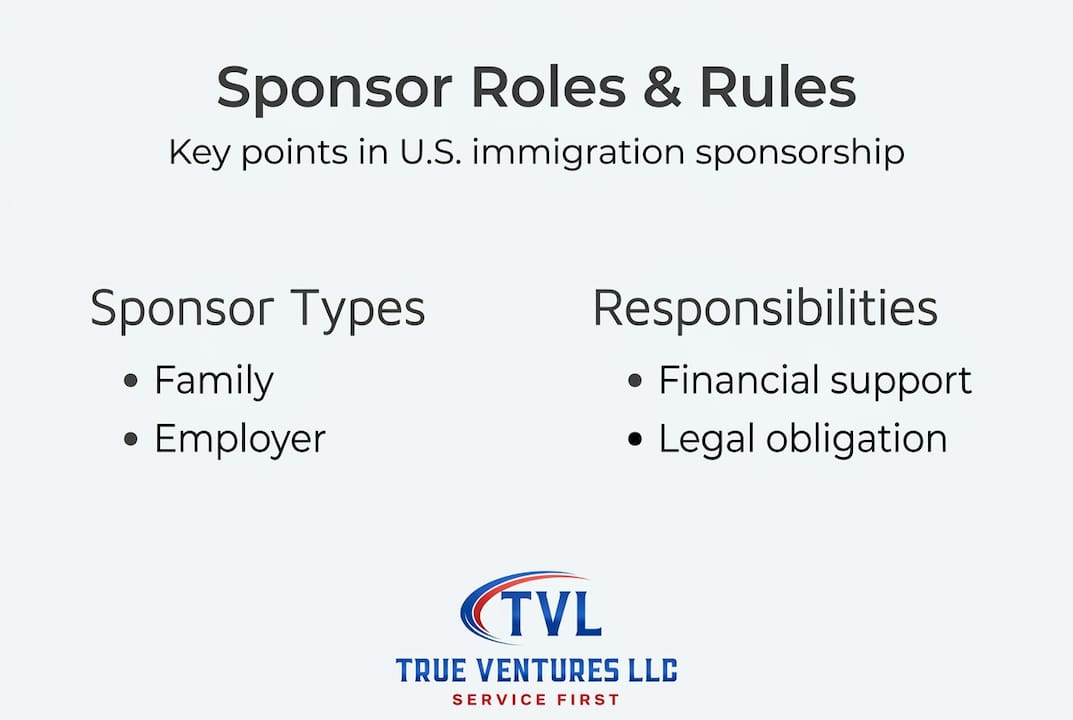
In the U.S. immigration system, a sponsor is any eligible person or entity that formally supports an immigrant's application for a visa or green card. But the word "support" carries much more weight than most people expect.
A sponsor provides both financial and legal backing to demonstrate that the immigrant will not become a public charge (a person who relies primarily on government assistance for income). This is not a formality. It is a binding legal obligation that U.S. authorities take seriously.
There are three primary types of sponsors:
- Family members: U.S. citizens and lawful permanent residents (LPRs) who petition for relatives to immigrate.
- Employers: Companies or individuals who hire foreign nationals and support their visa or green card applications.
- Organizations: In limited situations, nonprofits or religious organizations that sponsor certain categories of workers.
The financial liability attached to sponsorship is substantial. Sponsors bear long-term financial liability, and it does not expire simply because circumstances change. The obligation generally continues until the immigrant naturalizes, works 40 qualifying quarters, permanently leaves the U.S., or dies.
Key distinction: Immediate relatives of U.S. citizens, such as spouses, children, and parents, move through the immigration process faster because there is no annual visa cap on their category. Relatives in preference categories (siblings, adult children) face years-long backlogs due to limited annual visa numbers.
Understanding these sponsor legal obligations before filing anything is essential. The system is designed to protect both the immigrant and the American public, and sponsors are the bridge between the two.
Family-based sponsorship: forms, categories, and the Affidavit of Support
Now that we know the core responsibilities, let's see how family-based sponsors put these into action.
U.S. citizens and LPRs sponsor family members through a two-step process that begins with a formal petition and ends with a binding financial promise. Here is how it typically unfolds:
- File Form I-130 (Petition for Alien Relative). This establishes the qualifying family relationship. Approval does not grant a visa but reserves the immigrant's place in line.
- Determine the immigrant's category. Immediate relatives (spouses, minor children, and parents of U.S. citizens) have no visa cap. All other family preference categories have annual limits and wait times.
- File Form I-864 (Affidavit of Support). This is a legally binding contract. Sponsors filing Form I-864 must demonstrate income at or above 125% of the Federal Poverty Guidelines for their household size.
- Maintain the financial obligation. Even if the sponsor loses their job, divorces the immigrant, or moves abroad, the contract remains enforceable.
- Track the obligation's end date. It terminates only when the immigrant becomes a citizen, works 40 qualifying quarters, leaves permanently, or passes away.
Pro Tip: If your income alone does not meet the 125% threshold, you are not automatically disqualified. A joint sponsor can step in and take on the financial obligation independently, using Form I-864. A household member, like a spouse who lives with you, can combine their income using Form I-864A.
| Category | Who qualifies | Wait time | Visa cap |
|---|---|---|---|
| Immediate relatives | Spouses, minor children, parents of U.S. citizens | Fast, no cap | None |
| F-1 (family preference) | Unmarried adult children of U.S. citizens | Years | Yes |
| F-2A | Spouses and children of LPRs | Moderate | Yes |
| F-3 | Married children of U.S. citizens | Long | Yes |
| F-4 | Siblings of U.S. citizens | Very long | Yes |
For a deeper look at the petition process, our family petition guide walks you through each stage in plain language. You can also review the full green card process for families to understand what comes after the petition is approved.
Employment sponsorship: how employers and organizations support immigrants
Family is one sponsor route, but employment sponsorship opens different pathways. Here is how it works for employers and organizations.
Employers sponsor H-1B nonimmigrant visas through Form I-129, after first obtaining a Labor Condition Application (LCA) from the Department of Labor. The H-1B is a temporary work visa for specialty occupations requiring at least a bachelor's degree. Since demand far exceeds the 85,000 annual cap, USCIS uses a weighted lottery that gives an advantage to applicants with U.S. advanced degrees.

For permanent employment-based immigration, employers file Form I-140 for green cards across five preference categories (EB-1 through EB-5). Most employment-based categories do not require Form I-864, unless the petitioner is a relative or owns 5% or more of the sponsoring company.
Here is a quick look at the major employment pathways:
| Visa/Category | Form required | Who files | Purpose |
|---|---|---|---|
| H-1B | I-129 + LCA | Employer | Temporary specialty work |
| EB-1 | I-140 | Employer or self | Extraordinary ability/multinational mgr |
| EB-2/EB-3 | I-140 + PERM | Employer | Professional or skilled workers |
| EB-4 | I-360 | Employer/org | Religious and special immigrant workers |
| EB-5 | I-526 | Investor | Investment-based residency |
Key things employers and applicants should know:
- PERM labor certification is required for most EB-2 and EB-3 petitions. It proves no qualified U.S. workers are available for the position.
- Cap-exempt organizations include universities, affiliated nonprofits, and government research institutions. Workers sponsored by these entities bypass the H-1B lottery entirely.
- Religious organizations can sponsor special immigrant religious workers under EB-4 without going through PERM.
Pro Tip: If you are a skilled worker struggling with H-1B lottery odds, targeting cap-exempt employers is one of the most underused but effective strategies available. Hospitals, nonprofits, and research institutions often qualify and can offer stable, long-term sponsorship.
Our employment-based green card guide breaks down each EB category in detail. You can also explore EB-3 visa strategies if you are navigating that particular pathway in 2026.
Special scenarios and sponsorship edge cases
Beyond the standard scenarios, here is what you should know about edge cases and alternatives for sponsors.
Not every sponsorship situation fits neatly into the family or employer box. Joint sponsors can meet income requirements independently, meaning they take on the full obligation without combining income with the primary sponsor. A joint sponsor must also meet the 125% poverty threshold on their own and file a separate I-864.
Here are the most important edge cases to understand:
- Household member income (Form I-864A): A person living in the sponsor's household, like a working adult child or spouse, can pool their income with the primary sponsor to meet the financial threshold. They sign a separate I-864A form.
- Employment-based I-864 exceptions: In most employment green card cases, no I-864 is required. The exception is when the petitioner is also a relative or holds 5% or more ownership in the sponsoring company.
- Self-petitioners: Some immigrants, like EB-1A (extraordinary ability) applicants, do not need an employer sponsor at all. They file their own I-140 petition.
- Nonprofit pathways: Organizations can support immigrants in navigating the process, but direct sponsorship by nonprofits is typically limited to specific categories such as religious workers or cap-exempt H-1B positions. They are rarely involved in family or employment green card sponsorship outside these niches.
Pro Tip: If you are the primary sponsor and worried your income falls short, do not guess. Calculate your household size correctly, including any immigrants you are already sponsoring on previous petitions. An accurate household count changes the poverty threshold significantly.
For a closer look at how joint sponsorship works, and to understand the finer sponsor legal nuances that trip people up most often, those resources are worth reviewing before you file.
The hidden truths about immigration sponsorship: what we see most people miss
At True Ventures, we talk with sponsors every week who did not realize what they signed up for until it was too late. The most common mistake is not a paperwork error. It is an emotional decision made without a realistic look at the long-term picture.
Sponsoring someone feels like an act of love or loyalty, and it often is. But the financial obligation attached to Form I-864 does not respond to feelings. If your income drops, if the relationship breaks down, or if the immigrant needs public benefits years later, you may receive a bill from the government. That is not a warning meant to discourage sponsorship. It is a reality that sponsors deserve to know upfront.
We also see many sponsors who assume their responsibility ends the moment the immigrant gets a green card. It does not. The sponsorship legal risks extend until one of the specific legal triggers ends the obligation. Transparency before you sign is more honorable than regret after the fact. The immigrants counting on you deserve a sponsor who went in with eyes fully open.
Need help navigating sponsorship? True Ventures can guide you
Sponsorship paperwork is the visible part. The strategy behind it, knowing which forms to file, how to document income correctly, when to bring in a joint sponsor, and how to avoid costly delays, is where most people need help.
At True Ventures, our team has firsthand experience navigating these exact processes, and we bring that clarity to every client we work with. From immigration consulting services to hands-on immigration filing assistance, we guide families, employers, and organizations through each stage without the confusion. Reach out to us and let's talk through your situation together.
Frequently asked questions
Who can legally become a sponsor for a U.S. immigrant?
U.S. citizens and LPRs can sponsor family members, while eligible employers and some nonprofits can sponsor workers, provided all parties meet the relevant income and legal requirements.
How long does a sponsor's financial responsibility last?
A sponsor's obligation under Form I-864 typically ends when the immigrant becomes a U.S. citizen, earns 40 work quarters, permanently departs the U.S., or dies, which can take many years.
What happens if the sponsor does not meet income requirements?
If the primary sponsor falls short, a joint sponsor or household member can supplement by filing Form I-864 or I-864A to satisfy the income threshold independently or jointly.
Can a nonprofit organization sponsor immigrants directly?
Yes, but only in limited roles. Nonprofits can directly sponsor workers in categories like religious workers or cap-exempt H-1B positions, but they are rarely involved in standard family or employment-based green card sponsorship.