

Family sponsorship gets most of the attention when people think about U.S. green cards. But there's a second major route that millions of skilled workers, professionals, and investors use every year: employment-based immigration. The U.S. allocates approximately 140,000 employment-based visas annually across five distinct preference categories, from extraordinary-ability professionals to investors creating American jobs. If you've ever assumed a family member in the U.S. was your only ticket to permanent residency, this guide will change how you see your options.
Table of Contents
- What is employment-based immigration?
- Understanding the five EB visa categories (EB-1 to EB-5)
- The step-by-step employment-based green card process
- Visa availability, priority dates, and processing time challenges
- Our perspective: What most guides miss about employment-based immigration
- How True Ventures, LLC can support your immigration journey
- Frequently asked questions
Key Takeaways
| Point | Details |
|---|---|
| Multiple pathways | Employment-based immigration allows skilled workers, professionals, and investors access to U.S. green cards through five distinct visa categories. |
| Complex process | The green card journey involves rigorous steps from employer sponsorship and labor certification to monitoring visa availability and completing detailed paperwork. |
| Eligibility for families | Spouses and unmarried children under 21 can typically benefit as derivative applicants alongside the main applicant. |
| Timing varies greatly | Processing times depend on visa category, country of origin, and annual caps, with some applicants facing long backlogs. |
| Expert guidance helps | Professional immigration support can simplify complex rules, prevent errors, and increase your chances of a successful outcome. |
What is employment-based immigration?
Employment-based immigration is the process through which skilled workers, professionals, and investors can become U.S. lawful permanent residents based on what they do, not who they know. It's a separate track from family-sponsored immigration, and it's built around the idea that your qualifications, your profession, or your financial investment can itself justify permanent residency.
"Employment-based immigration refers to U.S. immigrant visas (green cards) allocated annually, approximately 140,000 including family, across five preference categories (EB-1 to EB-5) for skilled workers, professionals, and investors to become lawful permanent residents based on job skills or investment."
That 140,000 figure includes not just the primary applicant but also their spouse and unmarried children under 21. So one approved petition can open the door for an entire family.
Who qualifies? The range is broader than most people realize. For a solid overview of employment-based immigration, the eligible groups include:
- Priority workers with extraordinary ability in science, arts, education, business, or athletics
- Professionals with advanced degrees or exceptional ability
- Skilled and unskilled workers filling roles where U.S. workers are in short supply
- Special immigrants, including certain religious workers and broadcasters
- Investors who create jobs by putting capital into U.S. enterprises
The process typically involves an employer sponsor filing a petition on your behalf, though some categories allow you to petition for yourself. Getting expert immigration guidance early in this process can save you from costly mistakes and wasted time.
Understanding the five EB visa categories (EB-1 to EB-5)
Now that you know employment-based immigration is diverse, let's explore how the five major categories compare. Each one serves a different type of applicant, and choosing the right category from the start matters enormously.
| Category | Who qualifies | Job offer required? | Labor certification? |
|---|---|---|---|
| EB-1 | Extraordinary ability, top researchers, multinational executives | No (EB-1A) | No |
| EB-2 | Advanced degree holders, exceptional ability, NIW | Usually yes | Usually yes |
| EB-3 | Skilled workers, professionals, other workers | Yes | Yes |
| EB-4 | Special immigrants (religious workers, broadcasters, etc.) | Varies | No |
| EB-5 | Investors creating 10 U.S. jobs | No | No |
The EB-1 category stands out because it allows self-petition with no labor certification required, making it the fastest and most autonomous path for those who qualify. Think Nobel laureates, Olympic athletes, or top-tier multinational managers.
EB-5 sits at the other end of the spectrum. It requires a minimum investment of $800,000 in a targeted employment area or $1,050,000 elsewhere, along with proof that the investment creates at least 10 full-time jobs for U.S. workers.
For most working professionals, EB-2 and EB-3 are the most relevant. EB-2 covers advanced degree holders and those with exceptional ability. EB-3 covers skilled workers (requiring at least two years of training), professionals with a bachelor's degree, and other workers. For a detailed breakdown, the EB-3 visa detailed guide walks through eligibility and strategy step by step.

Pro Tip: Don't automatically aim for the highest category you think you might qualify for. A strong EB-2 case is often faster and more secure than a borderline EB-1 attempt. The attorney role in immigration includes helping you identify the most realistic and efficient path, not just the most prestigious one.
The step-by-step employment-based green card process
You've seen the categories. Now let's walk through the essential steps involved in the employment-based green card journey. The path has several stages, and each one has its own timeline and documentation requirements.
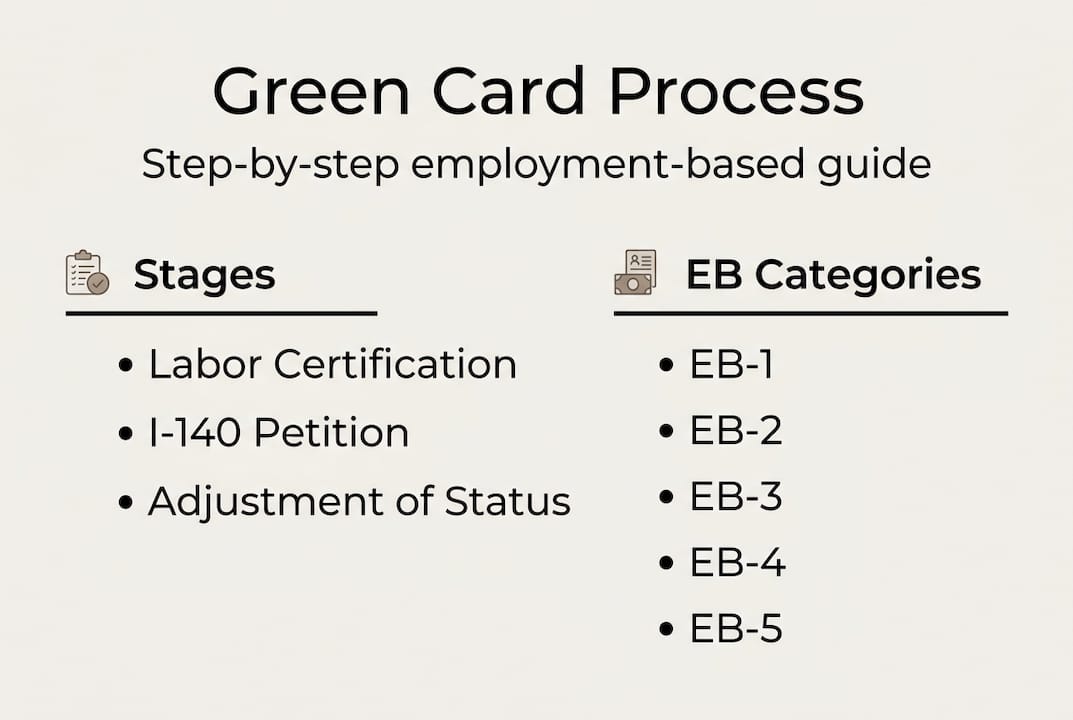
- PERM labor certification (for most EB-2 and all EB-3): Your employer files with the Department of Labor to prove no qualified U.S. worker is available for the role. This is called PERM labor certification and typically takes 6 to 18 months.
- Form I-140 (Immigrant Petition): Your employer files this petition with USCIS to establish your eligibility. This is your official place in line.
- Priority date becomes current: You check the monthly Visa Bulletin to see when your priority date (the date your I-140 was filed) is reached.
- Adjustment of status (Form I-485) or consular processing: If you're in the U.S., you file I-485 to adjust status. If abroad, you go through a U.S. consulate. Spouses and children under 21 can be included as derivative beneficiaries.
- Biometrics, interview (if required), and approval: USCIS reviews your file and, if approved, issues your green card.
| Stage | Typical timeframe | Key form |
|---|---|---|
| PERM labor certification | 6 to 18 months | ETA Form 9089 |
| I-140 petition | 6 to 8 months (standard) | Form I-140 |
| Visa availability wait | Months to decades | Visa Bulletin |
| I-485 or consular process | 8 to 24 months | Form I-485 |
For a full breakdown, the step-by-step green card process guide covers each stage in plain language. Before you begin, reviewing an immigration document checklist can help you get organized from day one.
Pro Tip: Start gathering supporting documents (degree certificates, employment letters, tax records, and translations) before your employer even files the PERM. Delays in document collection are one of the most common reasons cases stall.
Visa availability, priority dates, and processing time challenges
Following the process steps, it's vital to understand why wait times can vary so dramatically, and why some applicants face much longer waits than others.
Here's the core issue: the U.S. caps employment-based green cards at roughly 140,000 per year, and no single country can use more than 7% of that total. This per-country cap hits applicants from high-demand countries the hardest. For Indian nationals in the EB-2 or EB-3 category, backlogs exceed 10 years. Chinese nationals face similar challenges. For most other countries, wait times are far shorter, and some categories are current right now.
The Visa Bulletin is your compass. Published monthly by the State Department, it lists the priority dates currently being processed for each category and country. If your priority date is earlier than the listed date, you can move forward with your I-485 or consular processing. If not, you wait.
Here's a number that surprises most people: despite the 140,000 annual allocation, only about 49,766 employment-based visas were actually issued in FY2024. Processing limits, administrative backlogs, and unused numbers all contribute to that gap.
What can you do while waiting?
- Monitor the green card process explained resources regularly for Visa Bulletin updates
- Keep your status current (H-1B extensions, for example)
- Understand that your family members can often receive Employment Authorization Documents (EADs) and Advance Parole while waiting
- Know that your priority date is generally retained even if you change employers, as long as you follow the right steps
The backlog reality is frustrating, but understanding it helps you plan realistically instead of being caught off guard.
Our perspective: What most guides miss about employment-based immigration
Most guides stop at the forms and the rules. They don't tell you what it actually feels like to wait five, eight, or twelve years for a green card while your life keeps moving forward.
At True Ventures, LLC, we've worked with clients who got married, had children, changed careers, and lost loved ones, all while their I-485 was pending. Conventional advice doesn't prepare you for those realities. It doesn't tell you that a job change could jeopardize your case if you don't understand job portability under AC21, which allows you to change to a same or similar role after your I-140 is approved and your I-485 has been pending for 180 days.
The uncomfortable truth is that employment-based immigration rewards those who treat it like a long-term project, not a one-time filing. Keep meticulous records. Document every employment change. Never assume your status is fine without verifying it. And before any major life decision, including a job offer, a move abroad, or even a long international trip, consult someone who knows your file. The cost of avoiding filing errors is far lower than the cost of fixing them.
We believe the gap between legal requirements and the lived immigrant experience is where most people get hurt. Bridging that gap is exactly what we're here to do.
How True Ventures, LLC can support your immigration journey
If reading through these steps left you feeling more aware of what's at stake, that's a good thing. Employment-based immigration is genuinely complex, and even small errors in forms or timing can delay your case by months or years.
At True Ventures, LLC, we provide hands-on immigration filing assistance for I-140 petitions, I-485 adjustments, and the full range of employment-based filings. Our team brings firsthand immigrant experience to every case, which means we understand what's on the line for you and your family. Explore our full consulting services to find the right level of support for your situation. A single consultation can clarify your path and give you the confidence to move forward without second-guessing every step.
Frequently asked questions
What are the main types of employment-based green cards?
The five main categories are EB-1 through EB-5, each covering different skills, professions, or investment levels, from extraordinary ability workers and advanced degree holders to religious workers and major investors.
How long does the employment-based immigration process take?
Timelines vary significantly: for high-demand countries such as India or China, waits can exceed 10 years in EB-2 and EB-3; for most other countries, it may take 1 to 3 years if visas are available.
Do family members get a green card too?
Yes, spouses and children under 21 typically qualify as derivative beneficiaries and can adjust status or immigrate alongside the primary applicant, often with work authorization while waiting.
What is PERM labor certification and who needs it?
PERM is a Department of Labor process that tests the U.S. labor market to confirm no qualified U.S. worker is available; it is required for most EB-2 and all EB-3 applicants before the I-140 can be filed.
Can I change jobs while waiting for my employment-based green card?
After I-140 approval and 180 days with an I-485 pending, you can change employers to the same or a similar occupation under the AC21 portability rule without losing your place in line.
Recommended
- Understanding the U.S. Green Card Process: A Step-by-Step Guide for Immigrant Families
- EB-3 Visa Guide: Strategic Pathways to U.S. Permanent Residency in 2026
- How Attorneys Improve Immigration Outcomes: A Guide
- U.S. Immigration Document Checklist: What Every Applicant Needs
- Explore types of U.S. visas: your 2026 guide to options