
For the first time in over 50 years, US net migration could turn negative in 2026, a shift that would have seemed unthinkable just a decade ago. Western governments are tightening entry rules at a speed that leaves many families scrambling to adjust their plans. Whether you are waiting on a family petition, preparing an employment-based application, or simply trying to understand what comes next, the ground has shifted under your feet. This article breaks down the real numbers, explains the forces driving change, identifies who is most affected, and gives you a practical roadmap to move forward with confidence.
Table of Contents
- What are the major immigration trends in 2026?
- Why are immigration flows declining? Key drivers in the US and EU
- Who is most affected by new immigration trends in 2026?
- How to plan and adapt: Steps for immigrants and families in 2026
- Our take: What most guides miss about the 2026 immigration landscape
- Get help navigating 2026 immigration challenges
- Frequently asked questions
Key Takeaways
| Point | Details |
|---|---|
| Sharp declines in migration | Most Western countries have seen historic drops in immigration due to new policies and enforcement. |
| Data-driven decisions matter | Understanding real numbers and where pathways remain helps families plan smarter. |
| Skilled routes still open | Some options remain for skilled workers, but competition and compliance standards are higher. |
| Preparation is critical | Early organization, expert advice, and double-checking documents are vital to success in 2026. |
What are the major immigration trends in 2026?
The numbers tell a striking story. According to Brookings, US net migration projected between negative 925,000 and positive 185,000 for 2026, making this potentially the first negative figure in more than half a century. That range reflects deep uncertainty, but even the optimistic end of that estimate is dramatically lower than recent years.
The European Union is seeing a similar pattern. EU asylum applications declined sharply in 2025 and into January 2026, with residence permits also falling across member states. These are not small fluctuations. These are structural changes driven by deliberate policy choices.
At the same time, global displacement is not shrinking. At mid-2025, there were 304 million international migrants worldwide and 42.5 million refugees. The gap between people who need to move and the doors that are open to them has never been wider.
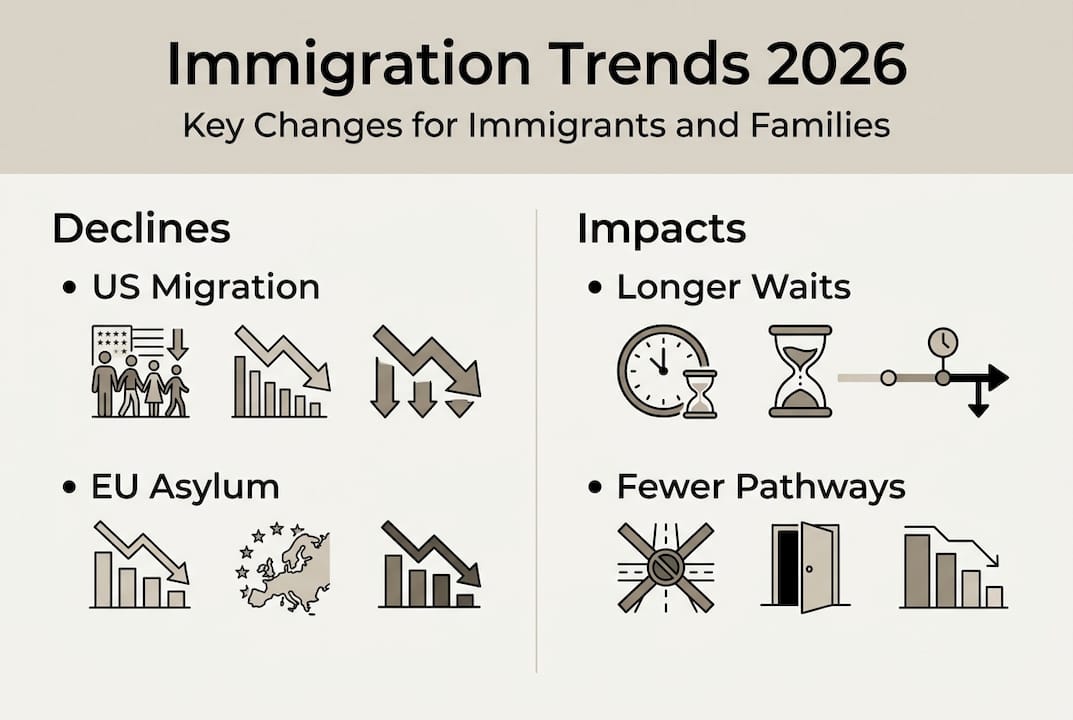
Here is a snapshot of the key numbers shaping 2026:
| Region | Key Metric | 2026 Trend |
|---|---|---|
| United States | Net migration | Possibly negative for first time in 50+ years |
| European Union | Asylum applications | Sharp decline since 2025 |
| Global | International migrants | 304 million at mid-2025 |
| Global | Refugees | 42.5 million at mid-2025 |
Key takeaways from the data:
- Western nations are receiving far fewer immigrants than in recent years
- Global displacement continues to rise even as legal entry points close
- The mismatch between need and access is creating historic backlogs
- Skilled worker and labor pathways remain the most stable entry points
The bottom line: More people need to migrate than ever before, but fewer legal pathways exist in the countries most people want to reach. That tension defines 2026.
Why are immigration flows declining? Key drivers in the US and EU
The drop in immigration is not accidental. Declines in the West are caused mainly by stricter enforcement, more limited legal options, and increased vetting, including use of AI and social media screening. Governments are not just processing fewer people. They are actively raising the bar for who qualifies.
In the United States, executive actions have expanded the categories of people subject to removal, reduced parole programs, and introduced new social media screening requirements for visa applicants. In the EU, policy tightening contrasts with persistent or rising displacement globally, meaning the political will to restrict entry is outpacing the humanitarian need to admit people.
Here is a side-by-side look at enforcement measures:
| Measure | United States | European Union |
|---|---|---|
| AI-based vetting | Yes, active in 2026 | Piloted in several member states |
| Social media screening | Required for many visas | Expanding |
| Country-specific freezes | Yes, several active | Yes, varies by country |
| Asylum processing | Severely restricted | Reduced intake at borders |
| Legal pathways | Narrowed significantly | Tightened, with exceptions |
What does this mean for you in practical terms?
- Applications that once took months now take much longer
- Evidence standards are higher, and small errors trigger denials
- Country of origin increasingly determines your options
- Understanding what immigration law covers is more important than ever before
Pro Tip: If you are preparing a filing, start collecting immigration evidence at least six months before your intended submission date. Backlogs are real, and appeals take time you may not have.
"The most dangerous assumption in 2026 is that the rules you knew last year still apply today." The landscape changes faster than most people realize.
Who is most affected by new immigration trends in 2026?
Not every applicant feels these changes equally. The impact depends heavily on your category, your country of origin, and your occupation.
Family-based applicants are facing longer waits and higher denial rates. Petitions like the I-130 are still being filed, but processing times have stretched and documentation requirements have grown stricter. Families separated by borders are waiting longer than at any point in recent memory.
Refugees and asylum seekers face the steepest climb. Both the US and EU have reduced the number of people admitted through humanitarian channels. If you are fleeing persecution, your legal options in Western countries are narrower than they were two years ago.
Skilled workers are in a different position. Some skilled worker pathways persist, especially in Canada, Australia, and select EU countries. In the US, employment-based categories like EB-3 remain active, though competitive. Understanding strategic EB-3 pathway options can make a real difference in your outcome.
Here is a breakdown of who is most affected:
- Family-based applicants: Longer backlogs, stricter evidence requirements, higher denial risk
- Refugees and asylum seekers: Severely restricted access in US and EU
- Skilled workers: Still viable, but competitive and document-intensive
- Applicants from high-risk countries: Subject to country freezes and additional scrutiny
- Low-wage workers: Fewer pathways, more uncertainty
If you are navigating the U.S. green card process, here is a practical checklist to reduce your denial risk:
- Confirm your category is currently active and accepting applications
- Gather all supporting documents before filing, not after
- Verify that your country of origin is not subject to a current freeze
- Check work visas for EU residents if you are considering alternate destinations
- Consult a professional before submitting anything
Pro Tip: Start with a complete requirements checklist for your specific visa category. Most avoidable denials come from missing one document that seemed minor at the time.
How to plan and adapt: Steps for immigrants and families in 2026
Knowing what is happening is only useful if you act on it. Here is a clear action plan built for the realities of 2026.
- Start early. USCIS compliance reviews have never been more detailed, and missing evidence or errors will cause denials. Begin your preparation at least six months ahead of any planned filing.
- Build your document file now. Use an immigration document checklist and gather everything before you start the application, not during it.
- Monitor policy changes actively. Rules changed multiple times in 2025 alone. Recheck the requirements for your specific category within 30 days of your planned submission.
- Prioritize importance of compliance review. A single inconsistency between your application and your supporting documents can trigger a request for evidence or an outright denial.
- Get comprehensive immigration support early. An experienced consultant or attorney can identify problems before they become denials.
Pro Tip: Keep a timestamped backup of every document you submit, every email you send, and every receipt you receive. If a dispute arises, your paper trail is your best defense.
"Preparation is not just about having the right documents. It is about understanding the system well enough to anticipate what comes next."
Think of your immigration application like a job interview where the interviewer already has a reason to say no. Your job is to give them no reason to use it. That means clean documentation, consistent information, and zero gaps in your evidence.
Our take: What most guides miss about the 2026 immigration landscape
Most articles about 2026 immigration trends focus on the restrictions. What they miss is the deeper lesson: adaptability matters more than any single pathway.
We have worked with clients who had their primary plan disrupted by a policy change announced with almost no warning. The ones who recovered fastest were not the ones with the most money or the best credentials. They were the ones who had already thought through a backup. A second country. An alternate visa category. A way to maintain legal status while they regrouped.
Legal help is not just for emergencies. A proactive review of your current status and your planned pathway, done now, can reveal vulnerabilities you did not know existed. We have seen how attorneys improve outcomes not by solving crises but by preventing them.
The most prepared immigrants in 2026 are not the ones who know the most rules. They are the ones who stay ready to pivot when the rules change. Build that flexibility into your plan from the start.
Get help navigating 2026 immigration challenges
The 2026 immigration landscape rewards preparation and punishes guesswork. If you are filing an I-130, pursuing an EB-3, or managing an H-1B renewal, the margin for error is smaller than it has ever been.
At True Ventures, LLC, we provide immigration filing assistance tailored to the specific pressures of this moment. Our team has firsthand immigrant experience and a deep understanding of what USCIS and other agencies are scrutinizing right now. Whether you need a full filing review or just a clear second opinion, our Minneapolis immigration consultants are ready to help you move forward with confidence and precision. Reach out today to get guidance built for 2026, not 2023.
Frequently asked questions
Is US immigration still possible in 2026 despite new restrictions?
Yes. While many legal pathways are more limited, some legal paths like EB-3 and certain family routes remain available with careful preparation and strong documentation.
How long do US and EU applications typically take in 2026?
Processing timelines are longer than in recent years due to stricter vetting and backlogs. Plan for additional months beyond standard estimates and monitor regulatory updates regularly.
Are there countries with increased immigration opportunities in 2026?
Yes. Canada and Australia have adjusted their immigration targets upward, particularly for skilled workers and occupations tied to labor shortages.
What is the most common reason for immigration application denial in 2026?
Missing evidence, incomplete documentation, or inconsistencies flagged by stricter compliance reviews are the most common reasons applications are denied or delayed.
Recommended
- U.S. Immigration Document Checklist: What Every Applicant Needs
- Navigating Your Immigration Journey with Expert Guidance
- Streamline your immigration consultation: step-by-step guide
- Navigating Immigration Filing: Tips to Avoid Errors
- Understanding What is Immigration Law: A Clear Guide | Serendib Law Firm