
Becoming a U.S. citizen is one of the most significant milestones in an immigrant's life, but the road to naturalization can feel overwhelming. Between gathering the right documents, understanding eligibility rules, preparing for the civics test, and navigating USCIS timelines, it is easy to feel lost before you even begin. We created this guide to cut through that confusion. Whether you are just starting to explore your options or you are already preparing your N-400 application, you will find clear, honest, and practical guidance at every stage of the process.
Table of Contents
- Understanding eligibility and preparing to apply
- Filing Form N-400: Methods, documents, and best practices
- Biometrics, interview, and test: What to expect and how to prepare
- Exceptions, accommodations, and how to request them
- Final steps: Decisions, Oath of Allegiance, and what comes next
- Why a detailed, personalized approach to naturalization matters more than ever
- Get expert support for your U.S. naturalization journey
- Frequently asked questions
Key Takeaways
| Point | Details |
|---|---|
| Check eligibility first | Start by confirming your citizenship status and that you meet USCIS’s naturalization requirements. |
| Prepare documents early | Gather and organize key paperwork before filing your N-400 to reduce delays and mistakes. |
| Consider filing online | An online USCIS account offers streamlined tracking and timely notifications for your application. |
| Understand exceptions | Special rules may allow you to skip the English or civics test if you qualify for age, time, or disability-related exemptions. |
| Use official study guides | Rely on USCIS’s latest civics test questions and study materials for your interview preparation. |
Understanding eligibility and preparing to apply
Before you fill out a single form, you need to confirm that you actually qualify for naturalization. Skipping this step is one of the most common and costly mistakes applicants make.
First, check whether you are already a U.S. citizen. Many people who were born abroad to at least one U.S. citizen parent may have acquired citizenship automatically at birth without knowing it. If that applies to you, you may only need to apply for a U.S. passport or a Certificate of Citizenship, not go through naturalization at all. Start there before investing time and money in an application you may not need.
If naturalization is the right path, your baseline eligibility requirements include:
- Lawful Permanent Resident (LPR) status, meaning you hold a valid Green Card
- Continuous residence in the United States, generally for five years (three years if married to and living with a U.S. citizen)
- Physical presence for at least 30 months out of the past 60 months (18 months out of 36 for the three-year path)
- Good moral character, demonstrated throughout the required residence period
- Age, at least 18 years old when filing (unless applying under a parent's naturalization)
- Commitment to the principles of the U.S. Constitution
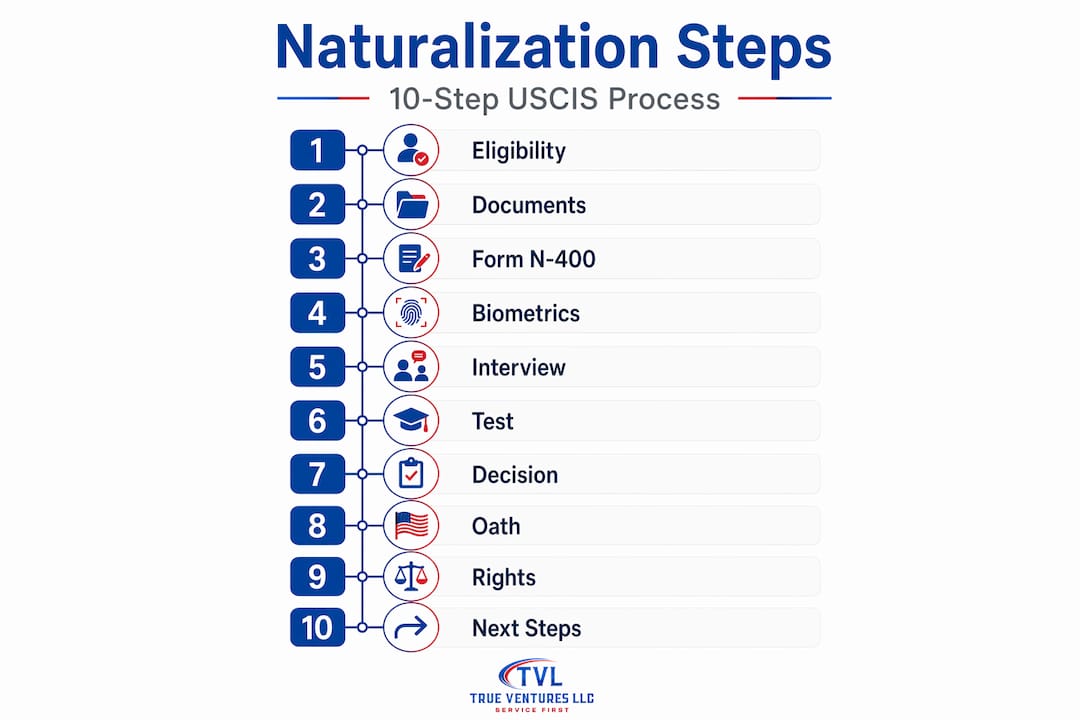
USCIS provides a 10-step overview of the naturalization process, starting with confirming whether the applicant is already a U.S. citizen and then determining eligibility. Treating these 10 steps as your master roadmap from day one keeps you organized and prevents surprises later.
Once you confirm eligibility, assemble your documents. Review a solid immigration document checklist to know exactly what to gather, and study the step-by-step immigration process to understand how each phase connects to the next.
| Document category | Examples |
|---|---|
| Identity and status | Green Card (front and back), passport, birth certificate |
| Residence history | Tax returns, utility bills, lease agreements |
| Travel records | Passport stamps, travel itinerary, I-131 approvals |
| Family records | Marriage certificate, divorce decree (if applicable) |
| Moral character | Police certificates, court records (if any) |
Pro Tip: Start building your personal document folder at least six months before you plan to file. Chasing down tax records or tracking international travel dates at the last minute creates unnecessary stress and delays.
Filing Form N-400: Methods, documents, and best practices
The N-400, Application for Naturalization, is the official form you submit to USCIS to begin the formal application process. Getting it right the first time saves months of waiting and avoids costly requests for evidence.
Form N-400 can generally be filed online or by paper. Online filing requires a USCIS online account, while paper applicants receive a notice confirming receipt. Each method has trade-offs worth understanding.
| Filing method | Advantages | Disadvantages |
|---|---|---|
| Online (USCIS account) | Real-time case tracking, instant confirmation, faster communication | Requires internet access and a USCIS account setup |
| Paper mail | No technology barrier, familiar process | Slower confirmation, no real-time status updates |
Here is a step-by-step approach to completing and submitting your N-400:
- Create your USCIS online account if you plan to file digitally. Do this at least two weeks before your target filing date so you can become familiar with the system.
- Read every question carefully. The N-400 asks about your personal history, residence, employment, travel, and moral character going back many years. Answer fully and honestly.
- Gather your supporting documents. This includes a copy of your Green Card, two passport-style photos, and any documentation relevant to your specific situation such as name change records or military service paperwork.
- Double-check all entries before submitting. Inconsistencies between your N-400 and your immigration history are a leading cause of delays and interview complications.
- Pay the filing fee. As of 2026, the standard N-400 filing fee is $760 for online filers and $810 for paper filers. Fee waivers are available for qualifying low-income applicants.
- Keep copies of everything you submit. Store both paper and digital copies in a secure place.
Knowing how to properly collect immigration evidence strengthens every part of your application. Also understand the role that notaries play in immigration filings. In the United States, immigration notaries are not attorneys, so be cautious about who prepares or reviews your paperwork.
Pro Tip: Set up your USCIS online account early, even weeks before you are ready to file. Familiarity with the system prevents last-minute technical issues that can derail your submission date.
Biometrics, interview, and test: What to expect and how to prepare
Once USCIS receives your N-400 and confirms it is complete, the process shifts into active review. Three major milestones follow: biometrics, an interview, and the naturalization test.
Biometrics comes first. After filing, USCIS will send you an appointment notice to visit an Application Support Center (ASC). There, a technician collects your fingerprints, photograph, and signature. This information runs through FBI and other federal databases to verify your background and identity. The appointment itself is quick, usually under 30 minutes, but you must attend. Missing it without rescheduling can pause or close your case.
The naturalization interview comes next, typically scheduled several months after biometrics. A USCIS officer reviews your N-400 with you in person. They will ask you to confirm and clarify your answers, verify your documents, and assess your English communication skills in real time during the conversation.
USCIS's naturalization interview and test include an English test and a civics test, unless an exemption applies. For the English test, the officer evaluates your ability to read, write, and speak basic English through reading sentences aloud, writing a dictated sentence, and conversing during the interview. For the civics test, applicants must answer oral questions about U.S. history and government.
Here is what the civics test structure looks like for new applicants:
- The officer asks up to 20 civics questions from the official question bank.
- You must answer at least 12 correctly to pass.
- Questions cover topics like the branches of government, the Bill of Rights, U.S. history, and the role of the Constitution.
- All answers are oral, not written.
"Applicants filing Form N-400 on or after Oct. 20, 2025 take the new 2025 civics test."
USCIS provides official study resources for the naturalization interview and test, including the 2025 civics question and answer document and a full study guide. These resources are free and available in multiple languages for the civics portion. Make them part of your daily study routine starting at least three months before your interview date.
Understanding the advantages of legal immigration assistance can be especially valuable at this stage. Many applicants benefit from mock interviews and practice sessions with experienced professionals who know what officers commonly ask.
Exceptions, accommodations, and how to request them
Not every applicant follows the standard path. USCIS has important exceptions and accommodations designed to make the naturalization process accessible to people with different circumstances, ages, and abilities.
USCIS provides an exceptions and accommodations page that covers the two primary age and residence exemptions for the English test requirement:
- The 50/20 exemption: If you are 50 years of age or older and have lived in the U.S. as a lawful permanent resident for at least 20 years, you are exempt from the English language test. You may take the civics test in your native language using an interpreter.
- The 55/15 exemption: If you are 55 years of age or older and have lived in the U.S. as a lawful permanent resident for at least 15 years, you also qualify for the English test exemption and may use an interpreter for the civics test.
- The 65/20 exception: Applicants who are 65 or older and have been LPRs for at least 20 years take a shorter version of the civics test covering only 20 specially designated questions, of which they must answer 6 correctly.
- Medical disability exceptions: If a physical or developmental disability or mental impairment prevents you from meeting English or civics requirements, you can file Form N-648, Medical Certification for Disability Exceptions, completed by a licensed medical professional. This form must accompany your N-400 at the time of filing.
Beyond test exemptions, USCIS also provides disability accommodations for interview logistics. These include sign language interpreters, wheelchair-accessible interview rooms, extended appointment times, and other arrangements for applicants who need them. The key is planning ahead. Do not wait until your interview notice arrives to ask for accommodations.
Understanding your rights means understanding what USCIS is and how it operates as a federal agency. Knowing the organizational structure helps you navigate its systems with less frustration.
Pro Tip: Contact your local USCIS field office as soon as you file your N-400 if you anticipate needing accommodations. Early communication gives the office time to prepare and dramatically reduces the chance of delays at your appointment.
Final steps: Decisions, Oath of Allegiance, and what comes next
After your interview, USCIS has three possible responses: approve your application, continue it for additional review, or deny it. Most applicants who are well-prepared receive an approval either at the end of their interview or shortly after by mail.
Here is how the final phase typically unfolds:
- Receive your decision. If approved at the interview, USCIS may schedule your oath ceremony immediately or send you a notice with the date.
- Receive Form N-445, the Notice of Naturalization Oath Ceremony. Review its instructions carefully and bring it to your ceremony along with your Green Card.
- Attend the Oath of Allegiance ceremony. This may be a judicial ceremony conducted in a federal court or an administrative ceremony run by a USCIS officer. Both are equally valid.
- Take the Oath. You will swear or affirm your allegiance to the United States, renounce foreign allegiances, and commit to supporting the Constitution. This is the formal, legal moment you become a U.S. citizen.
- Receive your Certificate of Naturalization. Guard this document carefully. It is your primary proof of citizenship.
- Update your records. Apply for a U.S. passport, update your Social Security record, register to vote, and inform relevant agencies of your new status.
USCIS's 10-step naturalization overview ends with the Oath, but your responsibilities as a new citizen continue. These include serving on juries if called, filing U.S. taxes on worldwide income, and being eligible to vote in all federal, state, and local elections.
Transitioning from permanent resident to citizen also has immigration benefits for your family. As a U.S. citizen, you can petition for certain immediate relatives in categories that have no annual visa cap, which can dramatically speed up family reunification. Review the Green Card process guide to understand how citizenship changes your ability to support family members still abroad.
Why a detailed, personalized approach to naturalization matters more than ever
Here is something we rarely hear stated plainly: the official USCIS checklist is a starting point, not a finish line.
Many applicants treat the 10 steps as a simple linear path. Follow the steps, pass the test, take the oath, done. But immigration, like life, rarely works that cleanly. The eligibility rules interact with each other in ways that trip up even well-prepared applicants. A single extended international trip can break your continuous residence. A tax filing inconsistency from years ago can raise a good moral character question. A policy update, like the October 2025 civics test change, can shift how you need to prepare mid-process.
What experienced applicants understand is that naturalization is an ongoing project with a long runway, not a one-time event. That means starting your document collection well before you are eligible. It means tracking your exact days of physical presence throughout your entire LPR period. It means knowing in advance whether any family member's special circumstance, like a disability or advanced age, qualifies them for an exemption so that the accommodation request is ready from day one.
The 10 steps also mask enormous variation in timelines. Depending on which USCIS field office has jurisdiction over your address, your wait between filing and interview could be eight months or over 18 months. Understanding your local office's processing times lets you plan realistically rather than waiting anxiously.
We have seen how much a tailored, strategic approach changes outcomes. Reviewing the detailed Green Card process gives you context for how all the immigration stages connect and why strategy at each phase matters more than most people realize. The applicants who succeed most smoothly are the ones who treat preparation as a discipline, not a last-minute task.
Get expert support for your U.S. naturalization journey
Navigating the naturalization process with confidence is absolutely possible, but the details matter enormously. A missed document, a misread eligibility rule, or an overlooked accommodation request can add months to an already long journey.
At True Ventures, LLC, we understand this process from the inside out because many on our team have lived it firsthand. We work with individuals and families in Minneapolis and across the country to build accurate, well-organized application packages and develop personalized strategies for every stage of naturalization. Whether you are assessing eligibility for the first time or preparing for your interview, our immigration consulting services are designed to give you the clarity and confidence you deserve. Let us help you get this right.
Frequently asked questions
How long does the U.S. naturalization process typically take?
The entire process from filing Form N-400 to citizenship usually takes 12 to 18 months, though timing varies significantly by your local USCIS field office and the complexity of your case.
Can I take the naturalization test in a language other than English?
Yes. If you qualify for the 50/20 or 55/15 exemption, or have an approved medical disability exception, you may take the civics test in your preferred language using an interpreter.
What happens if I do not pass the civics or English test?
USCIS allows one retest for the English and civics portions, typically scheduled within 60 to 90 days of your original interview date, giving you time to study and prepare more effectively.
Where can I find official study materials for the new civics test?
USCIS offers free official civics study guides, including the full 2025 civics test question and answer sheet, directly on its website at no cost.
How do I request accommodations for a disability during the naturalization process?
File Form N-648 alongside your N-400 and contact your USCIS field office early to arrange any physical or logistical accommodations needed for your interview appointment.