

Imagine spending months gathering documents, paying fees, and waiting anxiously, only to get a notice that your application was rerouted because the medical exam envelope was not sealed correctly. This scenario is more common than most families realize, and it is exactly the kind of preventable setback that derails green card applications every year. The legal permanent residency process in the United States involves layers of forms, eligibility criteria, and sequential steps that must align precisely. This guide walks you through each phase of the workflow so you can avoid confusion, prepare correctly, and give your family the best possible outcome.
Table of Contents
- Understanding the legal permanent resident workflow
- Eligibility and prerequisites for adjustment of status
- Step-by-step checklist: filing forms and supporting documents
- Troubleshooting and avoiding common mistakes
- Verifying application status and final decision
- What most guides miss about the legal permanent resident workflow
- Get expert help with your green card application
- Frequently asked questions
Key Takeaways
| Point | Details |
|---|---|
| Two-phase process | Permanent residency workflow involves both petition and adjustment steps, each with its own requirements. |
| Essential documents | Missing or mishandled forms like I-693 or incorrect I-130 selections can cause delays or denials. |
| Status monitoring | Regularly check your application status to stay ahead of interview scheduling and requests for evidence. |
| Avoid common errors | Carefully follow USCIS instructions to prevent misrouting and minimize avoidable mistakes. |
| Expert guidance | Professional help can simplify the workflow and ensure you meet all legal requirements accurately. |
Understanding the legal permanent resident workflow
Now that you understand why mistakes happen, let's break down the core workflow and terminology so you can see how the process fits together.
The legal permanent resident workflow involves two main phases: the immigrant petition and the adjustment of status or consular processing. Understanding what separates these two phases prevents the most common source of confusion for families just starting out.
The petition phase is where a qualifying sponsor, usually a U.S. citizen or lawful permanent resident family member, formally asks the government to recognize a relationship or employment qualification. The adjustment phase is where the immigrant, already inside the United States, changes their status to lawful permanent resident without leaving the country. Families who entered on a visa or were paroled in typically go through adjustment. Those outside the U.S. go through consular processing at a U.S. embassy abroad.
| Feature | Adjustment of status | Consular processing |
|---|---|---|
| Where it happens | Inside the United States | At a U.S. embassy abroad |
| Primary form | Form I-485 | DS-260 |
| Medical exam | Form I-693, civil surgeon | Medical at approved panel physician |
| Work authorization | Available via Form I-765 while pending | Not available until visa is issued |
| Travel | Requires advance parole | Person remains abroad until approved |
For the step-by-step green card process, three forms anchor the family-based workflow: Form I-130 (Petition for Alien Relative), Form I-485 (Application to Register Permanent Residence), and Form I-693 (Report of Medical Examination and Vaccination Record). Each form plays a distinct role, and submitting them out of sequence or without the right supporting documents leads directly to delays.
"Understanding which phase you're in, petition or adjustment, determines every document you need and every deadline you must meet."
Reviewing clear immigration paths early in your planning helps you visualize the full timeline and ensures you're not surprised by steps that seem to come out of nowhere.
Eligibility and prerequisites for adjustment of status
With a sense of the big picture, let's clarify who qualifies and what you must have ready before filing any forms.
Eligibility for family-preference adjustment involves maintaining the family relationship, being admissible or eligible for a waiver, and meeting discretion criteria. In practical terms, this means three things need to be true at the same time.

First, the qualifying relationship must exist and still be intact. For immediate relatives, such as spouses, unmarried children under 21, and parents of U.S. citizens, this tends to be straightforward. For preference category relatives, the relationship must fall under one of the four family preference categories established by immigration law.
Second, you must be admissible to the United States. Admissibility is the legal standard for being allowed to receive a green card. Certain bars under INA Section 245(c) can disqualify someone even if they have an approved petition. Common bars include:
- Entering without inspection (crossing the border unlawfully)
- Failing to maintain continuous lawful status after the age of 18
- Working without authorization
- Being in removal proceedings in certain circumstances
Third, a visa number must be immediately available. For immediate relatives, there is no cap, so a visa is always available. For preference categories, the Department of State Visa Bulletin determines monthly availability based on country of birth and priority date. Checking the Visa Bulletin before filing any forms is non-negotiable.
Reviewing EB-3 visa adjustment steps can also help if your family's case involves employment-based pathways that overlap with adjustment eligibility timelines.
| Category | Who qualifies | Annual cap? |
|---|---|---|
| Immediate relative | Spouse, unmarried child under 21, parent of U.S. citizen | No cap |
| Family preference F1 | Unmarried sons/daughters of U.S. citizens | Yes |
| Family preference F2A | Spouses and children of permanent residents | Yes |
| Family preference F2B | Unmarried adult children of permanent residents | Yes |
| Family preference F3/F4 | Married children and siblings of U.S. citizens | Yes |
Step-by-step checklist: filing forms and supporting documents
Once you've confirmed eligibility, here's your complete checklist for each major step, from petition to interview.
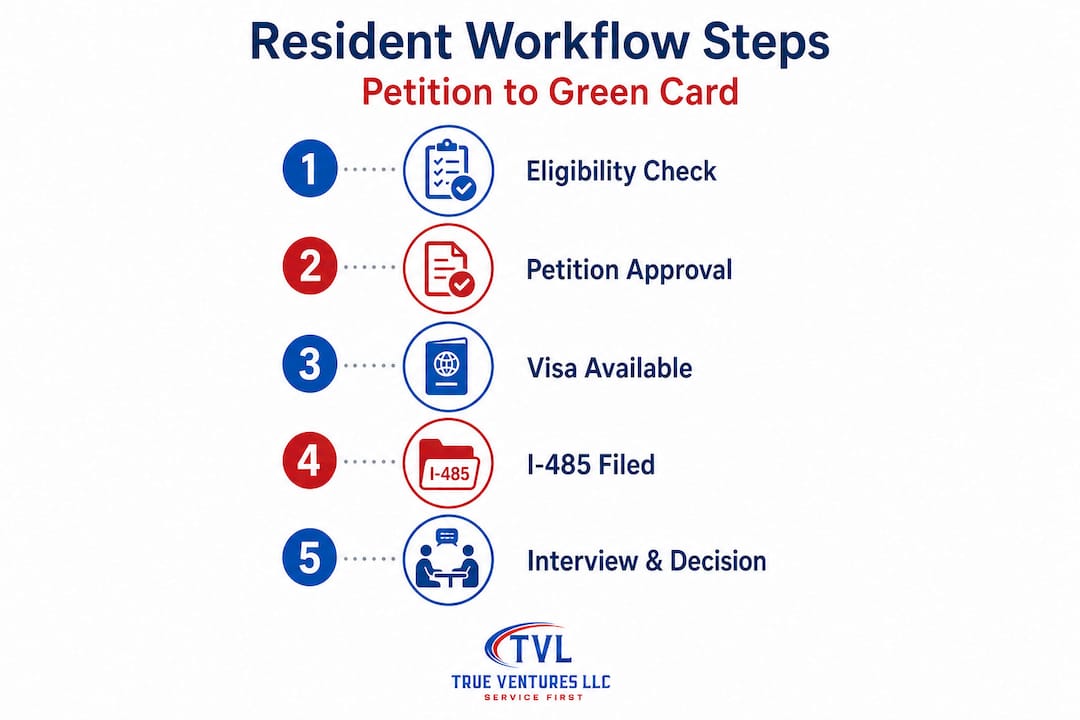
The adjustment of status workflow covers eligibility confirmation, an approved petition, visa availability, filing I-485, biometrics, interview, potential requests for evidence, and a final decision. Following this sequence carefully is the difference between a smooth process and one that stalls for months.
1. File Form I-130 with the correct Part 4 selection. Part 4 of the I-130 asks where the applicant will apply for an immigrant visa. If the applicant is inside the United States and eligible to adjust status, you select "Adjustment of Status." If they are abroad, you select the appropriate consulate. Getting this wrong routes your file to the wrong processing center and triggers unnecessary delays.
2. Gather supporting documents for the petition. Required evidence typically includes proof of the petitioner's U.S. citizenship or permanent residency, proof of the qualifying relationship (birth certificates, marriage certificates), and government-issued identification for both parties. Certified translations are required for any document not in English.
3. Wait for petition approval or file concurrently if eligible. Immediate relatives can file the I-130 and I-485 at the same time. Preference category applicants must wait for petition approval and for a visa number to become current before filing I-485.
4. Schedule and complete the civil surgeon medical exam. This step trips up more families than almost any other. The civil surgeon completes Form I-693, seals it in an envelope, and signs across the seal. You must submit this sealed envelope to USCIS. The primary adjustment-of-status form is Form I-485, which must be filed with the I-693 medical in a sealed envelope unless online filing is allowed. Opening that envelope invalidates the entire medical exam and forces you to pay for and complete another one.
5. File Form I-485 with all required supporting documents. The I-485 package typically includes: two passport-style photos, a copy of the I-94 arrival record, a copy of the passport biographical page, the sealed I-693 envelope, copies of any prior immigration approvals, Form I-864 (Affidavit of Support) with supporting financial documentation, and the filing fee.
6. Complete the biometrics appointment. After filing, USCIS mails an appointment notice for biometrics, where they collect fingerprints, photos, and a signature. This information is used for background checks. Missing this appointment without rescheduling can put your case on hold.
7. Prepare for the adjustment of status interview. Most family-based I-485 cases require an in-person interview. You will be asked questions about your application, your background, and your relationship. Bring original versions of every document submitted. Organize them in the same order as your application.
8. Respond promptly to any Request for Evidence. If USCIS issues a Request for Evidence (RFE), you have a deadline to respond. Missing the deadline typically results in denial. Working on collecting immigration evidence in advance, before you even file, reduces the chance of receiving an RFE significantly.
"Your application is only as strong as the evidence behind it. Organize every document before filing, not after a request arrives."
Pro Tip: Create a physical folder and a digital backup for every document in your application. Label each document clearly and organize them by form and section. This saves significant time if USCIS requests additional evidence or if your attorney needs to review materials quickly. Consider using filing Form I-485 support services if document organization feels overwhelming.
Troubleshooting and avoiding common mistakes
With forms submitted, now focus on avoiding mistakes that commonly lead to delays or rejected applications.
USCIS explicitly calls out missing or incorrectly handled I-693 envelopes and improper Part 4 selections on the I-130 as reasons for routing delays or application confusion. These are not minor clerical issues. They affect which office processes your case and whether your medical exam is accepted at all.
Here are the most frequent mistakes families make and how to avoid each one:
- Opening the I-693 sealed envelope. Once the civil surgeon seals it, do not open it for any reason. If you are unsure whether the seal is intact, contact the civil surgeon's office before submitting.
- Filing an outdated form version. USCIS updates forms regularly. Always download the form directly from the USCIS website the day you plan to complete it. Submitting an expired version results in rejection.
- Submitting documents without certified translations. Any document in a foreign language must come with a full English translation signed by a certified translator. Partial translations are not accepted.
- Mismatched names across documents. Your name must appear consistently across every form and every supporting document. A middle name omitted on one form but included on another can trigger an RFE.
- Missing the Affidavit of Support documentation. The I-864 requires the sponsor's most recent tax return, W-2s, and proof of current income. Missing any component of the financial evidence package is one of the most common reasons for RFEs in family-based cases.
- Waiting too long to track your case. Many families file and then wait passively. You should set up a USCIS online account and check your case status regularly.
Pro Tip: Track your application status through the USCIS online portal every week after filing. Case status changes can indicate action is needed, and catching them early gives you time to respond correctly.
Verifying application status and final decision
Finally, let's cover how you'll verify your progress and ensure you receive the decision you're striving for.
Case status updates, biometrics, interviews, and the final USCIS decision are central to the workflow's last phase. Each milestone in this phase requires your attention, not just your patience.
After filing, you can expect the following progression:
- Receipt notice (Form I-797): Confirms USCIS received your application. The receipt number on this notice is what you use to check your case status online.
- Biometrics notice: Usually arrives within a few weeks. Attend on the scheduled date. Rescheduling is possible but adds weeks to your timeline.
- Interview notice: Schedules your in-person appointment at a local USCIS field office. Bring your original documents organized exactly as they appear in your filing.
- Decision: After the interview, USCIS may approve on the spot, request more evidence, or issue a notice of intent to deny. Approvals result in a welcome notice followed by a green card mailed to your address.
You can monitor your tracking immigration application progress through your USCIS online account, which displays real-time case status changes and any notices sent to your address.
If USCIS denies your application, you generally have options to appeal or file a motion to reopen depending on the reason for denial. Understanding why a denial happens is critical before taking any next step.
What most guides miss about the legal permanent resident workflow
Most immigration guides treat the green card process as a simple checklist. File this form. Submit that document. Show up at the appointment. Done. But families who experience delays consistently report that their mistakes were not about missing items, they were about misunderstanding the purpose of each item.
Take the I-693 sealed envelope as an example. Every guide says "submit it sealed." But very few explain why. The reason is that USCIS needs to verify the civil surgeon's findings are unaltered. The sealed envelope is a chain-of-custody mechanism. When families understand that, they don't casually open it "just to check." The same logic applies to I-130 Part 4. That selection is not just a checkbox. It determines which USCIS processing pathway your entire case follows. Selecting the wrong option sends your file to a completely different workflow, and unwinding that mistake takes time that could stretch your timeline by months.
We've worked alongside families who experienced exactly these setbacks. A spouse who had everything ready, but whose I-130 Part 4 selection pointed to consular processing instead of adjustment of status, spent four additional months correcting the routing before their I-485 could even be reviewed. That is a four-month delay on what should have been a routine family-based case.
The deeper issue is that USCIS instructions are written in legal and administrative language that does not match how families understand their own situations. The instructions assume you know what "principal applicant" means, that you understand the difference between "inspected and admitted" versus "inspected and paroled," and that you can cross-reference INA sections independently.
Our perspective: structured preparation beats reactive problem-solving every time. When you take a deep dive on the green card process before you file, not after something goes wrong, you shift from hoping for the best to knowing what to expect. That shift alone changes outcomes for families we work with every day.
Get expert help with your green card application
Navigating the legal permanent residency workflow with precision is possible, but it requires knowing every step and what can go wrong at each one. At True Ventures, LLC, we work with immigrant families across the Minneapolis area and nationwide to make this process manageable, accurate, and far less stressful.
Our immigration filing assistance services help you organize every required document, complete each form correctly, and avoid the common errors that lead to delays and RFEs. From Form I-130 through the final green card decision, we guide you through each phase with clear timelines and direct support. Explore our consulting services to find the right level of help for your family's situation. The goal is simple: get it right the first time.
Frequently asked questions
What are the main steps in the legal permanent resident workflow?
The adjustment workflow steps are eligibility confirmation, petition approval, visa availability, filing Form I-485, attending biometrics, completing the interview, responding to any requests for evidence, and receiving a final USCIS decision.
Do I need a medical exam for adjustment of status?
Yes, USCIS requires Form I-693 signed and sealed by a civil surgeon, and you must submit it with your Form I-485 or when specifically requested by USCIS.
Can I file Form I-485 online?
Online filing for I-485 is only available for stand-alone, employment-based cases; the majority of family-based I-485 applications must still be submitted by mail.
What happens if I make a mistake on Form I-130 or miss the sealed envelope for the medical exam?
Errors in form completion or improper medical envelope handling can delay your case, trigger rerouting to the wrong processing pathway, and require significant time to correct before your application moves forward again.