
Many applicants assume their most recent annual physical is close enough, or that showing up with a stack of vaccination records will satisfy U.S. immigration authorities. It will not. The immigration medical exam is a federally regulated health screening, entirely separate from routine medical care, and it directly affects whether your adjustment of status application succeeds or fails. Under INA section 212(a)(1), USCIS requires applicants to prove they are not inadmissible on health-related grounds. This guide walks you through every step, requirement, and practical tip you need to complete this process without costly mistakes.
Table of Contents
- Who needs the immigration medical exam and why
- What happens during the exam: Process, procedures, and tests
- Vaccination requirements and flexible exceptions
- Class A and Class B conditions: What makes you inadmissible?
- Results, validity, fees, and what to bring
- A fresh perspective: Why the immigration medical exam is a gatekeeper, not just a formality
- How True Ventures helps you navigate the immigration medical exam
- Frequently asked questions
Key Takeaways
| Point | Details |
|---|---|
| Exam is mandatory | Most applicants seeking U.S. status adjustment must complete the immigration medical exam for legal clearance. |
| Follow official procedures | Only USCIS-approved civil surgeons and CDC rules deliver valid results; shortcuts lead to rejection. |
| Vaccination flexibility | You need only one dose for incomplete series, and some adults qualify for immunity by age or history. |
| Class A conditions affect eligibility | Certain findings can result in denied applications unless a waiver or treatment is approved. |
| Results must be timely | Exam results are valid only while your immigration application is pending, so timing is crucial. |
Who needs the immigration medical exam and why
Having introduced the purpose and requirements, let's clarify who needs the exam and why it's essential for your application.
Most people filing Form I-485 (Application to Register Permanent Residence or Adjust Status) must complete an immigration medical exam. This applies to family-based petitioners, employment-based applicants, diversity visa winners, and many others seeking lawful permanent residence inside the United States. If you are applying from abroad through consular processing, the U.S. embassy or consulate coordinates your medical exam separately, but the underlying screening standards are the same.
The reason the exam exists is straightforward: U.S. law prohibits granting permanent residence to individuals with certain health-related conditions that pose a public health risk or require vaccination compliance. USCIS is not evaluating whether you are healthy in a general sense. It is specifically checking whether you fall under any health-related grounds of inadmissibility, which are defined in the Immigration and Nationality Act.
The consequences of skipping this step or submitting an incomplete exam are serious. Here is what can happen:
- Your I-485 application can be rejected outright if Form I-693 is missing
- An incomplete or improperly sealed form results in a Request for Evidence (RFE), which delays your case by months
- Using an expired exam forces you to pay for and repeat the entire process
- Submitting results from a doctor who is not a USCIS-designated civil surgeon renders the exam invalid
"The immigration medical exam is a health screening required for most U.S. adjustment of status applicants to demonstrate they are not inadmissible on health-related grounds under INA section 212(a)(1)." — USCIS
Working with knowledgeable immigration consultants who understand these requirements can prevent easily avoidable errors that stall your case.
What happens during the exam: Process, procedures, and tests
Now that you know who the exam affects, let's break down what actually happens during the appointment and what is tested.
The exam follows a structured sequence that every civil surgeon must complete according to CDC Technical Instructions. These instructions are legally binding, not optional guidelines. Here is what the appointment typically looks like, step by step:
- Identity and document verification. The civil surgeon confirms your government-issued ID and reviews any medical records you bring.
- Medical history review. You answer questions about past illnesses, hospitalizations, mental health treatment, substance use, and current medications.
- Physical examination. A head-to-toe examination checks for signs of communicable diseases, physical abnormalities, and other conditions relevant to inadmissibility.
- TB screening. Depending on your age and history, this is either an IGRA blood test or TST skin test. A chest X-ray follows if the result is positive or if you have TB risk factors.
- Blood tests. Syphilis testing is required for age-appropriate applicants. Additional blood work may be ordered based on findings.
- Gonorrhea urine test. Required for applicants aged 15 and older.
- Mental health evaluation. The civil surgeon screens for harmful behavior associated with physical or mental disorders.
- Drug abuse and addiction screen. Substance abuse is a Class A condition, so this assessment is taken seriously.
- Vaccination review. Your records are checked against CDC requirements. Missing vaccines are administered at the appointment if available.
The exam requirements are detailed and standardized: every civil surgeon performing this exam must follow exact protocols, and any deviation can invalidate results.
Comparison: Immigration medical exam vs. regular physical
| Feature | Immigration medical exam | Regular physical |
|---|---|---|
| Doctor required | USCIS-designated civil surgeon only | Any licensed physician |
| Purpose | Legal inadmissibility screening | General health assessment |
| Results form | Sealed Form I-693 for USCIS | Standard patient records |
| TB screening | Required for all applicants | At doctor's discretion |
| Vaccination compliance | Federally mandated list | Clinically recommended |
| Legal consequences | Affects immigration status | None |
Pro Tip: Book your appointment as early as possible. Civil surgeons in busy metro areas fill up fast, and some tests (like TST skin tests) require a follow-up visit 48 to 72 hours later, which can push your overall timeline by a week or more.
If any findings raise concerns, the civil surgeon may refer you to a specialist before completing Form I-693. Knowing about potential issues in advance, such as a previously treated tuberculosis case or a mental health history, gives you time to gather documentation and explore your immigration waiver guide options before your appointment.
Vaccination requirements and flexible exceptions
With the required tests covered, let's look at what vaccinations you must show, and when exceptions apply.
Vaccination compliance is one of the most misunderstood parts of the immigration medical exam. Many applicants assume they need to complete entire multi-dose vaccine series before the appointment, but that is not accurate.
According to CDC vaccine requirements, one dose of an age-appropriate vaccine is sufficient, even if a full series has not been completed. The civil surgeon documents what you have received and may administer missing doses on the spot.
Vaccines reviewed during the immigration medical exam
| Vaccine | Age group | Notes |
|---|---|---|
| MMR (measles, mumps, rubella) | All ages | Presumptive immunity for adults born before 1957 |
| Tdap/Td | All ages | Tdap once, Td boosters every 10 years |
| Polio (IPV) | All ages | Adults may need 1-3 doses |
| Varicella | All ages | Presumptive immunity if born before 1980 |
| Hepatitis B | All ages | 3-dose series; 1 dose accepted |
| Hepatitis A | All ages | 2-dose series; 1 dose accepted |
| Influenza | All ages (Oct to Mar) | Annual during flu season |
| Pneumococcal | 65+ and at-risk groups | Based on age and health status |
| Meningococcal | Ages 11 to 18 | Required for this age group |
| Hib and Rotavirus | Infants and toddlers | Age-specific schedules apply |
Exceptions exist for specific populations:
- Refugees and asylees may have already completed vaccine requirements at overseas processing and may be exempt from duplicate vaccination
- Military applicants who received vaccines through the armed forces may use those records as evidence
- Presumptive immunity applies for certain vaccines based on birth year, eliminating the need for blood titer tests
- Applicants with documented medical contraindications (allergies or conditions that make a vaccine unsafe) may qualify for individual waivers
Bring every vaccination record you have, including childhood immunization cards from your home country. If records are in another language, the civil surgeon can typically interpret them, but having a translation ready prevents delays.
Class A and Class B conditions: What makes you inadmissible?
After learning what is tested, it's crucial to understand which findings actually threaten your immigration status.
Not every medical finding causes a problem. USCIS categorizes results into two classes, and understanding the difference removes a lot of unnecessary fear from the process.
Class A conditions are the ones that matter most legally. These conditions render applicants inadmissible under U.S. immigration law:
- Active tuberculosis or other communicable diseases of public health significance
- Failure to comply with vaccination requirements
- A physical or mental disorder associated with harmful behavior that is likely to recur
- Drug abuse or addiction, including dependence on controlled substances
Class B conditions are notable physical or mental health issues that do not, by themselves, make you inadmissible. These include conditions like well-controlled diabetes, hypertension, obesity, or resolved mental health issues without harmful behavior. They are documented on Form I-693 for USCIS awareness but do not block your application.
"Class A conditions (inadmissible): communicable diseases of public health significance, failure to vaccinate, physical or mental disorder with harmful behavior likely to recur, drug abuse or addiction. Class B: serious but not inadmissible conditions." — USCIS Policy Manual, Volume 8, Part B, Chapter 2
Pro Tip: If you have a history of substance use disorder, mental health treatment, or a communicable disease, do not hide it. Full, honest disclosure with supporting medical documentation (showing treatment completion or management) is far safer than omission, which can lead to permanent bars based on fraud or misrepresentation.
For applicants who do receive a Class A finding, all is not necessarily lost. Waiver pathways exist, particularly for certain communicable diseases and vaccination-related issues. Exploring options for overcoming inadmissibility with professional guidance significantly improves your chances of a successful resolution.
Results, validity, fees, and what to bring
Once you've completed the exam, here's how to handle results, validity, and practical prep to avoid delays.
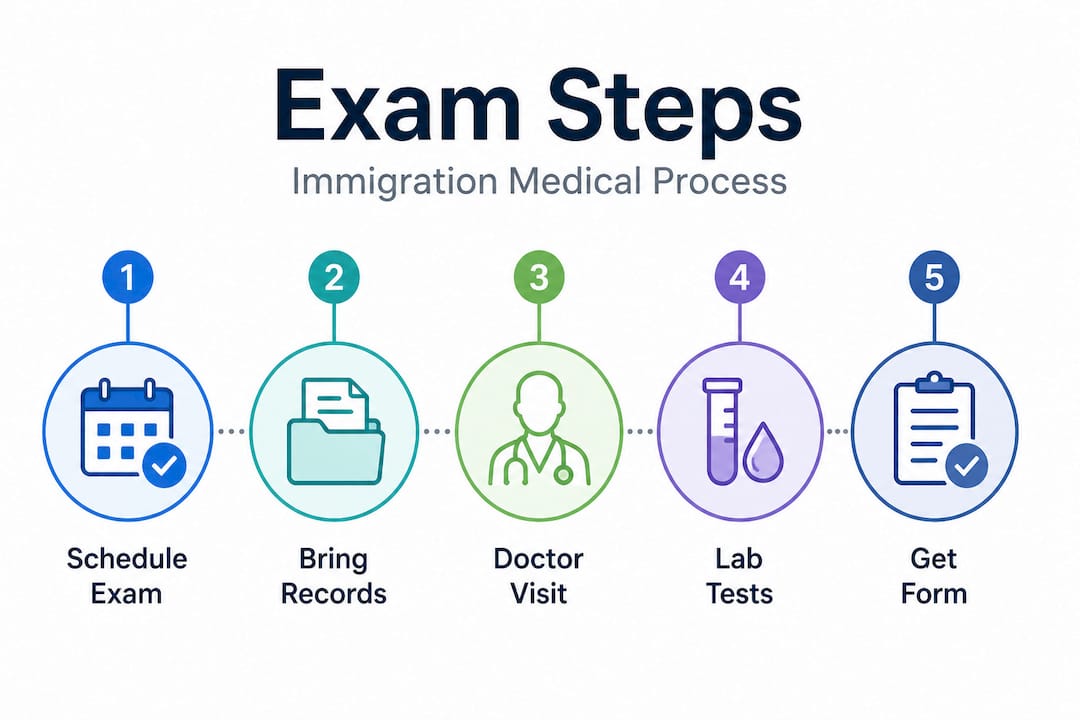
After the civil surgeon finishes all required assessments, the results are recorded on Form I-693. Both you and the civil surgeon must sign the form. It is then placed in a sealed envelope, which you must never open. An opened envelope invalidates the entire exam. The sealed form is submitted directly to USCIS with your I-485 application.
Here is exactly what to do before your appointment:
- Locate a USCIS-designated civil surgeon. Use the USCIS civil surgeon locator to find an authorized provider near you. Do not go to a general practitioner or urgent care clinic.
- Complete Form I-693, Part 1. Fill out the applicant sections before your appointment to save time.
- Gather your documents. Government-issued photo ID, all available vaccination records, a list of current medications, and any relevant medical history documentation.
- Budget for the cost. Civil surgeon fees typically range from $350 to $900. These fees are set independently by each civil surgeon, are not standardized nationally, and are usually not covered by insurance.
- Ask about same-day vaccines. Some civil surgeons stock common vaccines on site. Others require you to get them at a pharmacy first and return with proof. Confirm this before your appointment.
Important validity rules changed in 2025. For Form I-693 results signed on or after November 1, 2023, the form is valid only while your I-485 is pending. If your application is denied, withdrawn, or otherwise closed, the exam results become invalid and you must repeat the entire process before refiling. Under the prior rule (pre-November 2023), results were valid for two years from the civil surgeon's signature, regardless of application status.
Since December 2, 2024, Form I-693 must be submitted with Form I-485 at the time of filing. USCIS will reject applications missing this form rather than issuing an RFE. That is a significant shift that catches many applicants off guard.
A fresh perspective: Why the immigration medical exam is a gatekeeper, not just a formality
Beyond procedures and forms, let's discuss what the medical exam truly protects, and why treating it as a routine checkup is a mistake.
Here is something most articles on this topic miss: the immigration medical exam is fundamentally a public health tool, not a judgment on your individual health or worthiness as an immigrant. This distinction matters enormously because it changes how you should think about and prepare for it.
USCIS is not asking whether you are healthy by some ideal standard. It is screening for conditions that pose a risk of transmission or create a pattern of behavior harmful to others. Chronic, well-managed conditions like diabetes, hypertension, asthma, or depression do not trigger inadmissibility. The USCIS policy framework explicitly acknowledges that managed conditions without public health implications are Class B at worst, never Class A.
What applicants actually get tripped up by is documentation gaps, not medical conditions. Incomplete vaccination records. Missing TB test follow-ups. Outdated exams submitted after an application denial. These are procedural failures, and they are entirely preventable with proper planning.
The 2025 validity rule change reflects a genuine shift in how USCIS tracks public health continuity. Rather than allowing applicants to file and wait years with a fixed exam window, the new framework ties validity to active case status. This means USCIS can ensure that the health information they act on is current relative to the timeline of the case. It is a smarter system from a public health standpoint, even if it feels like a burden to applicants.
Our experience working through these requirements with clients at True Ventures has shown that the applicants who fare best are those who treat the medical exam as the legal document it is, not a doctor's appointment. Organizing your paperwork, understanding which conditions matter legally, and consulting a compliance review for immigration before you file are the habits that protect your case.
How True Ventures helps you navigate the immigration medical exam
Ready for your exam and paperwork? Here is how expert support can make the difference.
The immigration medical exam sits at the intersection of medicine and immigration law, and mistakes on either side carry serious consequences. At True Ventures, LLC, we work with clients in Minneapolis and across the country to prepare their I-485 applications accurately, including guidance on Form I-693 timing, document checklists, and next steps when complications arise.

Our team understands these requirements from the inside, because we have navigated them firsthand. Whether you need help organizing your immigration filing assistance package, figuring out how to address a Class B finding, or simply want a second set of eyes before you submit, our True Ventures services are built for exactly this moment. Reach out before your exam, not after a rejection notice.
Frequently asked questions
What should I bring to my immigration medical exam?
Bring government-issued photo ID, all available vaccination and medical records, a complete list of current medications, and Form I-693 with Part 1 already filled out by you.
How much does the immigration medical exam cost?
Fees typically range from $350 to $900 depending on the civil surgeon and your location, and most health insurance plans do not cover this cost.
Can my regular doctor do the exam?
No. Only a USCIS-designated civil surgeon who is an M.D. or D.O. with at least four years of post-training experience and a current, unrestricted state medical license can perform this exam inside the United States.
What happens if I test positive for a Class A medical condition?
Your I-485 application may be denied, but in some cases you may qualify for a waiver or be required to complete treatment before USCIS will approve your case.
How long are exam results valid?
For exams signed on or after November 1, 2023, the results remain valid only while your Form I-485 is actively pending. If the application is denied or withdrawn, you must redo the entire exam before refiling.