

Hiring international talent has moved from a nice-to-have to a genuine business necessity for many U.S. employers. Yet the moment most HR teams or business owners start researching employment-based green cards, they run into walls of government jargon, competing form numbers, and vague timelines. The good news is that the process follows a logical sequence once you understand the underlying rules. This guide walks you through every major stage, from choosing the right visa category to keeping your job offer valid until your employee gets their green card, with concrete steps and practical tips at each turn.
Table of Contents
- Understanding employment-based visa categories and employer eligibility
- PERM labor certification: Testing the U.S. labor market
- The Form I-140 immigrant petition: Filing and essential strategies
- After I-140 approval: Monitoring visa availability and staying compliant
- Our perspective: What most visa guides miss about employer sponsorship
- Get expert help with your employment-based visa case
- Frequently asked questions
Key Takeaways
| Point | Details |
|---|---|
| Know your visa path | Choosing the right category (EB-1, EB-2, EB-3) saves time and avoids rework. |
| Master the PERM process | Proper documentation and market testing are critical for approval when required. |
| Align all documents | Keep every job description and wage offer consistent across all filings to minimize risk. |
| Monitor after I-140 | Track visa bulletins, maintain the job offer, and be ready for final adjustment steps. |
Understanding employment-based visa categories and employer eligibility
Now that you see the value of a clear roadmap, let's start with the foundational question: do you need a PERM labor certification or not, and are you eligible to sponsor at all?
The U.S. employment-based green card system is organized into preference categories, each with its own requirements for both the worker and the employer. For the employment-based green card categories EB-1, EB-2, and EB-3, the overall process typically proceeds through a Form I-140 immigrant petition filed by the employer, followed by an adjustment of status or immigrant visa step when a visa number becomes available. Understanding which category fits your hire is the single most important decision you will make at this stage.
Here is a quick comparison of the three most common employment-based categories:
| Category | Who it covers | Typical candidates | PERM required? |
|---|---|---|---|
| EB-1 | Priority workers | Outstanding professors, researchers, multinational managers | No |
| EB-2 | Advanced degree or exceptional ability | Professionals with a master's degree or higher, or NIW applicants | Usually yes |
| EB-3 | Skilled, professional, or other workers | Bachelor's-level professionals, skilled tradespeople, other workers | Yes |
When planning your sponsorship strategy, you need to decide early whether you are pursuing a category that requires PERM and a firm job offer, like EB-2 and EB-3, versus categories with different evidentiary paths. Getting this wrong wastes months and thousands of dollars.
To be eligible to sponsor an employee, you generally must meet these baseline requirements:
- Your business must be a legally operating U.S. entity with a valid employer identification number.
- You must have a genuine, full-time job opening that matches the certified position.
- You must demonstrate the ability to pay the offered wage from the priority date forward, typically through tax returns, audited financials, or annual reports.
- The job offer must be for a permanent, ongoing position, not project work or temporary employment.
Explore the green card category guide for a deeper breakdown of which category aligns with your hire's background, and check the visa pathways for employers to see how employment-based routes compare with nonimmigrant options like H-1B.
Pro Tip: If your candidate has a master's degree and you plan to file EB-2, confirm early whether the specific role has traditionally required an advanced degree or whether you need to document a business necessity argument. This preparation prevents surprises at the PERM stage.
PERM labor certification: Testing the U.S. labor market
With the right visa category picked, most employers, especially for EB-2 and EB-3, must prove their need for talent through the PERM labor certification process.
PERM, which stands for Program Electronic Review Management, is the Department of Labor's mechanism for confirming that no qualified U.S. worker is available and willing to take your open position at the prevailing wage. Think of it as a formal, documented job search that you must conduct before the government will allow you to sponsor a foreign national. For many EB-2 and EB-3 cases, the employer must obtain an approved permanent labor certification from the Department of Labor before filing Form I-140.
Here are the core steps of the PERM process in order:
- Determine the prevailing wage. Submit a Prevailing Wage Request to the DOL's National Prevailing Wage Center. The DOL will issue a wage determination you must meet or exceed in your job offer.
- Draft a compliant job description. Your job duties, requirements, and title must reflect what the role genuinely requires. Padding requirements to exclude U.S. workers is a serious violation.
- Conduct recruitment. For most professional positions, you must run a mandatory 30-day advertising period that includes a Sunday newspaper ad, a job order with the State Workforce Agency, and three additional recruitment steps such as job fairs, an employer website, or a campus placement office.
- Document the recruitment results. You must retain all applications received, record why any U.S. applicant was found ineligible, and compile this into a recruitment report.
- File Form ETA-9089. Once the recruitment period is complete and a 30-day audit window has passed, you submit the PERM application electronically through the FLAG (Foreign Labor Application Gateway) system.
- Await DOL determination. Current DOL processing times for non-audited cases can range from several months to over a year. If audited, expect additional document requests and longer timelines.
Here is a simplified timeline table for reference:
| PERM stage | Typical duration | Key document |
|---|---|---|
| Prevailing wage determination | 3 to 6 months | PWD from National Prevailing Wage Center |
| Recruitment period | Minimum 30 days | Job ads, SWA job order |
| Post-recruitment wait | 30 days minimum | Recruitment report |
| FLAG/ETA-9089 filing | 1 to 2 hours to submit | Completed ETA-9089 |
| DOL adjudication | 6 to 18 months (standard) | PERM approval or audit notice |
The employer's sponsorship responsibilities during PERM go well beyond paperwork. You are legally certifying that the job is real, the wage is genuine, and the recruitment was conducted in good faith.
Warning: Attempting shortcuts during recruitment, such as fabricating applicant rejections or inflating job requirements to screen out U.S. workers, is one of the leading causes of PERM denial and DOL debarment. Penalties can include being banned from sponsoring workers for years.
Also note that employment-based visa categories commonly require employers to carefully complete labor market testing under PERM before any I-140 petition moves forward. And as outlined in federal guidance on immigrant work visas, the PERM process, including the FLAG system and ETA-9089, is the gateway to the subsequent I-140 filing.
Pro Tip: Start a dedicated digital folder the moment you begin the PERM process. Save every job posting screenshot, every applicant communication, and every rejection rationale with dates. Audits can arrive months after filing, and disorganized records are a fast path to denial.
The Form I-140 immigrant petition: Filing and essential strategies
Once PERM is approved, or immediately for categories not requiring it, the critical next step is filing a successful I-140 immigrant petition.
Form I-140 is the formal petition that establishes your employee's eligibility for an employment-based green card. As USCIS explains, the I-140 can be filed either online through the USCIS online filing portal or by mail to the appropriate USCIS service center, giving employers some flexibility in how they track and manage submission. Online filing is generally recommended because you receive instant confirmation of receipt and can monitor case status in real time.
Here is what you need to assemble before filing:
- Completed Form I-140 with accurate, consistent job title, wage, and duties.
- Approved PERM labor certification (Form ETA-9089), unless filing under a PERM-exempt category.
- Proof of ability to pay the offered wage, typically your business's most recent three years of federal tax returns, audited financial statements, or annual reports.
- Job offer letter on company letterhead specifying salary, title, duties, and that the position is permanent and full-time.
- Evidence of the beneficiary's qualifications, including degrees, transcripts, and professional licenses.
- Filing fee (currently $715 for standard I-140 filing as of 2026; verify the latest fee schedule on USCIS.gov before submitting).
A critical quality-check step many employers overlook: USCIS adjudicators are required to confirm that the offered position on the I-140 is the same or substantially similar to the DOL-certified position, and that the beneficiary genuinely meets all stated requirements. If your PERM says the job requires a B.S. in computer science and three years of experience, your employee's credentials must satisfy that, and your I-140 must not describe a different role.
Most I-140 denials trace back to job offer inconsistencies or an employer's failure to document the ability to pay. This is not a dramatic oversight; it often looks like a slightly different job title between the PERM and the petition, or a financial statement that is two years old when a more recent one was available. Small mismatches carry big consequences.

Review the green card process steps for a broader view of what comes before and after the I-140 in your employee's overall journey.
Pro Tip: Before you hit submit, lay your PERM approval, your I-140 draft, and your job offer letter side by side. Every job title, duty, wage, and educational requirement should match exactly. Any variation is a gift to a skeptical adjudicator.
After I-140 approval: Monitoring visa availability and staying compliant
With a properly filed I-140, the focus shifts to monitoring next steps, deadlines, and compliance until your international hire becomes a permanent resident.
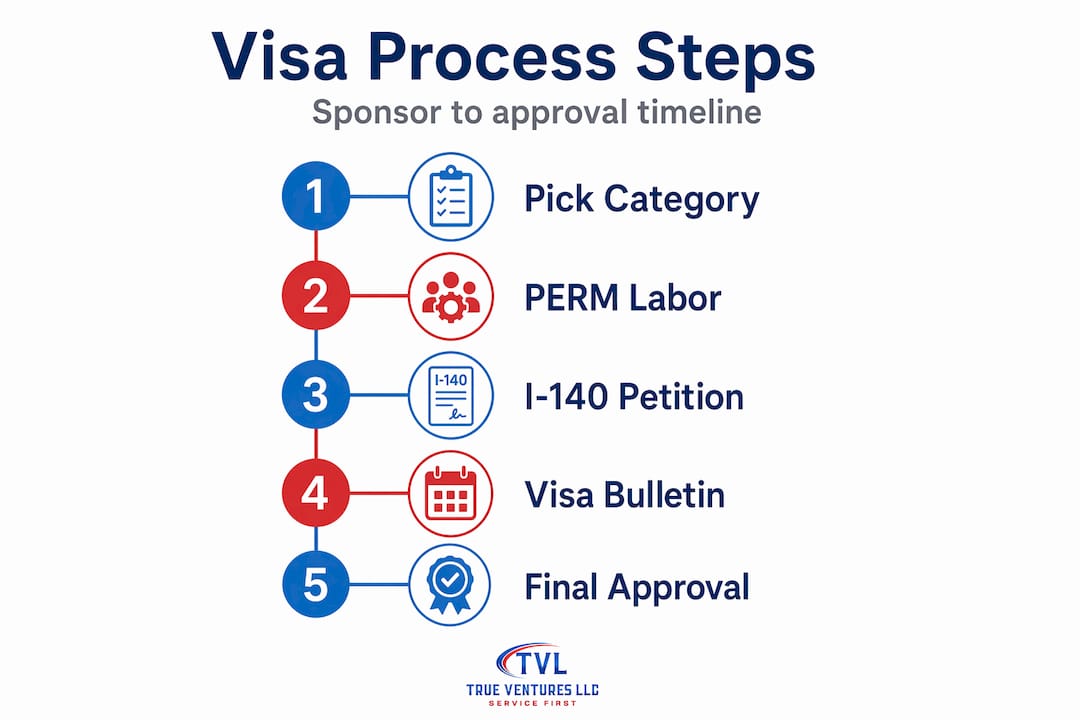
Getting the I-140 approved is a significant milestone, but it does not mean your employee can immediately apply for their green card. USCIS ties adjustment-of-status eligibility directly to immigrant visa availability and to the ongoing validity of the job offer described in the petition. For high-demand countries like India or China in EB-2 and EB-3, visa backlogs can stretch many years.
Here is what you need to monitor and manage after I-140 approval:
- The Visa Bulletin. The Department of State publishes this monthly chart showing which priority dates are currently being processed. Your employee's priority date (usually the date the PERM was filed) must be current before they can file Form I-485, the adjustment of status application.
- Maintaining the job offer. The role must still exist when the employee files for adjustment of status. If the position is eliminated or materially changed, the I-140 may no longer support the green card application.
- Ability to pay. Your obligation to demonstrate ability to pay the certified wage continues through the entire process, not just at I-140 filing.
- Employee's status. If your hire is in the U.S. on a nonimmigrant visa like H-1B, you must track visa validity and extensions to avoid gaps in work authorization.
For employees abroad or those who prefer consular processing, they will go through a U.S. embassy or consulate in their home country rather than filing Form I-485 here. Both routes lead to the same outcome: lawful permanent residence.
| Do | Don't |
|---|---|
| Monitor the Visa Bulletin every month | Assume the job offer stays valid automatically |
| Maintain clean financial records each year | Let your ability-to-pay documentation lapse |
| Notify your employee of any material job changes | Change the job title or duties without evaluating impact |
| Track your employee's nonimmigrant visa expiration | Wait until the last minute to extend H-1B status |
| Work with your consultant on any RFE responses | Ignore requests for evidence from USCIS |
For employers managing EB-3 cases specifically, the EB-3 adjustment process outlines the specific timelines and strategies for navigating backlog periods.
Our perspective: What most visa guides miss about employer sponsorship
Most articles about employment-based immigration focus heavily on the forms. Fill out I-140 correctly, get your PERM certified, file I-485 when the date is current. That is all accurate. But the cases that hit serious trouble almost never fail because of a missing signature or a wrong fee amount. They fail because of inconsistency across a process that can span three to seven years.
Think about what happens over that timeframe. HR staff turns over. Company names change. Job duties evolve as technology changes the role. The salary range on your PERM certification from three years ago may no longer reflect what you are actually paying. These are not dramatic violations. They are the kind of quiet drift that happens at any functioning organization. And USCIS is not forgiving about them.
Our experience working with employers, especially small to medium-sized businesses navigating this for the first time, shows a consistent pattern: the companies that sail through this process treat employment-based sponsorship the way they treat payroll or tax compliance. It lives in a defined system, with an assigned owner, regular review cycles, and documented updates. The companies that struggle treat it as a one-time legal project that gets handed off and forgotten.
The sponsorship roles and rules that govern your obligations do not pause between filings. Your legal duty as a sponsor is continuous, and building internal processes to reflect that is not just good practice. It is what actually protects you when USCIS or DOL comes asking questions.
Get expert help with your employment-based visa case
Employment-based sponsorship is one of the most document-intensive and deadline-driven areas of U.S. immigration. A single inconsistency between forms filed years apart can trigger a request for evidence, an audit, or a denial that costs your business months of delays and the real risk of losing your employee entirely.

At True Ventures, LLC, we work with employers across industries to build sponsorship processes that hold up under scrutiny from start to finish. Whether you are filing your first I-140 or managing a pipeline of international hires, our team brings firsthand immigrant experience and deep procedural knowledge to every case. Explore our immigration consultant services to see how we approach employer-side sponsorship, or get started directly with our filing assistance program for structured support at every stage. We are here to make this process reliable, not just possible.
Frequently asked questions
What is the difference between EB-1, EB-2, and EB-3 visas?
EB-1 covers priority workers such as multinational managers and researchers, EB-2 is for professionals with advanced degrees or exceptional ability, and EB-3 covers skilled, professional, and other workers. All three categories proceed through a Form I-140 petition and a subsequent adjustment or visa step.
Do all employment-based visas require a PERM labor certification?
Most EB-2 and EB-3 cases require PERM, but EB-1 and some special EB-2 scenarios such as National Interest Waivers do not. The USCIS Policy Manual outlines which category paths require a job-offer-based PERM filing versus alternative evidentiary routes.
How long does the employment-based visa process usually take?
Timelines vary widely based on visa category, country of birth, and USCIS processing volumes, ranging from roughly 12 months for uncongested EB-1 cases to many years for high-demand EB-3 categories from countries like India or China.
What is the most common reason Form I-140 petitions are denied?
Most denials result from inconsistencies between the certified PERM position and the job described in the I-140, or from weak evidence of the beneficiary's qualifications. USCIS adjudicators are specifically required to confirm that the offered and certified positions match and that the beneficiary meets stated requirements.
Can an employer file the I-140 online or must it be by mail?
USCIS allows I-140 filing both online through its portal and by mail to the appropriate service center. Online filing is generally preferred because it provides instant receipt confirmation and easier case tracking.