

Immigration paperwork is intimidating even before you read the first question on a form. A single missed signature or wrong filing date can delay your case by months or trigger a denial that feels impossible to recover from. Fortunately, Minneapolis has built one of the strongest immigration support networks in the Midwest, offering both free nonprofit resources for families with limited income and full-service private firms for those navigating complex visa situations. Knowing how to use both wisely, and understanding when a dedicated local firm is worth every penny, can protect your family's future before a costly mistake happens.
Table of Contents
- Understanding the immigration landscape in Minneapolis
- Core benefits of working with a Minneapolis immigration firm
- Comparing nonprofit clinics and full-service immigration firms
- How Minneapolis immigration firms reduce stress and risk
- Our perspective: Why personal experience matters more than credentials
- Connect with Minneapolis immigration experts
- Frequently asked questions
Key Takeaways
| Point | Details |
|---|---|
| Free clinics for basics | Minneapolis offers nonprofit legal hubs that provide free assistance for common immigration needs. |
| Expert local firms | Choosing a Minneapolis firm ensures specialized support for complex cases and appeals. |
| Comprehensive representation | Local firms coordinate your case from paperwork to hearings, reducing stress and risk. |
| Clear comparison tools | Understanding the differences between clinics and firms helps families select the right fit. |
| Personal experience matters | Evaluating a firm's communication and case history increases your chances of a successful outcome. |
Understanding the immigration landscape in Minneapolis
Minneapolis is home to a remarkably coordinated network of immigration legal services. That coordination is not accidental. Minnesota has a long history of welcoming refugee and immigrant communities, and the legal infrastructure has grown to match that commitment. Whether you are brand new to the United States or managing a multi-step petition process, the city offers meaningful options at nearly every budget level.

At the foundation are established nonprofits like the Immigrant Law Center of Minnesota (ILCM) and Advocates for Human Rights. These organizations have served thousands of clients across the state, focusing primarily on families and individuals who cannot afford private representation. As a starting point, Minnesota's Immigration Legal Services Hub offers free clinics and resources through these established nonprofits, connecting low-income clients with attorneys who volunteer their time for document reviews, screening sessions, and general guidance.
Free legal clinics typically cover the basics: checking whether a green card renewal form is correctly completed, explaining what a Notice to Appear (NTA) actually means, or screening someone for possible asylum eligibility. These services are essential and genuinely life-changing for those who qualify. For a deeper look at what these organizations offer, the immigrant law center guide breaks down the types of support available across the Minneapolis metro area.
Private firms, on the other hand, operate differently. They take on paid, full-representation cases where the complexity is higher and the stakes are greater. Think employment-based visa petitions, H-1B sponsorships, I-485 adjustment of status filings, or multi-year appeals against deportation orders. These cases require sustained attention, strategic planning, and a working knowledge of both federal immigration law and local court tendencies.
Here is a quick breakdown of service types available across Minneapolis:
| Service type | Provider | Cost | Best for |
|---|---|---|---|
| Legal clinics | Nonprofits (ILCM, Advocates) | Free or low-cost | Basic questions, document checks |
| Case consultations | Private firms | Varies | Strategy, complex situations |
| Full representation | Private firms | Paid | Appeals, petitions, hearings |
| Document preparation | Accredited reps | Low fee | Forms and straightforward filings |
The most important thing to understand is that these two systems are not competitors. They are designed to complement each other. Nonprofit clinics serve as a first point of contact. Private firms step in when the situation demands more.
"The most dangerous assumption a client can make is thinking their case is simple because the form looks short."
Knowing which resource fits your situation can save you months of delay and thousands of dollars in avoidable errors.
Core benefits of working with a Minneapolis immigration firm
When your situation moves beyond a simple form check, a local immigration firm offers advantages that are genuinely hard to replicate anywhere else. Local expertise is one of the most overlooked factors in immigration outcomes. Attorneys and consultants who work in Minneapolis know which district offices handle certain case types, how local immigration courts tend to interpret procedural rules, and which documentation standards carry the most weight in regional filings.
A major benefit is having a single point of contact throughout your case. Immigration cases frequently involve multiple government agencies: USCIS for petitions, the National Visa Center for consular processing, and sometimes the Department of Labor for employment-based cases. Without a dedicated team managing the timeline, it is surprisingly easy for something to fall through the cracks. A Minneapolis firm coordinates all of this for you, keeping every deadline visible and every response on track.
Here is what strong local representation typically includes:
- Initial case evaluation and strategy review
- Document collection and verification
- Petition drafting and quality review before submission
- Status tracking through USCIS and related agencies
- Response preparation for Requests for Evidence (RFEs)
- Appeals support if a petition is denied
- Ongoing compliance updates as immigration regulations change
According to the Minnesota's Immigration Legal Services Hub Initiative, private firms are best for complex paid cases needing full representation, particularly when the consequences of an error could include deportation, visa denial, or a multi-year ban on reentry.
For employment-based cases, strategic petition support from a Minneapolis firm can significantly reduce the risk of an RFE, which is a formal government request for additional documentation that can delay a case by three to six months. Firms that have handled dozens of similar petitions already know what USCIS is likely to question and address it proactively.
Pro Tip: Ask any firm you consider about their RFE rate on cases similar to yours. A lower rate typically reflects stronger initial filings and better preparation, both of which directly protect your timeline. Reviewing the professional immigration benefits of working with an experienced firm can help you ask the right questions before you commit.
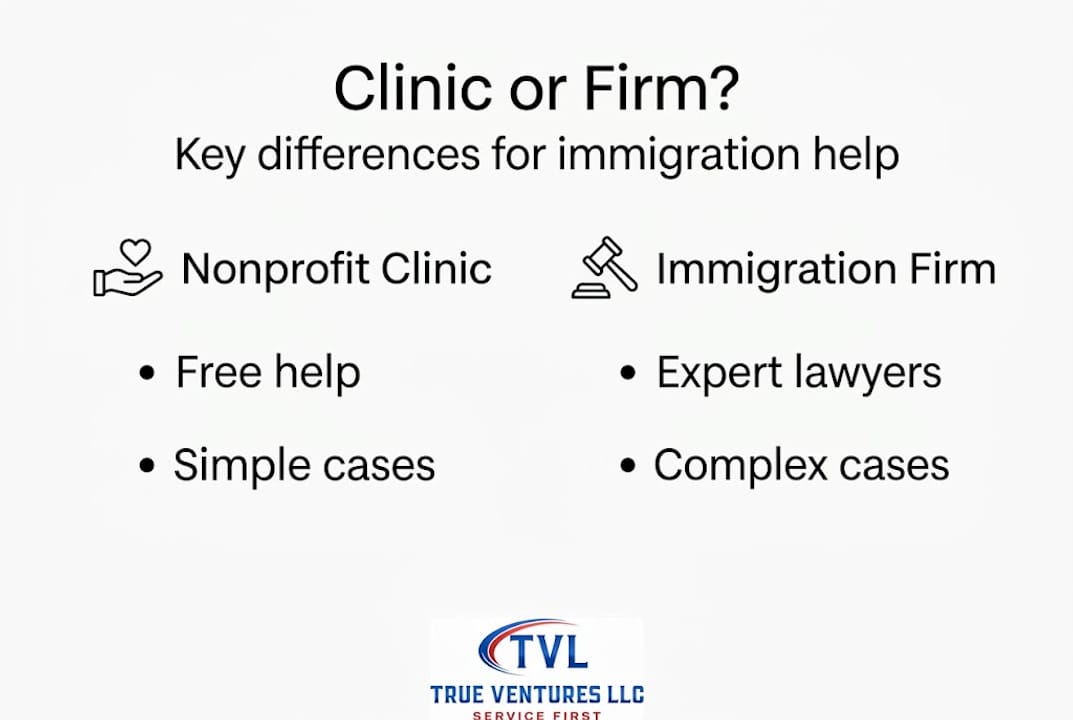
| Factor | Nonprofit clinic | Private immigration firm |
|---|---|---|
| Cost | Free or minimal | Paid, varies by case |
| Scope | Basic guidance | Full representation |
| Case complexity | Low to moderate | Moderate to high |
| Ongoing management | Limited | Comprehensive |
| Appeals support | Rarely | Typically included |
Comparing nonprofit clinics and full-service immigration firms
Choosing between a nonprofit clinic and a private firm is not about which one is better in general. It is about which one fits your specific situation right now. Both serve critical roles in the Minneapolis immigration ecosystem, and understanding the difference helps you use your time and resources wisely.
Nonprofit clinics shine when you need basic answers quickly. If you are unsure whether your current visa status allows you to work legally, a free clinic can give you a fast, reliable answer without requiring a paid retainer. If you need help completing a simple I-90 renewal for a green card or want a professional to review a DACA renewal application, nonprofit services are designed for exactly that purpose.
However, nonprofit clinics typically operate with limited capacity. Volunteer attorney time is a finite resource, and many clinics function on a first-come, first-served basis. This means complex cases involving multiple family members, employment sponsorships, or pending appeals may not get the sustained attention they need. Nonprofits like the ILCM Hub offer affordable and free clinics for basic needs, while private firms are better equipped for complex paid cases requiring full representation across multiple stages.
Full-service firms fill that gap. They are built to manage long-term cases, navigate appeal processes, and respond quickly to government correspondence like RFEs or Notices of Intent to Deny. When the stakes include a family member's legal status or an employer's ability to retain an international worker, that depth of service is not a luxury. It is a necessity.
Here is where each option typically fits best:
- Nonprofit clinic: DACA renewals, basic asylum screening, simple green card renewals, general questions about status
- Private firm: H-1B petitions, I-130/I-140 filings, I-485 adjustment of status, consular processing, deportation defense, complex appeals
For a closer look at how full-service firms approach comprehensive immigration support, the range of case types managed in Minneapolis has grown significantly in recent years, reflecting the increasing complexity of federal immigration regulations.
A useful data point: according to immigration legal services research, more than 60% of clients who engage nonprofit clinics ultimately need additional professional assistance once their case progresses beyond the initial stage. This does not mean nonprofit services failed. It means immigration cases often start simple and get complicated fast.
Understanding your case's trajectory early, not just its current status, helps you choose the right level of support from the start.
How Minneapolis immigration firms reduce stress and risk
The emotional weight of an immigration case is often underestimated by people who have never experienced it. You are not just managing paperwork. You are managing uncertainty about where you or someone you love will be allowed to live, work, and build a life. That pressure is real, and it is one of the strongest reasons to work with a dedicated local firm.
Coordinated legal services hubs in Minnesota reduce stress by helping families access resources and avoid the procedural errors that can derail even well-intentioned applications. Local firms extend that benefit further by providing consistent case management that tracks deadlines, flags potential issues, and communicates proactively rather than reactively.
Missed deadlines are one of the most common and most preventable causes of immigration case failure. USCIS response windows are strict. A missed RFE deadline can result in automatic denial. A missed appeal window can close your options permanently. A professional firm keeps a structured calendar on your behalf, so these deadlines never sneak up on you.
Here is what strong case management looks like in practice:
- Deadline tracking: Every USCIS notice is logged with a response-required date and flagged for attorney review
- Document verification: All submitted documents are checked for completeness, accuracy, and formatting before filing
- Status monitoring: Case status is tracked through USCIS online tools and flagged at every change
- Client updates: Clients receive regular communication about where their case stands, not just when something goes wrong
- Regulatory compliance: As immigration rules shift under new administration priorities, firms update their strategies to keep clients aligned
Legal experts also serve as genuine advocates during hearings and appeals. Immigration court can feel adversarial, and having a professional who knows the process and has appeared in similar proceedings makes a significant difference. Research on how attorneys improve immigration outcomes consistently shows that represented individuals achieve better results across case types compared to those who proceed without help.
Pro Tip: Before hiring any firm, request a timeline estimate and ask how they communicate case updates. Firms that cannot answer both questions clearly may struggle to manage your case consistently.
Our perspective: Why personal experience matters more than credentials
Certifications and credentials matter. We are not going to tell you otherwise. But after working with hundreds of families across complex immigration journeys, we have noticed something consistently: the firms that produce the best outcomes are the ones where the client actually feels heard.
Immigration is deeply personal. It involves your family's safety, your career, your identity, and your sense of belonging. A firm that leads every conversation with jargon and a retainer agreement, but never asks about your specific situation, is not serving you. It is processing you.
What predicts success more accurately than credentials is communication quality. Do they return calls promptly? Do they explain decisions in plain language? Do they ask questions before offering solutions? At True Ventures, we were built by people who navigated immigration personally, and that changes how we listen. For a broader look at how comprehensive support changes outcomes, the key ingredient is always relationship quality.
We encourage every family to interview at least two firms before deciding. During those interviews, listen for clarity, empathy, and honesty about what the process will actually involve. Any firm worth trusting will welcome those questions.
Pro Tip: Ask the firm to walk you through a case similar to yours from start to finish. Their ability to do so, in plain language, tells you more than any credential on the wall.
Connect with Minneapolis immigration experts
You have done the research. You understand the difference between a free clinic and full-service representation, and you know what to look for in a firm. The next step is finding support that fits your case specifically.
At True Ventures, LLC, we specialize in exactly the situations where families need more than a quick answer. Our immigration consulting services are built around your specific case type, whether that is an I-130 family petition, an H-1B employment filing, or an I-485 adjustment of status. We also offer specialized Liberian legal services for clients navigating both U.S. and Liberian documentation requirements. Explore our filing assistance options and connect with a team that understands firsthand what is at stake.
Frequently asked questions
What types of immigration cases do Minneapolis firms handle?
Minneapolis immigration firms handle visas, green cards, asylum claims, appeals, employment-based petitions, and family reunification cases, including I-130, I-140, H-1B, and I-485 filings.
How do I know if a nonprofit clinic is right for me?
Nonprofit clinics are ideal for low-income clients seeking basic assistance like status questions or simple renewals. According to the Minnesota's Immigration Legal Services Hub Initiative, more complex cases with ongoing representation needs are better served by a private firm.
What should I look for when choosing a Minneapolis immigration firm?
Prioritize firms with direct experience handling cases similar to yours, clear communication practices, and a transparent process for tracking deadlines and responding to government requests.
Is legal representation necessary for immigration applications?
It is not legally required, but the Minnesota's Immigration Legal Services Hub Initiative notes that private firms are best for complex cases where errors carry serious consequences, making professional representation a smart investment for most families.
Can I use both a nonprofit clinic and a private firm?
Absolutely. Many families start with a free clinic for early guidance and then transition to a private firm when their case grows more complex. Using both strategically is one of the smartest ways to manage costs without sacrificing quality.